The first Medfield Cares About Prevention (MCAP) newsletter is attached –
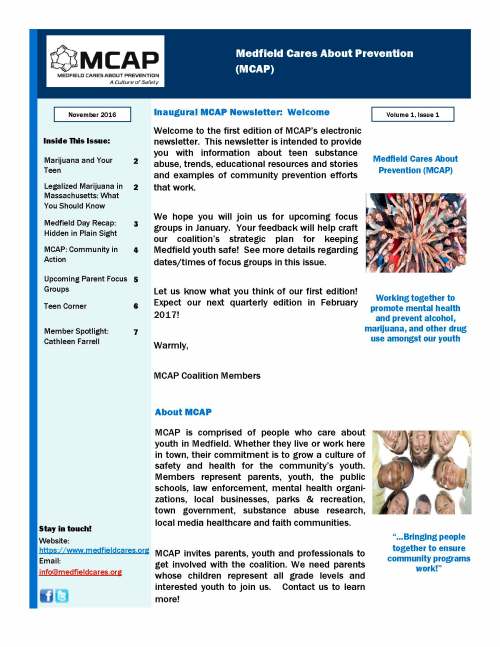
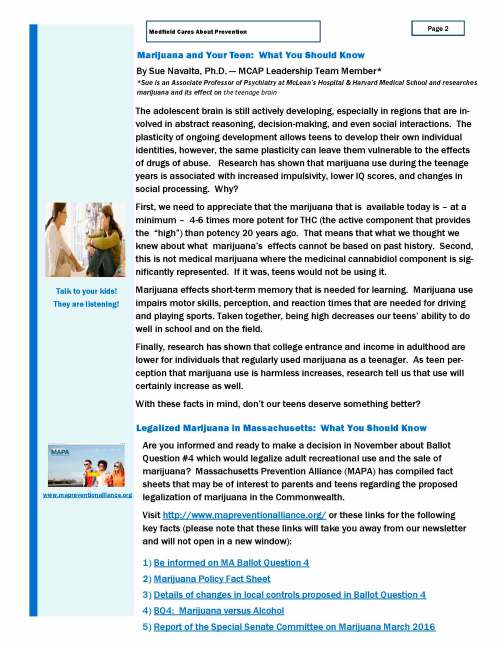
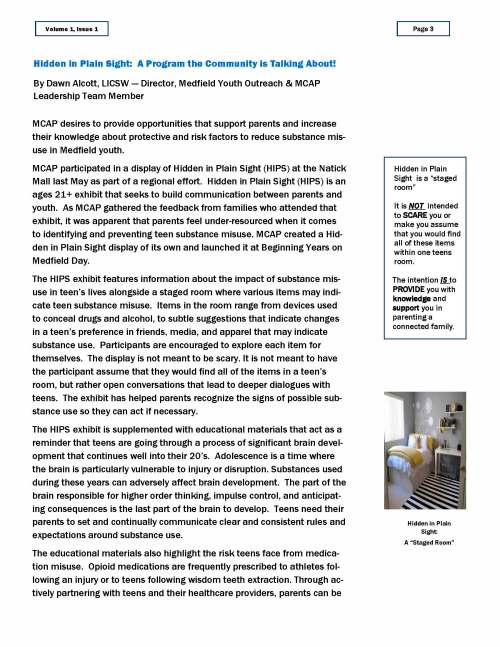
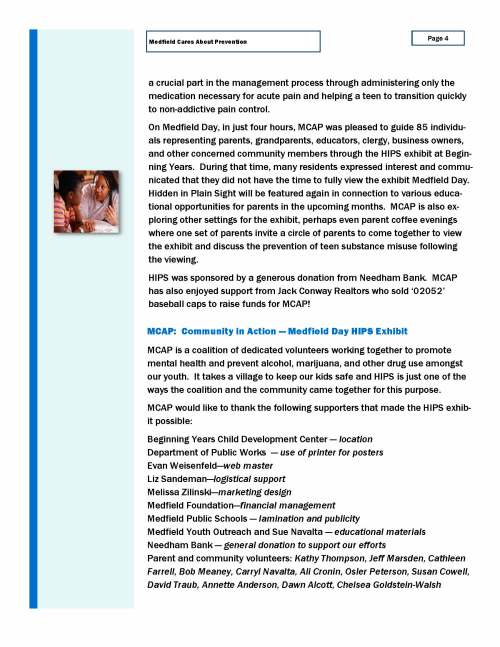
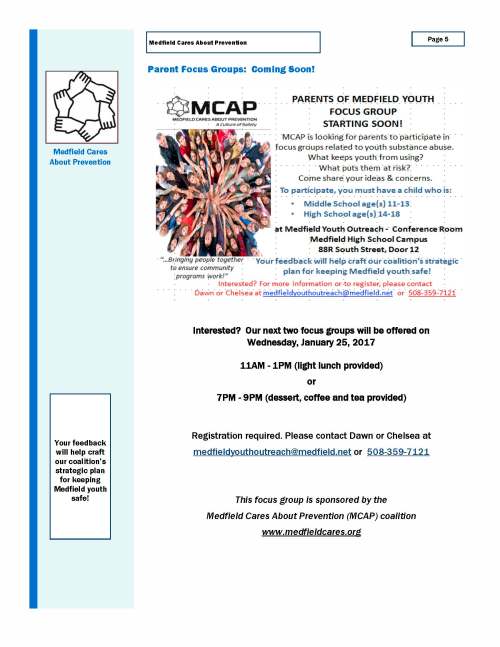
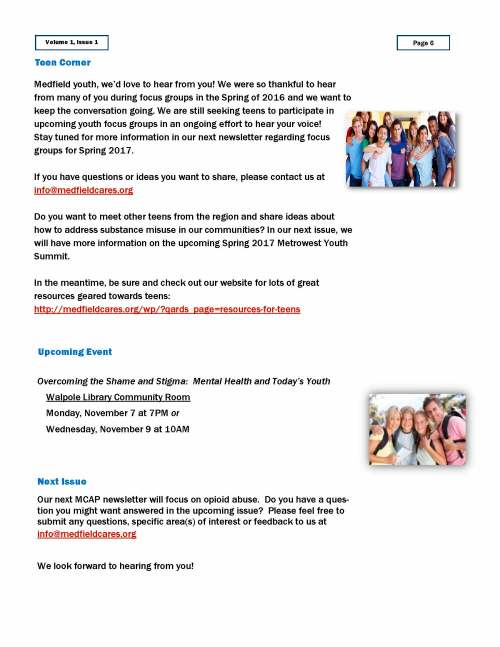
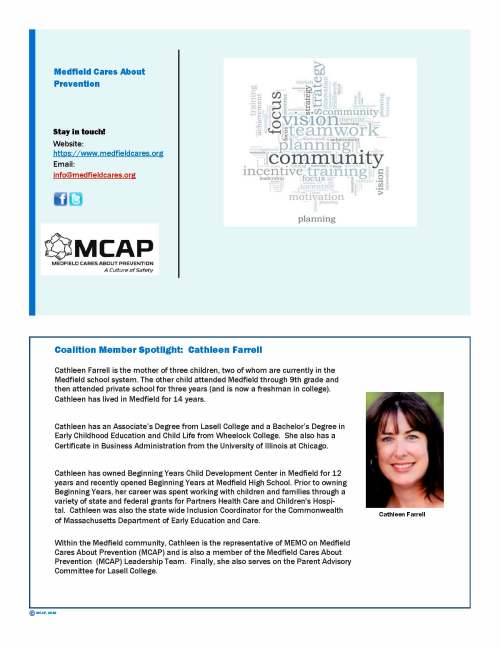

The first Medfield Cares About Prevention (MCAP) newsletter is attached –
Comments Off on MCAP newsletter #1
Posted in MCAP - Medfeild Cares About Prevention, Uncategorized
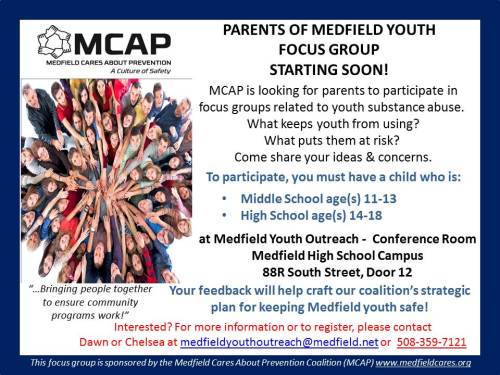
Comments Off on MCAP parent focus groups
June 21, 2016 in MCAP - Medfeild Cares About Prevention, Uncategorized

Come visit the HIPS exhibit at the Natick Mall tonight, and have a Medfield person as your tour guide, until 9 PM. The exhibit allows one to walk around in a teen’s bedroom full of all the things that indicate that substance abuse is happening.
Medfield Cares About Prevention (MCAP) (www.MedfieldCares.org) is staffing the exhibit tonight.
Comments Off on Medfield night at the Natick Mall, unitl 9
Posted in MCAP - Medfeild Cares About Prevention, Teens, Uncategorized

You are invited to a special exhibit! Metro West prevention coalitions unite to bring Hidden in Plain Sight, an initiative to help parents spot signs of teen risky behavior, to Natick Mall. See the above flyer for more details! While anyone age 21 and over may view the exhibit at any time it is open, the grand opening is May 10th from 10am to 12pm and will feature community and state leaders throughout the Metro West area. Medfield’s own coalition, Medfield Cares About Prevention (MCAP) will oversee the exhibit Thursday, May 19th from 10am to 2pm and Friday May 20th from 5pm-9pm. Why not make it a day or evening out to the mall with friends to explore the exhibit and catch up with coalition members from your community! We hope you to see you there!
REQUEST FOR PARENT/COMMUNITY VOLUNTEERS as “Tour Guides”
Hidden in Plain Sight:
Spot At-Risk Behavior at The Natick Mall
Community Initiative to Help Parents Recognize Signs of Youth Substance Use
WHAT: The Hidden in Plain Sight initiative helps parents spot signs of youth at-risk behaviors using an interactive display of a teenager’s bedroom. Specially trained “tour guides” from MetroWest community coalitions will walk participants through the display, providing education about adolescent development and common signs of substance use.
This exhibit encourages parents to communicate with their children about at-risk behavior that could lead to opioid addiction and other substance use disorders because a strong parent-teen relationship is the most effective tool to prevent substance use.
The initiative is sponsored by South Shore Hospital’s Youth Health Connection, BlumShapiro, The Natick -Mall, Natick Together for Youth, the Town of Natick, SOAR (Supporting Our Addicts Recovery) Natick, Ashland’s Decisions at Every Turn Coalition, Framingham Health Department, the Holliston Drug & Alcohol Awareness Coalition, Hopkinton Organizing for Prevention, Medfield Cares About Prevention, SAFE/JAG Coalition, and Wayland Cares.
WHY: The Commonwealth of Massachusetts is in the midst of an opioid epidemic, with an estimated 1,173 opioid related deaths in 2014 and an estimated 1,104 opioid related deaths between January and September 2015.*
Studies have shown that youth use of substances like alcohol, marijuana and prescription pain medication is associated with increased risk of addiction to heroin and other opioids.
WHEN: Hidden in Plain Sight is open to the public May 9th-26th
Mondays, Wednesdays, & Fridays from 5pm-9pm, Tuesdays & Thursdays from 10am-2pm, and Saturdays & Sundays from 12pm-4pm
Each sponsoring community coalition has taken responsibility for set shifts.
Medfield, through Medfield Cares About Prevention has committed to cover Thursday, May 19th from 10am to 2pm and Friday, May 20th from 5pm-9pm with volunteer “tour guides” from Medfield. Volunteers are welcome to sign up for the whole four hour shift or for two hour increments. Medfield Youth Outreach will offer trainings for volunteers on May 10th at 11am and 7pm (or upon request) at their location. “Tour guide” training is approximately 45 minutes long.
WHO: Hidden in Plain Sight is open to all members of the public over the age of 21 and therefore all volunteers must be age 21 or over. Children may not accompany adult volunteers due to the nature of the exhibit.
WHERE: The Hidden in Plain Sight event is at the Natick Mall, 1245 Worcester Street, Natick, MA 01760; located on the first floor of the mall, near Sears (next to GameStop and across from CVS). Volunteer training will be held at Medfield Youth Outreach at 88R South Street, Medfield High School (DOOR 12).
CONTACT: Please contact Dawn Alcott or Chelsea Goldstein-Walsh, medfieldyouthoutreach@medfield.net, (508) 359-7121 if you are interested in volunteering for this event.
*Source: MA Department of Public Health http://www.mass.gov/eohhs/docs/dph/quality/drugcontrol/county-level-pmp/data-brief-overdose-deaths-ma-residents-january-2016.pdf
Comments Off on MCAP presents Hidden in Plain Sight at Natick Mall
Posted in MCAP - Medfeild Cares About Prevention, Uncategorized
Tired this afternoon – home for dinner at 10PM last night, 9:30 PM the night before, and 9:00PM tonight, for meetings respectively of the –
Comments Off on On being a selectman
Posted in Energy Committee, MCAP - Medfeild Cares About Prevention, Medfield State Hospital, Select Board matters, Uncategorized
The Massachusetts Municipal Association recently released a white paper suggesting what towns should be doing about opiates. It has a list of the 10 best practices, several of which we are already doing (e.g. – the drug return turn in box at the MPD, Narcan in cruisers, and MCAP), but we have not yet appointed a point person to lead our effort or dealt with some of the other recommendations.
The report notes that someone has died from opiates in almost 75% of our towns in Massachusetts.
A PDF of the MMA’s white paper can be downloaded here – http://www.mma.org/images/stories/NewsArticlePDFs/municipal_services/mma_opioid_task_force_jan2016.pdf
The MMA’s article (below) can be found here –
MMA releases report with opioid strategies for cities, towns
January 25, 2016
At its Annual Meeting on Jan. 22 and 23, the MMA released a 16-page report intended to help local officials take action on the escalating opioid abuse epidemic that has claimed thousands of lives in recent years and is affecting virtually every community in Massachusetts.
“Local officials have the ability to lead by providing prevention programs, encouraging public awareness, ensuring safe disposal sites for prescription drugs, and serving as a clearinghouse for valuable resources for treatment and support,” said Attleboro Mayor Kevin Dumas, co-chair of the MMA’s Municipal Opioid Addiction and Overdose Prevention Task Force.
Task force co-chair Michael McGlynn, who recently concluded 28 years as the mayor of Medford, said the 16-page report “will offer some direction and information to the public and our colleagues in government.”
“Municipal officials across the Commonwealth have the obligation to lead the fight against the devastating impact of substance use disorders,” McGlynn said.
The report, titled “An Obligation to Lead,” outlines 10 specific opportunities for local officials to lead the fight against the public health epidemic surrounding the abuse of prescription drugs and opioids. Local officials are urged to lead an effort to increase public awareness and to designate a point person in city and town halls focused on the epidemic and available resources.
The report recommends the facilitation of broad-scale collaboration across departments, the development of a one-page resource guide for families and those seeking treatment or assistance, and a partnership with schools to develop a prevention curriculum.
Local officials are urged to provide naloxone (Narcan) to first responders and designate safe prescription drug disposal sites in their communities.
The opioid abuse epidemic claimed an estimated 1,200 lives in 2014 – complete data are not yet available for 2015 – and accounts for more than half of all deaths among 25- to 44-year-olds. In 2014, the epidemic caused more deaths than car accidents and gun violence combined in Massachusetts.
The MMA’s report represents the findings of the MMA’s 11-member task force, which held many meetings over an 18-month period with policy makers, experts, advocacy organizations, and partners.
The task force concluded that local officials are best positioned to manage the opioid crisis, but the group also developed a series of policy recommendations for state leaders in order to assist cities and towns in their efforts to manage this growing epidemic.
The task force called for the state to create a centralized database of all treatment services, to work to make more treatment beds available, to develop and fund a model prevention curriculum, and to better enforce the Prescription Monitoring Program.
• Download “An Obligation to Lead” (365K PDF)
By Katie McCue and John Ouellette
Comments Off on MMA on opiates
Posted in health, MCAP - Medfeild Cares About Prevention, Teens, Uncategorized

Medfield Cares About Prevention (MCAP) has a brand spanking new website. Check it out at www.MedfieldCares.org.
Thanks to Medfield’s own Evan Weisenfeld for the website.
Safe and Substance Free Parent Resource Guide for Keeping Teens Safe for Prom and Graduation.
This resource is available in part from the Norfolk County DA’s office in collaboration with Youth Health Connection and other partners. This information was shared by Medfield Cares About Prevention (MCAP).
Posted in MCAP - Medfeild Cares About Prevention, Teens
The Medfield Cares About Prevention (MCAP) meeting this morning saw three positive results:
Comments Off on MCAP
Posted in MCAP - Medfeild Cares About Prevention, Police Department, Teens
This is a great description, by a primary care physician from Western Massachusetts, of what it is like to treat addicts in this our age of opiates (e.g. – high school sophomores whose first drug use is heroin).
http://www.mcle.org/main/thisWeek?emcampaignID=15086&emuserID=43207
Comments Off on Treating addicts
Posted in MCAP - Medfeild Cares About Prevention
Medfield Select Board member
I started this blog to share the interesting and useful information that I saw while doing my job as a Medfield select board member. I thought that my fellow Medfield residents would also find that information interesting and useful as well. This blog is my effort to assist in creating a system to push the information out from the Town House to residents. Let me know if you have any thoughts on how it can be done better.
For information on my other job as an attorney (personal injury, civil litigation, estate planning and administration, and real estate), please feel free to contact me at 617-969-1500 or Osler.Peterson@OslerPeterson.com.
 | Zach on Warrant Committee’s slid… |
 | Donna Knott on Reading for “Read Across… |
 | Lester Cohen on Town’s Buildings Require… |
 | Select Board member… on Black Out at Budget Works… |
| Lester Cohen on Black Out at Budget Works… |

 Medfield02052's Blog