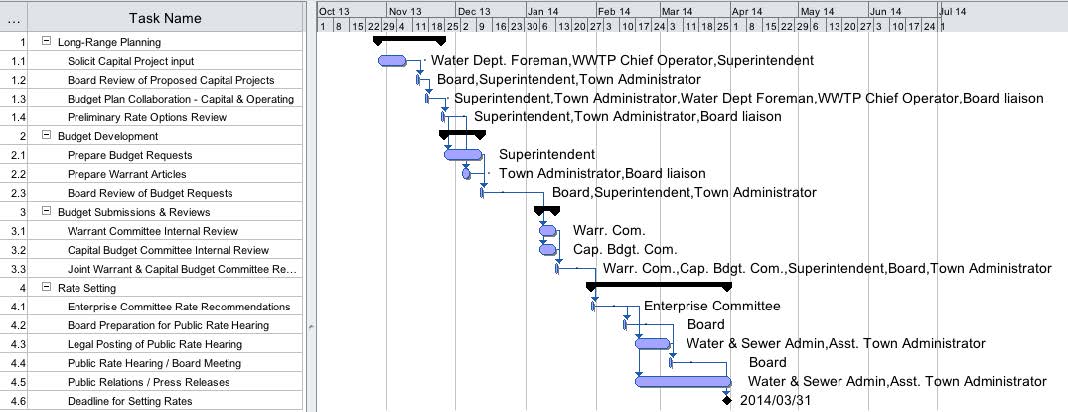
Last post contained the the 2013 budget time line from the W&S Board’s budget planning document created last year. Here is the current year’s version.


Last post contained the the 2013 budget time line from the W&S Board’s budget planning document created last year. Here is the current year’s version.
Comments Off on W&S 2014 Gantt
Posted in Budgets, Water & Sewer
The Water & Sewer Board has crafted an incredibly detailed Budget Planning and Rate Setting Process document (copy attached). The selectmen met with W&S last night to assist them in getting their process back on track. The selectmen also last night charged the W&S Board with both
This is the chart from the Water & Sewer Board’s Budget Planning and Rate Setting Process document that shows the separate steps required to ultimately get to both a budget and rates.
It would be an admirable town goal to have such a well documented and detailed planning process for all town budgets.
The W&S Board also has created an even more sophisticated and incredibly detailed model that they now use for planning purposes, in which all possible W&S variables can be entered and manipulated in order to plan for the future of its budgets and rates, assuming a multitude of various scenarios. They call it the Tool, and it is now in its third year of being used.
It would be an admirable town goal to have such a detailed planning Tool for all town budgets.
Comments Off on W&S budget discipline
Posted in Budgets, Water & Sewer
Tuesday December 2, 2014 @ 7:00 PM
AGENDA {SUBJECT TO CHANGE)
FY2016 Budget reviews:
7:00 PM Town Clerk
7:10 PM Council on Aging
7:20 PM Inspection Department
ACTION
Police Chief to discuss personnel hiring
Other business that may arise
Comments Off on BoS on 12/2/15
Posted in Budgets, Select Board matters
Email from Mike –
The tax rate for fy15 was approved today by the Dept. of Revenue. It is $16.04, which is a decrease of $0.08 from the $16.12 fy 14 rate. However, the property values on average increased by 5%, so the levy increase is about 4% and if you take out new growth about 3%. The Propositions 2 1/2 levy limit looks greater than it is because we included $155,000 in the levy, which is 1/2 of the first annual installment for the hospital purchase. Since it is an override debt exclusion it increases the allowable levy limit, but the funds to cover the %155,000 we raised by increasing the local receipts, so it raises the levy limit by that amount for just fy 15. Confusing ain’t it. Have a good weekend. Mike
From: recapdata@dor.state.ma.us
Sent: Thursday, November 20, 2014 9:01 AM
To:
Subject: Tax Rate Approval Notification
Massachusetts Department of Revenue Division of Local Services
Amy Pitter, Commissioner
Robert G. Nunes, Deputy Commissioner & Director of Municipal Affairs
Medfield Assessors Date: Thursday, November 20, 2014
Dear Assessors:
The Fiscal Year 2015 tax rate has been certified by the Bureau of Accounts for Medfield.
The four pages of the tax rate recapitulation form and the levy limit worksheet (not
applicable to districts) are available on the Division of Local Services website:
Page one of the tax rate recapitulation form includes the Director of Accounts’ electronic
signature and the date of approval. This letter is your notification of approval pursuant to
Massachusetts General Laws Chapter 59, section 23. Please forward copies of this notification
to other officials as you deem appropriate.
We wish to thank you for your cooperation and assistance in the tax rate setting process.
Sincerely,
Gerard D. Perry
Director of Accounts
Comments Off on Tax rate was approved
Posted in Budgets
At the selectmen meeting this week the Assessors reported that they are submitting a tax rate of $16.04 to the Dept. of Revenue, for its required approval as the town’s FY 15 tax rate. Last year the tax rate was $16.12.
Selectmen approved a unitary tax rate, which means the same rate for all property, rather than a higher rate for non-residential properties which results in only modest savings to homeowners but high impact on non-residential property – so great as to discourage such uses. After voting the unitary tax rate the selectmen electronically transmitted the proposed tax rate data to the Dept. of Revenue for its certification.
The selectmen also received the unfortunate news that Medfield Assessor for over 25 years, Stan Bergeron, will be retiring come March. Stan is a major reason why the Assessor’s office functions so well, and will be hard to replace.
This from the DOR DLS e-newsletter today –
By the Numbers
In order to provide an update on the progress of the ongoing tax rate and certification season, below please find an overview of the ongoing process. The following information is accurate as of close of business on Tuesday, November 18th, 2014:
Preliminary Certifications: 82 Communities Approved (97 Submitted)
Final Certification: 48 Communities
La4/ New Growth: 214 Approved (271 Submitted)
Tax Rates: 80 Approved
Balance Sheets: 225 Approved
Aggregate Free Cash Approved Total: $833,725,918
Comments Off on Proposed tax rate = $16.04
Posted in Budgets
This from the Dept. of Revenue Division of Local Services’ e-newsletter –
Local Aid Impacts of 9C Reductions
Using his authority under MGL c. 29, s. 9C, Governor Patrick has reduced various state appropriations to executive department agencies, including some minor reductions to cherry sheet appropriations. The Division of Local Services has reviewed these reductions and concluded that they will not impact previous cherry sheet estimates materially given the magnitude of the reductions and the normal variation in some of these accounts during the course of the year. Therefore, DLS will not be revising cherry sheet estimates as a result and does not anticipate that these reductions will impact the ongoing municipal tax rate setting process.
The Governor has also filed legislation seeking permission to reduce Unrestricted General Government Aid (UGGA) by $25.5 million. This reduction will not take effect until it is approved by the Legislature.
For additional information regarding these reductions and related actions, click here.
Comments Off on DOR on budget cuts
Posted in Budgets
From the Massachusetts Municipal Association –
November 20, 2014
SPEAKER DeLEO REJECTS $25.5 MILLION MUNICIPAL AID CUT
On Thursday morning, less than 24 hours after Governor Deval Patrick filed legislation to impose a $25.5 million mid-year cut in Unrestricted General Government Aid, House Speaker Robert DeLeo issued a strong statement in opposition to the measure.
“Understanding the vital role cities and towns play in providing services and jobs, I will not support a reduction of unrestricted local aid,” said Speaker DeLeo. “Local aid is integral to helping municipalities accurately assess and plan their budgets so they can contribute to the overall growth of the Commonwealth’s economy.”
The Speaker’s opposition to mid-year cuts to local aid will effectively kill the proposal for the remainder of the legislative session. “This is very good news for communities across Massachusetts,” said MMA Executive Director Geoff Beckwith. “We applaud and deeply appreciate the leadership of Speaker DeLeo and his colleagues in the Legislature for rejecting the Administration’s unwise and damaging proposal to slash unrestricted municipal aid.”
On Wednesday, November 19, the Governor announced his desire to close a $329 million state budget deficit by imposing over $65 million in mid-year cuts to cities and towns. He used his statutory budget authority to reduce key municipal and education reimbursements and aid programs by $40.3 million, and filed legislation seeking a $25.5 million reduction in unrestricted local aid. Speaker DeLeo’s opposition to the cut in unrestricted local aid will block that proposal, yet communities will still be hit with the $40.3 million reduction because the Governor Patrick can implement those cuts unilaterally without legislative approval.
The Governor’s $40.3 million in mid-year cuts to key municipal and education programs includes the following:
Every city, town and school district will be hit with one or more of these cuts. In most cases, the cuts will feel deeper because the reductions are being implemented five months into the fiscal year.
Comments Off on House speaker says ‘no” to municipal cuts
Posted in Budgets, Massachusetts Municipal Association
Gov. Patrick has proposed cuts to the current year spending in order to balance the state budget, which include about a 2% reduction in state aid to municipalities. This is the Massachusetts Municipal Association’s response –
Wednesday, November 19, 2014
GOV. PATRICK IMPOSES SWEEPING MID-YEAR BUDGET CUTS, TARGETS LOCAL AID AND SCHOOL ACCOUNTS
Two days after the November 4th state election, in the waning days of his tenure, Governor Patrick disclosed a $329 million deficit in the state’s fiscal 2015 budget, a shortfall caused mostly by state budget administrative and management issues, and not by declining tax revenues. Earlier today, the Governor released his plan to close the budget gap by slashing state and local funding by $65 million mid-year. He announced that he is using his budget powers to implement approximately $200 million in immediate cuts to state-funded programs in executive agencies under his control, including $40.3 million in cuts to important municipal and school reimbursement and grant programs.
In addition to the $40.3 million in immediate cuts, the Governor has proposed legislation to slash $25.5 million from Unrestricted General Government Aid, a measure which must be approved by the Legislature to take effect. This would translate into a 2.7 percent cut in UGGA funding for every city and town. His plan relies exclusively on budget cuts and does not draw on the state’s $1.2 billion rainy day fund.
While the Administration has said they are not proposing any cuts to Chapter 70 school aid, the reality is clear: the unilateral budget cuts will impose serious mid-year reductions in many important K-12 education accounts, and will be harmful to schools. In addition, his proposal to cut Unrestricted General Government Aid (UGGA) would further hit local schools, because cities and towns use their municipal aid to fund local education budgets.
Click here to link to the A&F website that contains the list of emergency budget cuts: http://www.mass.gov/anf/budget-taxes-and-procurement/state-budget/fy15-budget-info/fy15-budget-cut-information/
The MMA has issued a statement opposing the Governor’s cuts to cities, towns and school districts, and is calling on the Legislature to reject his proposal to slash UGGA funding.
A copy of the MMA’s statement can be downloaded by clicking here.
A copy of the MMA’s letter to the Legislature can be downloaded by clicking here.
GOVERNOR IMPLEMENTS $40.3 MILLION IN IMMEDIATE MID-YEAR CUTS TO KEY SCHOOL AND MUNICIPAL PROGRAMS
Using his statutory authority to reduce executive branch spending, the Governor has unilaterally reduced funding for state budget accounts under his control by approximately $200 million, including $40.3 million in painful mid-year cuts to accounts that provide direct funding to cities, towns and school districts. The MMA has identified the local government accounts impacted the most, listed in order of size:
Every city, town and school district will be hit with one or more of these cuts. In most cases, the cuts will feel much deeper because the reductions are being implemented five months into the fiscal year. For example, with only seven months left in fiscal year 2015, a 10% cut in an account will translate into a 17% cut from now to the end of the year, and a 50% cut in a program will translate into an 85% reduction in remaining reimbursements due to cities and towns.
PLEASE ASK YOUR LEGISLATORS TO OPPOSE THE GOVERNOR’S LEGISLATION TO IMPOSE A $25.5 MILLION MID-YEAR CUT TO UNRESTRICTED GENERAL GOVERNMENT AID
In a move that surprised the Legislature and local officials, the Governor has also filed legislation requesting $25.5 million or 2.7% cut in Unrestricted General Government Aid (UGGA) for every city and town. The MMA will strongly oppose any cut to unrestricted municipal aid, because that would destabilize local budgets in the middle of the fiscal year, and force reductions in community services. Unrestricted municipal aid is already $400 million below original fiscal 2009 levels, and any additional cuts will be painful for cities and towns across the state.
Please call your legislators today and explain that cities and towns should not be hit with mid-year cuts, especially since the shortfall is in no way related to local government or the overall performance of the economy, and is primarily due to state spending decisions and the administration of state government. At this point in the year, cuts in municipal or school funding accounts would be extremely painful at the local level.
PLEASE CALL YOUR REPRESENTATIVES AND SENATORS TODAY AND ASK THEM TO OPPOSE THE GOVERNOR’S PROPOSED $25.5 MILLION MID-YEAR CUT TO UNRESTRICTED MUNICIPAL AID
Comments Off on MMA on the proposed budget cuts
Posted in Budgets, Massachusetts Municipal Association
This from the Massachusetts Municipal Association –
Thursday, November 13, 2014
GOVERNOR’S OFFICE REVEALS $325M STATE BUDGET DEFICIT IN FY 2015
• Gov. Patrick Plans to Announce $325M in Budget Cuts Next Week
• Municipal and Education Accounts Could be Targeted for Mid-Year Cuts
$325M State Budget Shortfall Announced – Last week, Gov. Patrick’s Secretary for Administration & Finance announced that the state is facing a $325 million shortfall in its fiscal 2015 budget, and said that the Administration would be unveiling plans to close the budget gap at some point during the week of November 17th. He said that the plan would not draw from the state’s $1.2 billion stabilization fund, but instead would rely exclusively on mid-year spending cuts.
The MMA has Called on the Patrick Administration to Avoid any Mid-Year Cuts Targeted at Cities and Towns – In a face-to-face meeting with A&F Secretary Glen Shor and top Administration officials at the November 12 meeting of the Local Government Advisory Commission meeting, the MMA and local leaders presented a strong case that cities and towns should not be hit with mid-year cuts, especially since the shortfall is in no way related to local government or the overall performance of the economy, and is primarily due to state spending decisions and the administration of state government. At this point in the year, cuts in municipal or school funding accounts would be extremely painful at the local level. However, Administration officials responded that they appreciated the “input,” but did not take local funding off the table.
State Budget Gap Caused by Shortfall in “Non-Tax” Revenues, Spending in the New Economic Development Act, and a Cut in the Income Tax Rate –A&F Secretary Glen Shor stated that the $325 million shortfall is caused by several factors. First, although state tax revenues are still expected to meet expected levels, the state income tax rate will be automatically reduced from 5.2 percent to 5.15 percent, effective on January 1, a cut that will be triggered by existing law. This will reduce the state’s fiscal 2015 tax revenues by $70 million. Second, lawmakers and the Governor approved an $80 million economic development bill late last summer, and state revenues are not growing fast enough to offset the cost. Finally, and most importantly, the Patrick Administration is now reporting a $175 million shortfall in non-tax revenues and agency fees. While the Administration is providing no specific explanation of the non-tax shortfall, independent budget analysts expect that a significant cause is the breakdown in the state’s health insurance exchange website, which forced state officials to enroll thousands of residents in temporary Medicaid plans, for which the state will not receive full federal reimbursement.
Governor Can Impose Mid-Year Cuts on Spending in State Agencies Under His Control, and Ask Legislature for Authority to Cut Local Aid, the Judiciary and Others – Facing a $325 million budget shortfall, the Governor has the authority to unilaterally cut spending in executive branch agencies under his control. In addition, the Governor can ask the Legislature to grant him expanded budget-cutting authority over other accounts outside of the executive branch, such as Unrestricted General Government Aid, Chapter 70 school aid, constitutional officers, the judiciary and independent agencies, a step he has taken in the past. With the Legislature in informal session and only able to pass items with unanimous consent, it is unlikely that legislators would grant Gov. Patrick expanded budget reduction powers targeting local aid, but if that is one of the Governor’s proposals, local officials will need to contact their Representatives and Senators immediately.
Important Municipal and School Aid Accounts May be Targeted for Mid-Year Cuts – The last time Gov. Patrick faced a mid-year budget deficit was in December 2013, when state was projecting a $540 million deficit. The Governor used his budget powers to impose $28.75 million in mid-year cuts to important municipal and school aid accounts, which left cities and towns reeling from unexpected revenue losses. In 2013, the mid-year reductions included a 5% cut to the Special Education Circuit Breaker program, a 47% cut to the McKinney-Vento homeless student transportation account, a 70% cut to the Chapter 70 pothole account, a 3% cut in Veterans’ Benefits reimbursements, a 1% cut in regional school transportation funding, a 1.4% cut to charter school reimbursements, and other important accounts. In addition, the Governor asked the Legislature to cut $9 million from Unrestricted General Government Aid, a request that lawmakers rejected.
PLEASE ASK YOUR LEGISLATORS TO OPPOSE ANY PROPOSAL TO IMPOSE MID-YEAR CUTS TO UNRESTRICTED GENERAL GOVERNMENT AID OR CHAPTER 70 EDUCATION AID – The MMA will strongly oppose any cut to unrestricted municipal aid or Chapter 70, because that would destabilize local budgets in the middle of the fiscal year, and force reductions in community services. Unrestricted municipal aid has already nearly $400 million below original fiscal 2009 levels, and any additional cuts would be painful for cities and towns across the state. In addition, please tell your legislators that you are very worried about potential cuts to important municipal and school accounts in the state budget, including the Special Education Circuit Breaker, McKinney-Vento funding, charter school and regional school transportation accounts, and other programs.
Please Call Your Representatives and Senators Today and Ask Them to Oppose Any Proposals to Cut Municipal or Education Aid, and Share Your Concerns About the Impact of Mid-Year Cuts to Local Programs and Services
|
Comments Off on $325 m. state budget gap per MMA
Posted in Budgets, Massachusetts Municipal Association
The selectmen meeting last night included the annual budget meeting at which all department heads attend, and we all hear from the Chair of the Warrant Committee and the Town Administrator. Mike Marcucci, Chair of the Warrant Committee related –
Mike Sullivan reviewed hi first cut at the FY2016 budget – see copy atached.
Comments Off on Budget meeting
Posted in Budgets, Financial, Select Board matters
Medfield Select Board member
I started this blog to share the interesting and useful information that I saw while doing my job as a Medfield select board member. I thought that my fellow Medfield residents would also find that information interesting and useful as well. This blog is my effort to assist in creating a system to push the information out from the Town House to residents. Let me know if you have any thoughts on how it can be done better.
For information on my other job as an attorney (personal injury, civil litigation, estate planning and administration, and real estate), please feel free to contact me at 617-969-1500 or Osler.Peterson@OslerPeterson.com.
 | Zach on Warrant Committee’s slid… |
 | Donna Knott on Reading for “Read Across… |
 | Lester Cohen on Town’s Buildings Require… |
 | Select Board member… on Black Out at Budget Works… |
| Lester Cohen on Black Out at Budget Works… |

 Medfield02052's Blog