Category Archives: State

Virus follow-up – mayors/managers told Gov. this PM to close all schools,& Gov. did close all schools

From: Weyant, Elizabeth <EWeyant@mapc.org>
Date: Sun, Mar 15, 2020 at 4:58 PM
Subject: Re: Mayors and Managers: Call TODAY, March 15 at 5pm
Good afternoon, Mayors and Managers:
As a reminder, we are talking tonight at 5pm. If you have questions during the call, please email jcurtatone@somervillema.gov
Web log-in:
Audio-only call-in:
Please see below for a second sign on letter that Mayor Curtatone plans to send to Governor Baker, which several members of the Metro Mayors and North Shore Coalitions have already signed. Please take a look and let me know if we can also add your name. Mayor Curtatone plans to raise this on the call tonight as well, so there will be an opportunity to discuss it.
Best,
Lizzi

SECOND LETTER TO GOVERNOR BAKER

Dear Governor Baker:


Thank you for your continued leadership during these uncertain times. We are grateful that you have set up an emergency response center to disseminate information and help, and we are eager to continue working with you to offer guidance and assistance to our cities and towns across the entire Commonwealth.


Over 200 communities have now closed their schools for at least two weeks. We applaud these municipalities for making such difficult decisions, as we know that school closures come with a host of impacts on our communities. But scientists and medical experts continue to warn us that for school closures to be effective at stemming the spread of coronavirus, all of the schools in the Commonwealth must close. We ask you to immediately make these closures mandatory for all schools and early education centers across the Commonwealth.


We also seek your support and guidance on an emerging set of financial and logistical issues that affect our ability to fight the virus and to overcome this crisis, including ways to address child care for essential personnel and health care workers.


Scientists and medical professionals continue to urge that residents remain at home so we give our hospital and health systems the best chance of treating existing patients and reducing the risk to vulnerable individuals. Unfortunately, this means that we must consider additional closures to further limit spread of the virus. Experts have explained that time is running out to prevent an irreversible strain on our healthcare system and significant loss of life. If we cannot make these decisions as a state, individual communities may declare states of emergency and independently take stronger action. This is far from ideal because it could serve to generate panic and confusion among our residents. In order to ensure statewide consistency and follow recommended public health guidelines, you and your Administration may need to require extensive closures, including gyms, parks, health clubs, and places of worship. Restaurants and food establishments should immediately shift to take out and delivery options only.


By way of this communication, we are requesting that you meet virtually with a delegation of mayors and managers at your earliest convenience to discuss these issues. Maximizing the sharing of information and perspectives can only lead to better decision-making.


Please continue to keep us updated and let us know how we can be helpful in addressing this issue together.


Sincerely,


Joe Curtatone

Mayor of Somerville


Adam Chapdelaine

Town Manager of Arlington


Michael P. Cahill

Mayor of Beverly


Louis A. DePasquale

City Manager of Cambridge


Thomas G. Ambrosino

City Manager of Chelsea


Dr. Yvonne Spicer

Mayor of Framingham


Thomas M. McGee

Mayor of Lynn


Gary Christenson

Mayor of Malden


Paul Brodeur

Mayor of Melrose


Ruthanne Fuller

Mayor of Newton

Brian Arrigo

Mayor of Revere


Kimberley Driscoll

Mayor of Salem


Austin Faison

Town Manager of Winthrop


cc:        Lieutenant Governor Karyn Polito

Secretary Marylou Sudders

Virus follow-up – mayors/town managers tell Gov. this PM to close all schools, Gov. hears, & closes all schools

———- Forwarded message ———
From: Weyant, Elizabeth <EWeyant@mapc.org>
Date: Sun, Mar 15, 2020 at 4:58 PM
Subject: Re: Mayors and Managers: Call TODAY, March 15 at 5pm
To:
Good afternoon, Mayors and Managers:
As a reminder, we are talking tonight at 5pm. If you have questions during the call, please email jcurtatone@somervillema.gov
Web log-in:
Audio-only call-in:
Please see below for a second sign on letter that Mayor Curtatone plans to send to Governor Baker, which several members of the Metro Mayors and North Shore Coalitions have already signed. Please take a look and let me know if we can also add your name. Mayor Curtatone plans to raise this on the call tonight as well, so there will be an opportunity to discuss it.
Best,
Lizzi

SECOND LETTER TO GOVERNOR BAKER

Dear Governor Baker:


Thank you for your continued leadership during these uncertain times. We are grateful that you have set up an emergency response center to disseminate information and help, and we are eager to continue working with you to offer guidance and assistance to our cities and towns across the entire Commonwealth.


Over 200 communities have now closed their schools for at least two weeks. We applaud these municipalities for making such difficult decisions, as we know that school closures come with a host of impacts on our communities. But scientists and medical experts continue to warn us that for school closures to be effective at stemming the spread of coronavirus, all of the schools in the Commonwealth must close. We ask you to immediately make these closures mandatory for all schools and early education centers across the Commonwealth.


We also seek your support and guidance on an emerging set of financial and logistical issues that affect our ability to fight the virus and to overcome this crisis, including ways to address child care for essential personnel and health care workers.


Scientists and medical professionals continue to urge that residents remain at home so we give our hospital and health systems the best chance of treating existing patients and reducing the risk to vulnerable individuals. Unfortunately, this means that we must consider additional closures to further limit spread of the virus. Experts have explained that time is running out to prevent an irreversible strain on our healthcare system and significant loss of life. If we cannot make these decisions as a state, individual communities may declare states of emergency and independently take stronger action. This is far from ideal because it could serve to generate panic and confusion among our residents. In order to ensure statewide consistency and follow recommended public health guidelines, you and your Administration may need to require extensive closures, including gyms, parks, health clubs, and places of worship. Restaurants and food establishments should immediately shift to take out and delivery options only.


By way of this communication, we are requesting that you meet virtually with a delegation of mayors and managers at your earliest convenience to discuss these issues. Maximizing the sharing of information and perspectives can only lead to better decision-making.


Please continue to keep us updated and let us know how we can be helpful in addressing this issue together.


Sincerely,


Joe Curtatone

Mayor of Somerville


Adam Chapdelaine

Town Manager of Arlington


Michael P. Cahill

Mayor of Beverly


Louis A. DePasquale

City Manager of Cambridge


Thomas G. Ambrosino

City Manager of Chelsea


Dr. Yvonne Spicer

Mayor of Framingham


Thomas M. McGee

Mayor of Lynn


Gary Christenson

Mayor of Malden


Paul Brodeur

Mayor of Melrose


Ruthanne Fuller

Mayor of Newton

Brian Arrigo

Mayor of Revere


Kimberley Driscoll

Mayor of Salem


Austin Faison

Town Manager of Winthrop


cc:        Lieutenant Governor Karyn Polito

Secretary Marylou Sudders

MEMA – SITUATIONAL AWARENESS STATEMENT #3

Massachusetts Emergency Management Agency


MASSACHUSETTS EMERGENCY MANAGEMENT AGENCY

SITUATIONAL AWARENESS STATEMENT #3

Date:  March 13, 2020

Time: 4:00 PM


Re: Informational Update: Novel Coronavirus (COVID-19)


Situation

In response to the threat that COVID-19 poses to the Commonwealth, the Massachusetts Emergency Management Agency (MEMA) in collaboration with the Massachusetts Department of Public Health (MDPH) has formed an Interagency Planning Working Group comprised of health, human services, public safety and several other government agencies to develop continuity plans for COVID-19. This working group is broken down into three subgroups that include:

·         Support to First Responders Subgroup

·         Logistics Subgroup

·         Mass Care Subgroup


These groups are tasked with developing strategies and coordinating support efforts related to COVID-19.  This follows the Department of Public Health’s infectious disease task force that was stood up in January.


In an effort to support COVID-19 planning activities and coordinate statewide response the State Emergency Operations Center (SEOC) in Framingham has activated to Level 2 (Partial Activation).  In addition, MEMA’s Regional EOCs have also been partially activated to support local communities. The SEOC and REOCs will be operational Monday – Friday, 8AM – 4PM; operational shifts are subject to change as the situation continues to develop.


Representatives from the following agencies are present in the SEOC:

  • MEMA
  • American Red Cross
  • Dept. of Environmental Protection
  • Dept. of Fire Services
  • Dept. of Mental Health
  • Exec. Office of Elder Affairs
  • FEMA
  • InfraGard
  • MA Dept. of Public Health
  • MA National Guard
  • MA Office on Disability
  • MA State Police
  • MassDOT
  • Massport
  • Office of the Chief Medical Examiner
  • Operational Services Division
  • Salvation Army


COVID- 19 Cases in Massachusetts:

COVID-19 cases in Massachusetts as of March 13, 2020 (numbers updated daily by 4:00 PM): 123

  • Total confirmed cases of COVID-19: 6
  • Total presumptive positive cases of COVID-19:  117


Massachusetts residents subject to COVID-19 quarantine as of March 10, 2020 (this information is updated every Wednesday by 12:00 PM): 1,083

  • Total of individuals who have completed monitoring (no longer in quarantine): 638
  • Total of individuals currently undergoing monitoring/ under quarantine: 445


For more information visit https://www.mass.gov/info-details/covid-19-cases-quarantine-and-monitoring


National Emergency Declaration:

This afternoon, the President declared a National Emergency in response to the threat of the novel coronavirus. This is a process under the National Emergencies Act which would open certain authorities for the president to move around federal resources and conduct certain activities such as a nationwide quarantine.


State Actions:


Emergency Order Prohibiting Assemblages of more than 250 People:

Governor Baker has issued an emergency order prohibiting most gatherings of over 250 people in an effort to limit the spread of the coronavirus. The order includes, but is not limited to, the following events: community, civic, public, leisure, faith-based events, sporting events with spectators, concerts, conventions, fundraisers, parades, fairs, festivals, and any similar event or activity that brings together 250 or more persons in a single room or single space at the same time in a venue such as an auditorium, stadium, arena, large conference room, meeting hall, theatre, or any other confined indoor or outdoor space.  The Governor also directed the Department of Public Health (DPH) to issue guidance implementing the terms of the Emergency Order. The full DPH guidance is available at: https://www.mass.gov/doc/guidance-regarding-the-order-by-the-governor-prohibiting-assemblages-of-more-than-250-people/download.


Modifications to the Open Meeting Law:

The Baker-Polito Administration has issued an emergency order temporarily modifying the state’s Open Meeting Law in order to allow state, quasi and local governments to continue to carry out essential functions and operations during the ongoing COVID-19 outbreak. This emergency order suspends the requirement for public access to the physical location where a public meeting is taking place, provided there are other means of access available, such as a phone conference line, social media or other internet streaming services, or on-line meeting services. Additionally, the order relieves the requirement that a quorum of members be physically present at a public meeting. During this period, members may all participate by remote or virtual means. This order is applicable to meetings of public bodies including commissions, boards, and committees that engage in policy making at the state, quasi and local level, and it does not apply to Town Meetings or judicial and quasi-judicial hearings. The full text of the order is available at https://www.mass.gov/doc/open-meeting-law-order-march-12-2020/download


Updated Guidance for Community-Based and Congregate Care Settings:

The Baker-Polito Administration has released new policies for Assisted Living Residences, Congregate Care Settings, In-Home Caregivers and Workers (Agency Based and Non-Agency Based), and Community Day Program Settings to further protect individuals served in community-based and congregate care settings from respiratory illnesses, including Coronavirus (COVID-19). This guidance is available through the following links:


Updated Guidance to Elementary and Secondary Schools:

The Department of Elementary and Secondary Education (DESE), in conjunction with MDPH, has released updated guidance for school superintendents regarding COVID-19. The full guidance may be found here.


EOLWD Update:

The Executive Office of Labor and Workforce Development (EOLWD) recently received federal guidance allowing for flexibilities regarding unemployment compensation for individuals affected by COVID-19. EOLWD is analyzing that guidance and pursuing potential emergency regulations which further enable them to assist individuals whose employment has been affected by the virus.


Additionally, in order to reduce in-person traffic at career centers and UI walk-in centers, EOLWD has suspended requirements related to the Reemployment Services and Eligibility Assessment for the time being. Staff are in the process of contacting customers scheduled to appear at the centers to let them know that their benefits will not be impacted as a result of this change and that they will be back in touch with them when these services are re-scheduled.


Interagency Planning Subgroup Updates:


Support to First Responders Subgroup:

  • The subgroup met on 3/13 and facilitated a discussion of the needs of first responder agencies. The list of questions was forwarded to DPH for guidance and answers. The list of the questions focused on PPE and guidance on the quarantining and well-being of responder personnel.
  • OCME asked for the process to procure a secure space for a temporary mortuary should a community’s capabilities be exceeded. This request is being worked through the logistics section.
  • Fielded one call from a local fire department on planning for EMS/AMB resources should their system be impacted. Informational only at this time.
  • Will disseminate DPH guidance information to response agencies statewide.    


Logistics Subgroup:

  • Resources
    • Identifying vendors for:
      • Hand Sanitizer in multiple sizes
      • Disinfectant wipes
      • Disinfectant spray
      • Germicidal spray
      • Germicidal wipes
    • Prepared to receive shelf stable meals for distribution, if that requirement is posed
  • Process will be developed and socialized, to ensure a consistent ordering process utilizing existing CONOPS, which will then follow with a standard assignment, transportation, tracking, and delivery model to towns who request supplies from a disaster site (either SSA and/or Warehouse)
  • State Staging Areas (SSA)
    • Made outreach to all assessed SSAs in the Commonwealth
      • 19 SSAs called, 2 responded so far with availability.  Waiting for call back from others. 
    • Confirmed vendor availability for tents to support SSA operations
    • Primary use would be for staging of mass feeding capabilities if needed or cleaning supplies
  • Warehouses
    • Made outreach to numerous state agency and private sector warehouse providers (on state contract)
    • Multiple available spaces, ranging in size from 7,500 up to 80,000 sq. feet, and several have variable spaces
    • Some vendors have full wrap-around services, other require additional support.
    • Primary use would be for food storage (shelf stable meals) or bulk cleaning supplies
  • Agency reports
    • MANG: Has identified ~50 tents in their force inventory, working in fine-tuning numbers.  Also identifying available trucks and soldiers to support potential missions (general infantry, transportation, logisticians)
    • OSD: Pulling all applicable state contracts to determine inventory, timelines, etc., for sanitizers, cleaners, vendors to provide cleaning, etc.  Ready to conduct a bulk order for MEMA operations, and also a bulk order for other state agencies to pull from
    • DEP: Investigating guidance for water, waste water, and solid waste workers, in addition to vendors they use for sanitizing and fit testing
    • MassDOT: Inventorying available equipment and facilities to support commodity storage and distribution
  • Consistent and wide spread messaging about the resource request process is key, so that cities and towns know and understand the protocol for requesting PPE, sanitizers, and other services.


Mass Care Subgroup:

  • Discussed populations identified that will need mass care services and potential needs for sheltering. There are multiple, complex issues for mass care in this event and the group has begun to identify, prioritize, and problem solve.
  • The group is currently fleshing out a multilevel quarantine and isolation strategy that takes into considerations the needs of all populations to include the most vulnerable (i.e. homeless and the elderly).

o   Identifying facility options for quarantine.

o   Identifying isolation surge space and other isolation options.

o   Identifying the wrap-around services required to support populations in quarantine and isolation (i.e. feeding).

o   Identifying the resources required to support these operations to include medical staffing, equipment and supplies.

o   Coordinating with MEMA Logistics and Finance to identify possible vendor/ contractors needed to support these operations.


Statewide Conference Calls:

The SEOC coordinated the following conference calls today to share information and coordinate actions with key stakeholders:

  • 8:30 AM: Conference Call with DESE and K-12 School Districts
  • 10:00 AM: Interagency Conference Call
  • 11:00 AM Conference Call with Federal Congressional Delegation
  • 12:30 PM: Conference Call with MDPH and Courts
  • 1:30 PM: Conference Call with Chambers of Commerce
  • 2:00 PM: Conference Call with MDPH and Institutions of Higher Education
  • 2:00 PM: Conference Call with State Congressional Delegation
  • 4:00 PM: Conference Call with MA Municipal Association


Disaster/Emergency Recovery Actions:

  • MEMA and the Baker-Polito Administration are working closely with the U.S. Small Business Administration (SBA) to activate the Economic Injury Disaster Loan (EIDL) program which would provide assistance to eligible businesses and non-profits impacted by COVID-19.
  • The MEMA Small Business website and SBA survey form are live as of yesterday. As of this afternoon, MEMA Recovery has received 27 completed forms.
  • Guidance on cost tracking requirements under the Stafford Act has been sent to local officials.


Local Actions:

MEMA Regional offices have been in regular contact throughout the day with local officials. They report that numerous cities and towns across the Commonwealth are taking steps to limit potential exposure of residents to coronavirus, including postponing/cancelling public events and closing schools, town/city offices, and other public buildings. Local officials also report experiencing ongoing difficulties procuring supplies of PPE, hand sanitizer, and other cleaning supplies due to supply chain issues.


Local EOC Activations / States of Emergency:


EOC Activations:

  • Arlington
  • Belmont
  • Eastham
  • Gloucester
  • Longmeadow
  • Lynn
  • North Attleboro
  • Norwell
  • Sandwich
  • UMASS Lowell
  • Waltham
  • Worcester


States of Emergency:

  • Billerica
  • Deerfield
  • Groton
  • Holyoke
  • New Bedford
  • Norwood
  • Pittsfield
  • Westford
  • Weymouth


School Closings:


K-12 Schools:

The SEOC is aware, via reports from local officials and the media, of approximately 110 school districts with at least one school closure as of today (3/13). Note that school closures are constantly subject to change and residents should check local media or reach out to schools directly for the most up-to-date information.


Institutions of Higher Education:

The following colleges and universities have announced or implemented schedule changes and/or plans to move classes to online formats. Additional information about these changes is available on their respective websites.


  • Anna Maria College
  • American International College
  • Amherst College
  • Babson College
  • Bay Path University
  • Becker College
  • Berkley College
  • Boston College
  • Boston University
  • Brandeis University
  • Bridgewater State University
  • Clark University
  • Curry College
  • Elms College
  • Emerson College
  • Framingham State University
  • Fitchburg State University
  • Gordon College
  • Greenfield Community College
  • Hampshire College
  • Harvard University
  • Holy Cross College
  • Holyoke Community College
  • Lesley University
  • Massachusetts College of Art and Design
  • Massachusetts College of Liberal Arts
  • Massachusetts College of Pharmacy and Health Sciences
  • Massachusetts Institute of Technology
  • Mount Holyoke College
  • Northeastern University
  • Olin College of Engineering
  • Regis College
  • Springfield College
  • Springfield Technical Community College
  • Smith College
  • Stonehill College
  • Suffolk University
  • Tufts University
  • UMASS Amherst
  • UMASS Boston
  • UMASS Dartmouth
  • UMASS Lowell
  • UMASS Medical
  • Wentworth Institute of Technology
  • Western New England University
  • Westfield State University
  • Wheaton College
  • Williams College
  • Worcester Polytechnic Institute
  • Worcester State University

Stay Informed

In an effort to ensure you have good situational awareness and early guidance from DPH, all stakeholders and the general public are encouraged to visit the DPH website as updates and guidance changes frequently.  The link for DPH website can be found here: www.mass.gov/2019coronavirus


Planning Guidance

Below are hyperlinks from DPH’s website that provide specific guidance and recommendations for: (1) emergency responders and law enforcement, (2) businesses and employers, (3) elementary and secondary schools, and (4) colleges and universities. To access the hyperlinks hold “Ctrl” and click the link.

·         Guidance for emergency responders and law enforcement click here.

·         Guidance for businesses and employers click here.

·         Guidance for elementary and secondary schools click here.

·         Guidance for colleges and universities click here


Regarding continuity planning, employers should consider how best to decrease the spread of acute respiratory illnesses and lower the potential impact of COVID-19 in workplaces in the event of an outbreak by taking steps to:

·         Reduce transmission among staff

·         Protect people who are at higher risk for adverse health complications

·         Maintain business operations

·         Minimize adverse effects on other entities in their supply chains


All private and public sector agencies are encouraged to develop or update contingency plans to ensure they can continue to carry out essential functions regardless of the threat or impact. For guidance and more information on continuity planning visit https://www.mass.gov/info-details/continuity-and-safety-planning-guidance



MMA on Gov’s Exec. Order

MMA-3

GOV. BAKER ISSUES EXECUTIVE ORDER SUSPENDING PARTS OF OPEN MEETING LAW


Temporary relief is intended to enable local decision-making during COVID-19 emergency


March 13, 2020


Dear Osler Peterson,


Last night, Gov. Baker issued an Executive Order suspending certain provisions of the Open Meeting Law (OML). The Order is responsive to many of the concerns that municipal officials have raised over the past several days as communities respond to the COVID-19 emergency. Following the advice of public health professionals to reduce the spread of the virus, cities and towns are considering restricting access to many public buildings, seeking to hold meetings and hearings remotely, placing caps on the size of public meetings and events, and taking other actions to protect the public and those most vulnerable to the novel coronavirus. However, the current OML statutes and regulations make it virtually impossible to take all of these steps and conduct necessary governmental business at the same time. The Governor’s Executive Order provides municipalities and state agencies with an important measure of relief from the OML during the public health emergency.


You may wish to consult with your legal counsel to see how this action could provide you with relief or flexibility as you move forward with local actions under state law and local charter provisions to protect the public and your workforce during this unprecedented emergency. The MMA has been in close contact with the Governor’s office regarding Open Meeting Law issues (and many others), and we appreciate that the Administration is moving forward


If you have comments or opinions regarding the efficacy/helpfulness of the executive order, please share this with our legislative team – Legislative Director John Robertson at jrobertson@mma.org and Senior Legislative Analyst Brittney Franklin at bfranklin@mma.org.


Click Here for the Executive Order


Click Here for the “Coronavirus News and Resources for Local Government Leaders” page on MMA’s website

MMA on Gov’s budget

MMA-3

GOV. BAKER FILES $44.6 BILLION FY 2021 BUDGET PROPOSAL

• $31.6M INCREASE IN UNRESTRICTED MUNICIPAL AID (2.8%)

• GOV’S CH. 70 PLAN WOULD INCREASE FY 2021 SCHOOL AID BY $303.5M (5.9%)

• YET MANY DISTRICTS REMAIN MINIMUM AID AT $30-PER-STUDENT

• CHARTER SCHOOL & SPECIAL ED REIMBURSEMENTS INCREASE

• MOST OTHER MUNICIPAL AND SCHOOL ACCOUNTS LEVEL FUNDED

January 22, 2020


Dear Osler Peterson,


Earlier this afternoon, Gov. Charlie Baker submitted a $44.6 billion fiscal 2021 state budget plan with the Legislature, proposing a spending blueprint that would increase overall state expenditures by 2.3 percent, as the Administration deals with slow revenue growth by restraining most spending across the board and placing an estimated $310 million into the state’s rainy day fund. The budget relies on significant one-time revenues of at least $200 million from a sales tax “modernization” proposal, and an increase in the tax on transportation network companies.


UNRESTRICTED MUNICIPAL AID INCREASED BY $31.6 MILLION

As Gov. Baker pledged to local officials at the beginning of his administration, his budget includes a $31.6 million increase in Unrestricted General Government Aid, tracking the expected 2.8% increase in state tax revenues. Implementing this state-local revenue sharing framework continues to be a significant victory for cities and towns, and is good news in a budget where overall state spending is held to a 2.3% increase.


Click here to see the Division of Local Services preliminary fiscal 2021 Cherry Sheet aid amounts for your community


OVERALL CHAPTER 70 SCHOOL AID WOULD GO UP BY $303.5 MILLION, A 5.9% INCREASE – ALTHOUGH A LARGE NUMBER OF DISTRICTS ARE EXPECTED TO REMAIN AT MINIMUM AID ONLY

Fulfilling the commitments in the new Student Opportunity Act, the Governor’s fiscal 2021 budget submission would bring Chapter 70 school aid up to $5.48 billion, a $303.5 million increase in school aid. This would fund the first year of the 7-year plan to add $1.5 billion in new state funding for K-12 education. The majority of the funds would implement the improvements to the foundation budget, adding weight for low-income students, English Language Learners, special education costs, and school employee health benefits. While this is important progress for some communities, an initial look at the budget indicates that a large percentage of cities, towns and school districts would remain minimum-aid-only, and receive the minimum $30 per-student increase in the Act. MMA members from across Massachusetts have unanimously adopted resolutions calling for at least $100-per-student in minimum aid for the past several years, and the MMA will continue to strongly advocate for significantly higher minimum aid throughout the budget process.


Click here to see DESE’s calculation of fiscal 2021 Chapter 70 aid and Net School Spending requirements for your city, town, or regional school district, based on the Governor’s proposed budget and legislation. This landing page will also include the preliminary fiscal 2021 charter school assessments and reimbursements


CHARTER SCHOOL REIMBURSEMENTS WOULD INCREASE TO $138.2M – CHARTER FUNDING REMAINS A SERIOUS PROBLEM TO BE SOLVED

The Governor’s budget would increase the charter school reimbursement account up to $138.2 million, intended to meet the commitment in the Student Opportunity Act to fund 75% of the state’s 100-60-40 statutory obligation to mitigate Chapter 70 losses to charter schools. However, this appropriation does not include $15 million in special charter school reimbursement payments included in the fiscal 2020 budget to address significant hardships, such as excess losses to charter schools that result in a net cut in Chapter 70 aid for the public school system (non-charters).


The Student Opportunity Act pledges to phase in full funding of the statutory reimbursement formula over three years, and while this plan may meet that requirement, it would not fix the serious flaws in the charter school finance system. Charter schools will continue to divert a high percentage of Chapter 70 funds away from many municipally operated school districts, and place greater strain on the districts that serve 96% of public school children. Major problems will continue unless a true resolution of the charter school funding problem is achieved, a top MMA priority.


SPECIAL EDUCATION CIRCUIT BREAKER INCREASED TO $362.5M

The Governor’s budget would add $17.4 million to fund the Special Education Circuit Breaker program at $362.5 million, an increase of 5%. The Student Opportunity Act expanded the SPED circuit breaker by including out-of-district transportation, a good win for cities and towns. This new transportation component is being implemented over four years, and the Governor’s budget proposal includes the 25% phase-in amount for the coming fiscal year.


However, the $362.5 million appropriation amount does not include $18 million that has traditionally been provided to support administration and state agency transportation costs for special education students, and these funds will need to be added in order to ensure full funding.


REGIONAL SCHOOL TRANSPORTATION REIMBURSEMENTS LEVEL FUNDED

Gov. Baker’s budget submission would level-fund regional transportation reimbursements at the $75.8 million. This will be a hardship for virtually all communities in regional districts. Reimbursements for transportation of out-of-district vocational students remains significantly underfunded at $250K. Increasing these accounts is a priority for cities and towns and the MMA.


McKINNEY-VENTO REIMBURSEMENTS LEVEL FUNDED

The Governor’s budget would level-fund reimbursements for the transportation of homeless students at $11.1 million. The impact of this funding level will vary from community-to-community depending on the number of homeless families that remain sheltered in local hotels and motels. The Administration has been successful in reducing the number of homeless students who are dislocated from their original district, but those communities that continue to provide transportation to many students may continue to see shortfalls.


PAYMENTS-IN-LIEU-OF-TAXES (PILOT) LEVEL FUNDED

The Governor’s budget would level fund PILOT payments at $30 million, which would be a significant hardship for many smaller, rural communities with large amounts of state-owned land. This is a key account due to the major impact that PILOT payments have on budgets in very small communities.


Please contact your legislators today and ask them to support the $31.6M increase in municipal aid and the $303.5M increase in Chapter 70 aid.


Please ask your legislators to address the serious flaws in charter school funding, increase minimum Ch. 70 aid to $100 per student, and increase funding for school transportation, PILOT payments, and ensure full funding for the SPED Circuit Breaker


THANK YOU!

$117K more for Medfield is Gov’s budget

Per Governor’s proposed budget, the Town of Medfield gets about an additional $117,000 –

https://dlsgateway.dor.state.ma.us/reports/rdPage.aspx?rdReport=CherrySheets.CSbyProgMunis.MuniBudgEst

FY2021 Preliminary Cherry Sheet Estimates
Medfield
PROGRAM FY2020 Cherry Sheet Estimate FY2021 Governor’s Budget Proposal FY2021 House Budget Proposal FY2021 Senate Budget Proposal FY2021 Conference Committee
Education Receipts:
Chapter 70 6,288,744 6,364,134
School Transportation 0 0
Charter Tuition Reimbursement 0 0
Smart Growth School Reimbursement 0 0
Offset Receipts:
School Choice Receiving Tuition 0 0
Sub-Total, All Education Items: 6,288,744 6,364,134
General Government:
Unrestricted Gen Gov’t Aid 1,539,280 1,582,380
Local Share of Racing Taxes 0 0
Regional Public Libraries 0 0
Veterans Benefits 17,234 15,769
Exemp: VBS and Elderly 42,087 42,628
State Owned Land 47,799 47,544
Offset Receipts:
Public Libraries 17,504 17,373
Sub-Total, All General Government: 1,663,904 1,705,694
Total Estimated Reciepts: 7,952,648 8,069,828

Rep. Garlick’s Report to the Community is 1/30

Email today from Representative Denise C. Garlick –

Representative Denise C. Garlick announces her annual report to the Town of Medfield:


Dear Friends-


I hope that you and all you love are having a wonderful start to 2020. As the State Representative for the 13th Norfolk District, it is an honor to represent the people of Needham, Dover and Medfield and I am proud of our Towns and our Commonwealth.


I am writing to invite you to an annual Report to the Community

which I will present at the


Medfield Public Safety Building


on Thursday, January 30, 2020 from 7:15 – 8:30 PM.


The main topics will be a review of the work and events of 2019, and a preview of 2020.


The evening’s schedule will include a Reception (7:15-7:30), Report (7:30-8:00), and Questions and Discussion (8:00-8:30).


I hope you will be able join us. Please do not hesitate to contact me with any question or concern. With your support, I look forward to continuing this work.


Sincerely,

Denise

Denise C. Garlick

State Representative

DOR approves town’s “free cash”

Dept. of Revenue Email to Town Officials Last Week Appears Below-


Massachusetts Department of Revenue Division of Local Services
Christopher C. Harding, Commissioner
Sean R. Cronin, Senior Deputy Commissioner of Local Services

11/19/2019
NOTIFICATION OF FREE CASH APPROVAL – Town of Medfield

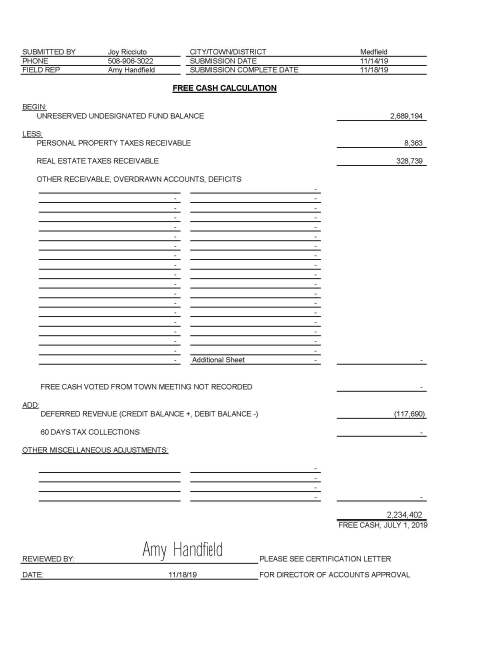
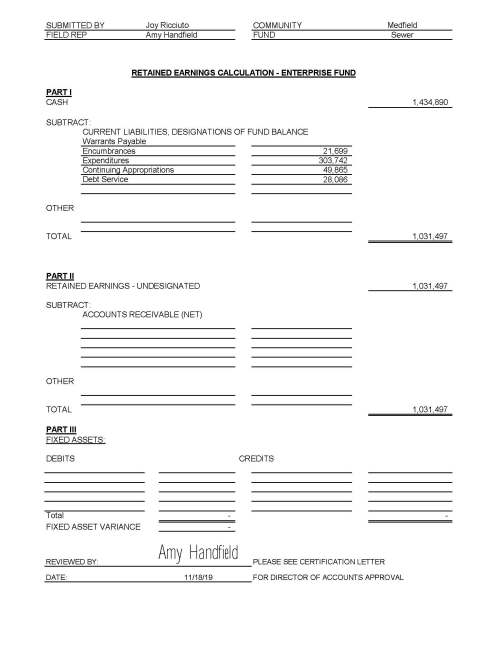
Based upon the un-audited balance sheet submitted, I hereby certify that the amount of available funds or “free cash” as of July 1, 2019 for the Town of Medfield is:

General Fund     $2,234,402.00
Enterprise Fund   Water Enterprise Funds Ch 44 S 53F 1/2   $635,298.00
Enterprise Fund   Sewer Enterprise Funds Ch 44 S 53 F 1/2   $1,031,497.00

This certification is in accordance with the provisions of G. L. Chapter 59, §23, as amended.

Certification letters will be emailed to the mayor/manager, board of selectmen, prudential committee, finance director and treasurer immediately upon approval, provided an email address is reported in DLS’ Local Officials Directory. Please forward to other officials as you deem appropriate.

Sincerely,

Mary Jane Handy
Director of Accounts
Massachusetts Department of Revenue


SUBMITTED BY PHONE FIELD REP FREE CASH CALCULATION BEGIN: UNRESERVED UNDESIGNATED FUND BALANCE 2,689,194 LESS: PERSONAL PROPERTY TAXES RECEIVABLE 8,363 REAL ESTATE TAXES RECEIVABLE 328,739 OTHER RECEIVABLE, OVERDRAWN ACCOUNTS, DEFICITS - - - - - - - - - - - - - - - - - - - - - - - - - - - - - - - - - - - - Additional Sheet - - FREE CASH VOTED FROM TOWN MEETING NOT RECORDED - ADD: DEFERRED REVENUE (CREDIT BALANCE +, DEBIT BALANCE -) (117,690) 60 DAYS TAX COLLECTIONS - OTHER MISCELLANEOUS ADJUSTMENTS: - 2,234,402 FREE CASH, JULY 1, 2019 REVIEWED BY: DATE: Medfield Amy Handfield 11/18/19 Amy Handfield 11/14/19 11/18/19 - - - - PLEASE SEE CERTIFICATION LETTER FOR DIRECTOR OF ACCOUNTS APPROVAL CITY/TOWN/DISTRICT SUBMISSION DATE SUBMISSION COMPLETE DATE Joy Ricciuto 508-906-3022 SUBMITTED BY COMMUNITY FIELD REP FUND RETAINED EARNINGS CALCULATION - ENTERPRISE FUND PART I CASH 2,136,939 SUBTRACT: CURRENT LIABILITIES, DESIGNATIONS OF FUND BALANCE Warrants Payable Encumbrances 56,912 Expenditures 566,050 800,160 78,519 OTHER TOTAL 635,298 PART II RETAINED EARNINGS - UNDESIGNATED 635,298 SUBTRACT: ACCOUNTS RECEIVABLE (NET) OTHER TOTAL 635,298 PART III FIXED ASSETS: DEBITS CREDITS Total - - FIXED ASSET VARIANCE - REVIEWED BY: DATE: 11/18/19 FOR DIRECTOR OF ACCOUNTS APPROVAL Amy Handfield PLEASE SEE CERTIFICATION LETTER Joy Ricciuto Medfield Amy Handfield Water Continuing Appropriations Debt Service SUBMITTED BY COMMUNITY FIELD REP FUND RETAINED EARNINGS CALCULATION - ENTERPRISE FUND PART I CASH 1,434,890 SUBTRACT: CURRENT LIABILITIES, DESIGNATIONS OF FUND BALANCE Warrants Payable Encumbrances 21,699 Expenditures 303,742 49,865 28,086 OTHER TOTAL 1,031,497 PART II RETAINED EARNINGS - UNDESIGNATED 1,031,497 SUBTRACT: ACCOUNTS RECEIVABLE (NET) OTHER TOTAL 1,031,497 PART III FIXED ASSETS: DEBITS CREDITS Total - - FIXED ASSET VARIANCE - REVIEWED BY: DATE: 11/18/19 FOR DIRECTOR OF ACCOUNTS APPROVAL Amy Handfield PLEASE SEE CERTIFICATION LETTER Joy Ricciuto Medfield Amy Handfield Sewer Continuing Appropriations Debt Service20191119-DOR-free cash certification-Medfield FY19_Page_220191119-DOR-free cash certification-Medfield FY19_Page_3

Final budget #s from state

Division of Local Services (DLS) of the Massachusetts Department of Revenue has released the final state aid amounts based on the recently passed and signed state budget.

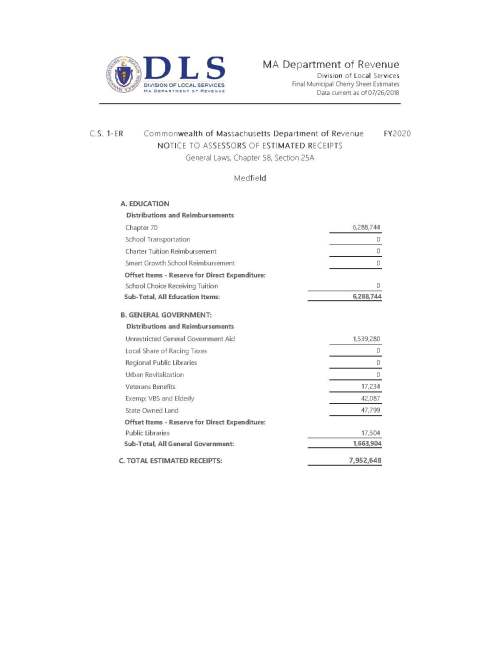
Our total state aid monies are up about $130,000 over the $7,822,174 received last year.


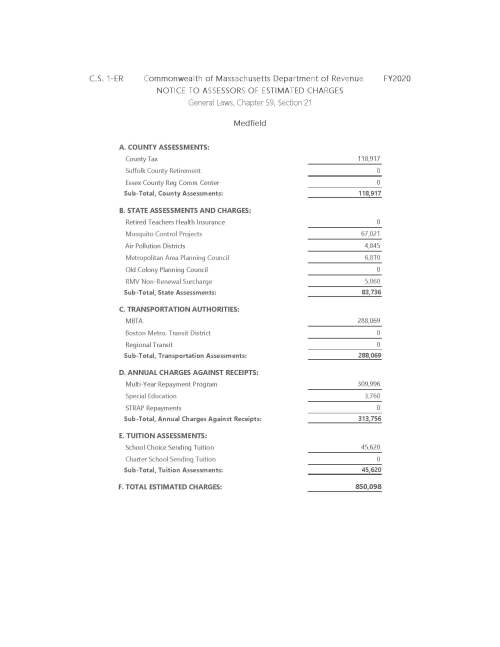
MA Department of Revenue Division of Local Services Final Municipal Cherry Sheet Estimates Data current as of 07/26/2018 C.S. 1-ER Commonwealth of Massachusetts Department of Revenue FY2020 NOTICE TO ASSESSORS OF ESTIMATED RECEIPTS General Laws, Chapter 58, Section 25A Medfield A. EDUCATION Distributions and Reimbursements Chapter 70 6,288,744 School Transportation 0 Charter Tuition Reimbursement 0 Smart Growth School Reimbursement 0 Offset Items - Reserve for Direct Expenditure: School Choice Receiving Tuition 0 Sub-Total, All Education Items: 6,288,744 B. GENERAL GOVERNMENT: Distributions and Reimbursements Unrestricted General Government Aid 1,539,280 Local Share of Racing Taxes 0 Regional Public Libraries 0 Urban Revitalization 0 Veterans Benefits 17,234 Exemp: VBS and Elderly 42,087 State Owned Land 47,799 Offset Items - Reserve for Direct Expenditure: Public Libraries 17,504 Sub-Total, All General Government: 1,663,904 C. TOTAL ESTIMATED RECEIPTS: 7,952,648 C.S. 1-ER Commonwealth of Massachusetts Department of Revenue FY2020 NOTICE TO ASSESSORS OF ESTIMATED CHARGES General Laws, Chapter 59, Section 21 Medfield A. COUNTY ASSESSMENTS: County Tax 118,917 Suffolk County Retirement 0 Essex County Reg Comm Center 0 Sub-Total, County Assessments: 118,917 B. STATE ASSESSMENTS AND CHARGES: Retired Teachers Health Insurance 0 Mosquito Control Projects 67,021 Air Pollution Districts 4,845 Metropolitan Area Planning Council 6,810 Old Colony Planning Council 0 RMV Non-Renewal Surcharge 5,060 Sub-Total, State Assessments: 83,736 C. TRANSPORTATION AUTHORITIES: MBTA 288,069 Boston Metro. Transit District 0 Regional Transit 0 Sub-Total, Transportation Assessments: 288,069 D. ANNUAL CHARGES AGAINST RECEIPTS: Multi-Year Repayment Program 309,996 Special Education 3,760 STRAP Repayments 0 Sub-Total, Annual Charges Against Receipts: 313,756 E. TUITION ASSESSMENTS: School Choice Sending Tuition 45,620 Charter School Sending Tuition 0 Sub-Total, Tuition Assessments: 45,620 F. TOTAL ESTIMATED CHARGES: 850,09820190731-cherry sheet-MuniFinalBudget175_2020_Page_2

MMA analysis of state budget

ALERT TODAY FROM THE MASSACHUSETTS MUNICIPAL ASSOCIATION ABOUT THE BUDGET –

We will get more that was originally proposed by either the Governor, the House or the Senate.

MMA-3


LEGISLATURE’S CONFERENCE COMMITTEE RELEASES FISCAL 2020 STATE BUDGET WITH MORE FUNDING FOR MANY LOCAL AID ACCOUNTS


HOUSE AND SENATE INCREASE KEY EDUCATION AND MUNICIPAL AID ACCOUNTS BY $128M ABOVE THE ORIGINAL BUDGET FILED IN JANUARY


PLEASE CONTACT THE GOVERNOR TODAY TO SUPPORT LOCAL AID FUNDING AND KEY MUNICIPAL ISSUES


July 22, 2019


Dear Osler Peterson,


On Sunday evening, July 21, the fiscal 2020 state budget conference committee that has been meeting since early June released H. 4000, the House-Senate compromise budget bill that is expected to be approved later today (Monday, July 22) by the Legislature.


Funding levels for many municipal and school aid accounts are higher in the Legislature’s final budget than in the recommendation (H. 1) filed by the Governor in January, providing $128 million more for key municipal and education programs. The Governor has 10 days to review the budget bill and make decisions on what to approve and what to veto or send back with proposed changes. Legislators will then have until the end of formal sessions in this calendar year (in November) to consider whether to accept or override those changes.


Please call the Governor’s office and ask that he approve the municipal and school aid accounts in the Legislature’s budget bill, including those funding levels that are higher than what he recommended in January, when the outlook for state finances was less positive than it is today.


You can find the Chapter 70 and UGGA amounts for your community in Section 3 of H. 4000, beginning on page 271 of the printed version of the budget, or on page 279 of the downloadable PDF.


Click Here for a Link to the Legislature’s Budget


Later this week, the Division of Local Services will notify communities of their final Cherry Sheet receipts and assessments. When available, Cherry Sheets will be posted on DLS’s website.


Click Here for a Link to the Division of Local Services Final Cherry Sheet


Here is a summary of the key priorities and local aid increases for cities and towns:


Unrestricted General Government Aid (UGGA)

In a continuing victory for cities and towns, H. 4000 appropriates $1.129 billion for the Unrestricted General Government Aid (UGGA) account, an increase of $29.7 million over the fiscal 2019 level of funding. The 2.7 percent increase reflects the policy of increasing general municipal aid at the rate of growth in state tax collections reflected in the consensus tax forecast. This revenue sharing policy has been adopted by the Governor and the House and Senate since fiscal 2016, and is a key priority of the MMA’s.


Chapter 70 School Aid and Local Contributions

In a major step forward for many communities, H. 4000 appropriates $5.176 billion for Chapter 70 school aid (7061-0008 and section 3). This is a $281 million increase over the current fiscal 2019 funding level. This will fund the basic requirements of Chapter 70 education aid, and makes progress by more aggressively implementing the recommendations of the Foundation Budget Review Commission, including higher funding for health insurance and special education costs, and significant increases in funding for communities with a high number of economically disadvantaged students. The budget continues to fund the target share provisions for those communities where the local contribution exceeds the target share level, and funds minimum aid at $30 per student. This Legislature’s budget provides a Chapter 70 increase of $68M above the amount originally proposed by the Governor in January. The community and district Chapter 70 funding levels match the distribution numbers passed in the Senate budget in May. We recognize that most communities will continue to remain minimum-aid-only districts, in spite of this impressive and appreciated statewide Chapter 70 increase, and the MMA will continue to prioritize higher minimum aid funding going forward.


  1. 4000 also supplements Chapter 70 by providing $10.5 million for a reserve fund to provide assistance to communities impacted by changes in how low-income students are counted. This amount is not included in the section 3 Chapter 70 distribution, and the Department of Elementary and Secondary Education (DESE) will distribute these funds to communities early in the school year, with the Legislature stating their intent that those districts that received over $500K under this program in fiscal 2019 should receive similar levels in fiscal 2020.


Special Education Circuit Breaker

In a significant win for cities and towns, H. 4000 fully funds the Special Education Circuit Breaker Program at $345 million. This is the program through which the state provides support for services provided to high-cost special education students. This is critically important, and represents a $25.7 million increase above last year’s general appropriations act. The Governor had proposed level-funding, and legislators in both branches proposed increases intended to move toward full funding. The final version of the budget matches the Senate’s funding level.


Charter School Impact Mitigation Payments

  1. 4000 appropriates $115 million for Charter School Impact Mitigation Payments, a $25 million increase over the current year. This is a big step forward in terms of overall funding, and is certainly appreciated, although the program remains significantly underfunded and charter school finance remains a major problem for many cities and towns. Winning full funding for this program and overhauling the existing charter finance scheme remains a top priority for MMA. Each year, dozens of cities and towns lose more funds to charter schools than they receive in new Chapter 70 funding, making them “net negative aid” communities.


Cities and towns will need to review their final Cherry Sheets to determine how much of the mitigation payment funding they will receive. The Legislature’s budget makes several changes to the overall program. First, they change the current 6-year reimbursement program (100-25-25-25-25-25) to a 3-year framework (100-60-40), apparently keeping the current cost-based approach, instead of moving to a number-of-students approach as proposed by the governor (MMA strongly supports the cost-based method). Second, they include a $7.5 million allocation to those communities whose net charter school tuition costs exceed 9% of net school spending AND whose Chapter 70 aid is a lower percentage of their foundation budget than the statewide average. Third, they include a $7.5 million allocation to be distributed by DESE to communities who have experienced high and sustained growth in charter school enrollments.


Again, it will be necessary to review final Cherry Sheet numbers to see how H. 4000 funds each district’s charter school mitigation needs.


Regional School District Student Transportation

  1. 4000 appropriates of $75.9 million to reimburse regional school districts for a portion of the cost of transporting students. This is a $7 million increase over fiscal 2019, and gets closer to the full funding target of $90 million.


Rural School Aid

The Legislature’s budget includes a $2.5 million account to provide one-time funding for rural schools, many of which are struggling with fixed costs and declining enrollment. H. 4000 includes language that would require DESE to make recommendations for future funding in fiscal 2021.


McKinney-Vento Homeless Student Transportation

  1. 4000 appropriates $11.1 million for this account to reimburse municipalities and school districts for a portion of the cost of transporting homeless students as required under state and federal rules. This is an increase of $2 million over the fiscal 2019 appropriation.


Payment in Lieu of Taxes on State-owned Land

  1. 4000 appropriates $30 million to pay a portion of the payment-in-lieu-of taxes amount due to cities and towns to offset the property tax exemption for state-owned land. This is a $1.5 million increase over fiscal 2019, although some communities will still experience challenges due to changing valuations by the state.


Shannon Anti-Gang Grant Program

  1. 4000 appropriates $11 million for the highly effective and valuable Shannon Anti-Gang Grant Program that has helped cities and towns respond to and suppress gang-related activities, a $3 million increase over the current year.


Community Preservation Act

The Legislature’s final budget increases recording fees at the Registry of Deeds to raise revenues for the Community Preservation Act (CPA) Trust Fund. This would provide an estimated $36 million in new funds to more than double the base percentage match for all 175 CPA cities and towns beginning in November 2020. In addition, H. 4000 would set aside up to $20 million from the fiscal 2019 budget surplus (if any) to supplement the matching funds that will be distributed in the fall of 2019.


If you have any questions or need additional information, please contact MMA Legislative Director John Robertson at 617-426-7272 ext. 122 or jrobertson@mma.org.


Please Contact Gov. Baker and Ask Him to Approve the Legislature’s Local Aid Increases as Described Above.


Thank you very much!