Category Archives: Legislature

Municipal Modernization Bill status

State-House-smaller_1 (1)

Here is an email exchange that gives you the current status of the Municipal Modernization Bill from our State Representatives -interesting that it has been broken into five parts for hearing purposes –


Denise and Shawn,

I hope you will support the Municipal Modernization Bill – the Massachusetts Municipal Association was asking us today to contact you about it.  Thanks in advance.

Best, Pete


denise-garlick-state-representative-headshot

Dear Pete,

It has been broken into 5 parts and is being heard in 5 different committees. I believe this is with the intention to expedite  the components.

I will follow the pieces carefully.

Hope all is well with your family and Medfield!

Denise


Shawn Dooley

Hey Pete.

Already voted to accept the sections that were sent to Revenue so hopefully the rest of committees will follow as well.

Met with Chairman of ways and means earlier today and asked for the bills to be reconsolidated into one big bill again.  Non committal but expressed that the Lt gov asked for the same thing.

Thanks so much for the note.

Shawn

Shawn Dooley

State Representative, 9th Norfolk

Medfield, Millis, Norfolk, Plainville, Walpole, & Wrentham.


Municipal Modernization Bill

This today from the MMA on the Municipal Modernization Bill –


MMA-2

February 16, 2016

GOV’S MUNICIPAL MODERNIZATION BILL CONTAINS NECESSARY REFORMS AND IMPORTANT UPDATES FOR CITIES AND TOWNS

Please Call Your Legislators Today and Ask Them to Pass the Municipal Modernization Act Now

Legislative hearings have been completed on the sweeping Municipal Modernization Bill that Gov. Baker and Lt. Gov. Polito filed in December. Five different committees heard testimony from scores of local officials and stakeholders during the past five weeks, and the next step will be for the legislation to be reassembled into one strong package for votes in the House and Senate.

Because several of the important reform measures in the Municipal Modernization Act are opposed by special interest groups, your legislators will need to hear from you.

The Governor’s Municipal Modernization Act (H. 3905) features dozens of welcome reforms related to procurement, municipal finance, human resources, economic development and the general administration of local government. The bill was based on a wide range of input from local leaders, and is built around four major actions: 1) updating and repealing obsolete state laws; 2) promoting independence at the local level; 3) streamlining state oversight; and 4) providing municipalities with greater flexibility and day-to-day decision-making powers.

KEY REFORMS IN THE BILL INCLUDE:

  • Giving cities and towns control over the number of liquor licenses that can be issued to restaurants and bars in the community;
    • Enacting unemployment insurance reforms to prevent school crossing guards, school bus drivers, and others from collecting unemployment payments during school vacations;
    • Allowing cities and towns to decide whether to exempt positions from Civil Service;
    Increasing procurement thresholds to eliminate unnecessary red tape and delays for simple purchases;
    Certifying the full and fair value of property values every 5 years, instead of every 3 years;
    • Replacing many of the mandatory paid classified ads for zoning and other notices with electronic posting as used in the Open Meeting Law; and
    • Giving municipalities the ability to levy fines to enforce the requirement that utilities remove double poles within 90 days.

The bill includes over 200 provisions that would update and reform a wide swath of state laws governing everything from basic municipal finance and administration to allowing cities and towns a first option to purchase tax-exempt property, and was written based on suggestions made by local officials on ways to make running local government more efficient and less costly, and to return “home rule” authority to cities and towns where it makes sense. The bill includes a number of proposals from the MMA’s legislative package.

Information about the municipal modernization bill can be found on the MMA website by clicking here.

ASK YOUR LEGISLATORS TO PASS ONE STRONG MUNICIPAL MODERNIZATION BILL:

Earlier this year, legislators divided the Municipal Modernization Act into five smaller bills, and sent them to different committees for public hearings.

With public hearings concluded, it is now time to bring the parts back together into a single consolidated bill and make plans for debate and passage in the House and Senate.

With the end of formal legislative sessions only 5½ months away, there is no time to waste. Please call your legislators today and ask them to reassemble the Municipal Modernization Act into one strong bill, and ask them for a commitment to pass the bill early this spring.

When you speak with your legislators, please ask them to talk to the leaders in their branches (the Speaker of the House, the Senate President and the Chairs of the House and Senate Ways & Means Committee) and seek a commitment to take up and enact a consolidated bill before the session ends.

The Municipal Modernization Act Will Help Every City and Town

Please Ask Your Legislators to Make the Bill a Top Priority this Session

Denise Garlick annual r3port

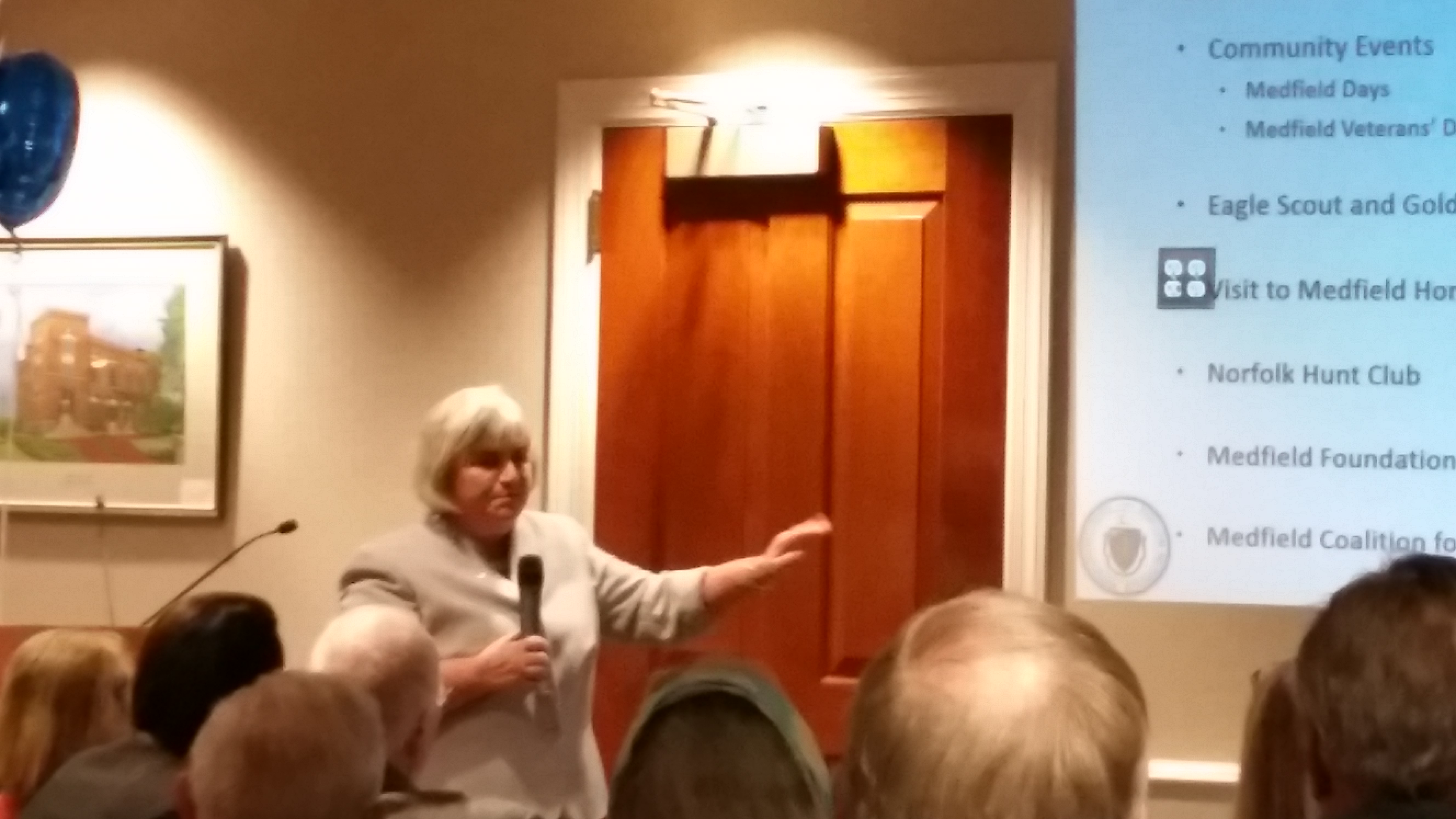
Demise Garlick is holding her annual report to the town this evening at the Town House. She is now the Chair of the Committee on Elder Affairs, so she now has a substantial staff – about six people, several of whom are here this evening. As an attorney I was glad to hear she has legal council, as well as a legislative aid.

Our state aid + 1%

State-House-smaller_1 (1)

From John Nunnari –


Although I’m sure both the MMA and the Department of Local Services has already provided previews of these numbers, I’m passing this along in case you hadn’t seen the numbers released today by the Governor.

The Governor is proposing an additional $107K over last year, which is approximately a 1% increase.

john


Municipality/Regional District 7061-0008 Chapter 70 Unrestricted General Government Aid Annual Formula Local Aide
FY ’15 Actual Appropriation $5,862,409.00 $1,289,875.00 $0.00
FY ’16 Actual Appropriation $5,925,859.00 $1,336,310.00
Governors FY ’17 Proposal $5,975,759.00 $1,393,771.00 $0.00
Medfield (House FY ’17 Proposed Numbers) $0.00 $0.00 $0.00
Medfield (Senate FY 17 Proposed Numbers) $0.00 $0.00 $0.00
FY ’17 Conference Committee Report           July +/- $0.00 $0.00 $0.00


John Nunnari, Assoc AIA
Executive Director, AIA MA

CPA match at 29.7% – none for us

The state announced its matching money for Community Preservation Act towns – 29.7% on average, but Medway which is in for 3% CPA surcharges got over 40% matching money.

Medfield residents continue to pay our money in so it can go to other towns, and leave our potential state matching money on the table.


Statewide CPA Trust Fund Distribution Announced

State-House-smaller_1 (1)

November 17, 2015:  The Massachusetts Department of Revenue (DOR) has released the Community Preservation Trust Fund distribution for each CPA municipality. The revenue from this year’s trust fund distribution comes from two sources: document recording fees collected over the past 12 months at the state’s Registries of Deeds, and a transfer of $10 million from the state’s FY2015 budget surplus. In total, more than $36 million will be distributed to the 156 communities eligible for a distribution this year.

All CPA communities will receive a 29.7% match on round one of the trust fund distribution this year.  Communities that adopted CPA with a full 3% local property tax surcharge will receive a higher percentage.  Click on the link below for details on this year’s distribution and a way to view the specific amounts for each community.

> SPREADSHEET: Click here for the CPA Trust Fund distribution amount for each municipality <

PLEASE NOTE:  According to a statement from DOR, this year’s CPA Trust Fund distribution amount for most communities was adjusted due to an update to FY2015 data after last year’s distribution was made. The adjustment was necessary because the surcharge percentage was incorrectly calculated in one community and another community did not notify DOR that they had adopted CPA and were therefore not included in last year’s distribution.

$49K more state $ for last winter

Governor Baker has proposed $25m. of supplemental FY15 monies for snow relief, that would mean $49,474 for Medfield.  This is the full alert this afternoon from the Massachusetts Municipal Association:


Friday, July 17, 2015

GOV. BAKER SIGNS $38.1B FY 2016 STATE BUDGET TO FUND KEY MUNICIPAL AND SCHOOL AID PROGRAMS

***BREAKING NEWS: GOV. BAKER ALSO PROPOSES $25M IN SNOW AND ICE RELIEF FUNDS IN YEAR-END FY 2015 BUDGET FILING***

NEW STATE BUDGET INCREASES UGGA BY $34M, ADDS $18.1M TO FULLY FUND SPECIAL EDUCATION CIRCUIT BREAKER, RESTORES $7.5M TO REGIONAL SCHOOL TRANSPORTATION, FUNDS CH. 70 MINIMUM AID AT $25 PER STUDENT, ADDS $3.6M TO CHARTER SCHOOL REIMBURSEMENTS – HOWEVER, GOVERNOR REDUCES KINDERGARTEN DEVELOPMENT GRANTS DOWN TO $1 MILLION – A $17.6M REDUCTION

GOVERNOR BAKER ALSO FILED A YEAR-END FISCAL 2015 BUDGET WITH $25M TO ASSIST CITIES AND TOWNS WITH SNOW AND ICE DEFICITS, TO BE DISTRIBUTED THROUGH THE CHAPTER 90 FORMULA – LEGISLATIVE APPROVAL IS NEEDED

Seventeen days into the new fiscal year, Governor Charlie Baker signed the first full-year state budget into law, a $38.1 billion spending plan for fiscal 2016 that will increase overall expenditures by approximately 3.5 percent, as the state closes a projected $1.8 billion structural budget deficit by restraining spending and eliminating up to 5,000 state jobs through a hiring freeze, attrition and an early retirement program.

In terms of local aid, the Governor’s signature pen inked into law strong progress on many important municipal priorities, including the significant victory in embracing the $34 million increase in Unrestricted General Government Aid as proposed by Gov. Baker and requested by the MMA. Beyond that, the Governor has approved more than $30 million to key municipal and education aid accounts and reimbursement programs above the amount he initially in his March budget proposal. This is a major victory for cities and towns that was made possible by your strong advocacy.

In a win for Gov. Baker, the Legislature’s budget includes a three-year suspension of the Pacheco anti-outsourcing law for the MBTA, and provides for a Fiscal and Management Control Board to oversee the MBTA.

GOV. PROPOSES $25M IN SNOW AND ICE RELIEF FUNDS FOR CITIES AND TOWNS ACROSS THE STATE:

AT THE SAME TIME THE GOVERNOR SIGNED THE FISCAL 2016 STATE BUDGET INTO LAW, HE ALSO FILED A YEAR-END FISCAL 2015 SUPPLEMENTAL BUDGET TO CLOSE THE BOOKS ON THE YEAR THAT JUST ENDED. BECAUSE OF THE RECORD-BREAKING WINTER AND RECORD-BREAKING SNOW AND ICE DEFICITS AT THE LOCAL LEVEL, GOV. BAKER’S FISCAL 2015 SUPPLEMENTAL BUDGET INCLUDES $25 MILLION IN ADDITIONAL RELIEF FOR CITIES AND TOWNS, WHICH WOULD BE DISTRIBUTED STATEWIDE THROUGH THE CHAPTER 90 FORMULA.

PLEASE CLICK HERE TO SEE YOUR COMMUNITY’S SHARE OF GOV. BAKER’S PROPOSED $25 MILLION IN SNOW AND ICE RELIEF FUNDING, INCLUDED IN HIS BUDGET SUBMISSION LETTER: http://www.mass.gov/anf/docs/anf/fy15/fy2015-supplemental-filing-letter.pdf

PLEASE CALL YOUR LEGISLATORS AND ASK THEM TO SUPPORT THE GOVERNOR’S PROPOSAL FOR SNOW AND ICE RELIEF FUNDS

FINAL FY 2016 STATE BUDGET FUNDS KEY MUNICIPAL AND SCHOOL AID PROGRAMS:

IN TERMS OF THE FISCAL 2016 STATE BUDGET THAT GOV. BAKER SIGNED INTO LAW TODAY, HERE IS A SUMMARY OF THE KEY MUNICIPAL AND SCHOOL FUNDING INCLUDED IN THE FINAL BUDGET:

$34 MILLION INCREASE IN UNRESTRICTED MUNICIPAL AID
In a major win for cities and towns, the final budget provides $979.8 million for UGGA, a $34 million increase over current funding.  This will be the largest increase in discretionary municipal aid in nearly a decade.  Every city and town will see their UGGA funding increase by 3.6 percent.

GOVERNOR EMBRACES $18.3 MILLION INCREASE TO FULLY FUND SPECIAL EDUCATION CIRCUIT BREAKER
In another victory for cities and towns, the final budget would fully fund the Special Education Circuit Breaker program with $271.7 million, an $18.3 million increase above fiscal 2015.  This is a vital program that every city, town and school district relies on to fund state-mandated services.

BUDGET ADDS $7.5 MILLION FOR REGIONAL SCHOOL TRANSPORTATION REIMBURSEMENTS
The final budget would restore $7.5 million to regional school transportation funding, providing a total of $59 million for the upcoming year.  Last November, former Gov. Patrick used his 9C budget powers to reduce this important program down to $51.5 million.  The final budget is a major step forward for communities with regional school districts.

GOVERNOR BACKS CHAPTER 70 MINIMUM AID OF $25 PER STUDENT
The final fiscal 2016 budget provides a $111.2 million increase in Chapter 70 education aid, with a provision providing every city, town and school district an increase of at least $25 per student, an improvement over the $20 per student amount originally proposed in March.  The appropriation is $5.9 million more than the recommendation in March, and the increase would be used to ensure the $25 per student minimum aid level and to slightly accelerate the implementation of the target share provisions enacted in 2007.

GOVERNOR REDUCES KINDERGARTEN DEVELOPMENT GRANTS DOWN TO $1 MILLION, A CUT OF $17.6 MILLION
This account has faced serious challenges during the fiscal 2016 budget process, with Gov. Baker’s original budget proposal including no funding for the Kindergarten Development Grant program, and the Senate budget funding the program at $1 million.  Only the House budget maintained funding at the fiscal 2015 level of $18.6 million.  177 communities and school districts depend on these funds, and the MMA and cities and towns will be calling on their legislators to override this $17.6 million reduction, and restore the funds.

BUDGET INCREASES CHARTER SCHOOL REIMBURSEMENTS BY $3.64 MILLION, ACCOUNT REMAINS UNDERFUNDED
Under state law, cities and towns that host or send students to charter schools are entitled to be reimbursed for a portion of their lost Chapter 70 aid.  The state fully funded the reimbursement program in fiscal 2013 and 2014, but is underfunding reimbursements by approximately $34 million this year (fiscal 2015).  The final fiscal 2016 budget will provide a $3.64 million increase up to $80.5 million, however this is still $50 million below full funding.  The action to increase funding is appreciated, yet it is important to remember that the account is still significantly underfunded.

STATE ADDS $1 MILLION TO McKINNEY-VENTO REIMBURSEMENTS
The final budget would add $1 million to increase fiscal 2016 reimbursements for the transportation of homeless students to $8.35 million.  The account remains below the full reimbursement called for under the state’s unfunded mandate law, yet this would be the first increase since fiscal 2013.

PAYMENTS-IN-LIEU-OF-TAXES (PILOT), LIBRARY AID ACCOUNTS, METCO, AND SHANNON ANTI-GANG GRANTS, VOKE ED TRANSPORTATION
PILOT PAYMENTS: The final budget would level-fund PILOT payments at $26.77 million.
LIBRARY AID: The budget funds library grant programs at $18.9 million, a $400 thousand increase above fiscal 2015 post-9C levels.
METCO: The final budget funds METCO at $20.14 million, a $2.23 million increase above fiscal 2015 post-9C levels.
SHANNON GRANTS: The final appropriation is $7 million, the same amount proposed by Gov. Baker in March.
VOCATIONAL EDUCATION TRANSPORTATION: Last year, Gov. Patrick wiped out all fiscal 2015 funding using his 9C powers, and the good news is that the fiscal 2016 budget would restore $1.75 million for fiscal 2016.

STATE MAY PROVIDE UP TO $10M FOR COMMUNITY PRESERVATION ACT FUNDING
During fiscal 2015, 156 cities and towns collected the local Community Preservation Act (CPA) surcharge and are eligible for state matching grants in fiscal 2016.  The Division of Local Services (DLS) estimates that the balance in the state trust fund will be sufficient to provide a first round match of only 18 percent of the surcharge levied by each city and town.  This would be the lowest state match in the program’s history.  Knowing this, the fiscal 2016 state budget would devote up to $10 million of any fiscal 2015 year-end state budget surplus to supplement the fiscal 2016 state match, a significant boost for all CPA communities.  The final amount available will depend on the final fiscal 2015 surplus, which will not be determined until later this autumn.

Please Call Your Legislators and Thank Them for a Strong Fiscal 2016 State Budget that Makes Progress on Key Municipal and Education Aid Priorities, and Ask Them to Support Gov. Baker’s Proposed $25 Million for Snow and Ice Funding in the Fiscal 2015 Year-End Budget

Our final state aid

The state has passed the budget, albeit a week into the fiscal year.  These are Medfield’s state local aid numbers, netting us a total of $7,358,252, up over $100,000 from $7,255,166 last year –

FY2016 Local Aid Estimates
Medfield
FY2015 Cherry Sheet Estimate
FY2016 Governor’s Budget Proposal
FY2016 House Budget Proposal
FY2016 Senate Budget Proposal
FY2016 Conference Committee
Education:
Chapter 70
5,862,409
5,913,169
5,925,859
5,925,859
5,925,859
School Transportation
0
0
0
0
0
Charter Tuition Reimbursement
12,129
998
1,164
1,212
1,090
Smart Growth School Reimbursement
0
0
0
0
0
Offset Receipts:
School Choice Receiving Tuition
0
0
0
0
0
Sub-total, All Education Items:
5,874,538
5,914,167
5,927,023
5,927,071
5,926,949
General Government:
Unrestricted Gen Gov’t Aid
1,289,875
1,336,310
1,336,310
1,336,310
1,336,310
Local Sh of Racing Taxes
0
0
0
0
0
Regional Public Libraries
0
0
0
0
0
Urban Revitalization
0
0
0
0
0
Veterans Benefits
18,649
21,430
21,430
21,430
21,430
State Owned Land
28,261
28,261
28,261
28,261
28,261
Exemp: VBS and Elderly
27,101
28,947
28,947
28,947
28,947
Offset Receipts:
Public Libraries
16,742
16,096
16,134
16,355
16,355
Sub-Total, All General Government
1,380,628
1,431,044
1,431,082
1,431,303
1,431,303
Total Estimated Receipts
7,255,166
7,345,211
7,358,105
7,358,374
7,358,252
Although the School Lunch program continues to be funded, we have removed the estimate from the cherry sheet as this program is an education offset that has no impact on the tax rate setting process.

MMA on state budget

This alert this AM from the Massachusetts Municipal Association on the state budget agreed upon by the Conference Committee, and scheduled for votes today in the legislature.   The highlights:

  • $34 million increase in state local aid funding over current funding.  This will be the largest increase in discretionary municipal aid in nearly a decade.
  • MBTA reforms get half a loaf, by creating a financial oversight board, but not giving it authority of the binding arbitration awards, which are the biggest cost driver. –

Wednesday, July 8, 2015

LEGISLATURE AGREES ON $38.1B FY 2016 STATE BUDGET THAT INCLUDES FUNDING FOR KEY MUNICIPAL AND SCHOOL AID PROGRAMS

STATE BUDGET CONFERENCE COMMITTEE REPORT SCHEDULED FOR VOTES IN HOUSE AND SENATE TODAY, HEADED TO GOVERNOR’S DESK

LEGISLATURE’S BUDGET INCREASES UGGA BY $34M, ADDS $18.1M TO FULLY FUND SPECIAL EDUCATION CIRCUIT BREAKER, RESTORES $7.5M TO REGIONAL SCHOOL TRANSPORTATION, FUNDS CH. 70 MINIMUM AID AT $25 PER STUDENT, PROTECTS $18.6M FOR KINDERGARTEN DEVELOPMENT GRANTS, ADDS $3.6M TO CHARTER SCHOOL REIMBURSEMENTS

Eight days into the new fiscal year, House and Senate budget negotiators have reached agreement on a $38.14 billion state budget, a fiscal 2016 budget plan that will be approved later this afternoon by votes in each branch. The Governor will have ten days to review, approve or veto hundreds of line item appropriations and outside sections. In the meantime, the state is maintaining operations through a temporary budget that runs through the end of July.

As proposed by the House-Senate budget conference committee, the Legislature’s fiscal 2016 state budget (H. 3650) would increase overall expenditures by approximately 3.5 percent, as the state seeks to close a projected $1.8 billion structural budget deficit by restraining spending and eliminating up to 5,000 state jobs through a hiring freeze, attrition and an early retirement program.

In terms of local aid, the Legislature’s budget provides strong progress on many important municipal priorities, including the significant victory in embracing the $34 million increase in Unrestricted General Government Aid as proposed by Gov. Baker and requested by the MMA. Beyond that, the Legislature has added more than $50 million to key municipal and education aid accounts and reimbursement programs above the amount recommended by the Governor in his March budget proposal. This is a major victory for cities and towns that was made possible by your strong advocacy.

The budget would expand the earned income tax credit for low-income workers by an estimated $71 million, and fund that expansion by eliminating a corporate tax break on recognized income. The Senate had proposed a freeze on the scheduled decrease in the state income tax rate, but that provision was not included in the budget.

The House and Senate compromised on MBTA reform language. In a win for Gov. Baker, the Legislature’s budget includes a three-year suspension of the Pacheco anti-outsourcing law for the MBTA, and provides for a Fiscal and Management Control Board to oversee the MBTA. The Governor had requested a strong control board with approval over binding arbitration decisions. The Legislature’s version provides for a separate MBTA control board, but does not grant the panel authority over binding arbitration awards.

Here is a summary and status of the key municipal and school funding issues in the Legislature’s fiscal 2016 state budget plan:

SENATE, HOUSE AND GOVERNOR ALL AGREE ON $34 MILLION INCREASE IN UNRESTRICTED MUNICIPAL AID
In a major win for cities and towns, the Senate, House and Governor’s budgets all supported $979.8 million for UGGA, a $34 million increase over current funding.  This will be the largest increase in discretionary municipal aid in nearly a decade.  Every city and town will see their UGGA funding increase by 3.6 percent.

LEGISLATURE EMBRACES $18.3 MILLION INCREASE TO FULLY FUND SPECIAL EDUCATION CIRCUIT BREAKER
In another victory for cities and towns, the Legislature’s budget would fully fund the Special Education Circuit Breaker program.  The House-Senate budget plan would provide $271.7 million, an $18.3 million increase above fiscal 2015.  The Governor’s original budget proposal would have level-funded the program at $253.4 million, but the MMA made full funding a top priority, and the Legislature responded.  This is a vital program that every city, town and school district relies on to fund state-mandated services.

LEGISLATURE’S BUDGET MAINTAINS KINDERGARTEN DEVELOPMENT GRANTS AT $18.6 MILLION
The Legislature’s budget would maintain funding for Kindergarten Development Grants at $18.6 million in fiscal 2016, which is a major victory for the 117 communities and school districts that depend on these funds. The Governor’s budget would have eliminated all funding.  This is an important account, because reducing or eliminating the $18.6 million would jeopardize expanded kindergarten programs all throughout the state.

LEGISLATURE ADDS $7.5 MILLION FOR REGIONAL SCHOOL TRANSPORTATION REIMBURSEMENTS
The Legislature’s budget would restore $7.5 million to regional school transportation funding, providing a total of $59 million for the upcoming year.  Last November, former Gov. Patrick used his 9C budget powers to reduce this important program down to $51.5 million, and Gov. Baker’s fiscal 2016 budget proposal would have kept funding at that level.  The Legislature’s final proposal is a major step forward for communities with regional school districts.

LEGISLATURE BACKS CHAPTER 70 MINIMUM AID OF $25 PER STUDENT
The Legislature’s budget is proposing a $111.2 million increase in Chapter 70 education aid, with a provision providing every city, town and school district an increase of at least $25 per student, an improvement over the $20 per student amount originally proposed in March.  The Legislature’s appropriation is $5.9 million more than the recommendation in the Governor’s budget submission, and the increase would be used to ensure the $25 per student minimum aid level and to slightly accelerate the implementation of the target share provisions enacted in 2007

LEGISLATURE WOULD INCREASE CHARTER SCHOOL REIMBURSEMENTS BY $3.64 MILLION, ACCOUNT REMAINS UNDERFUNDED
Under state law, cities and towns that host or send students to charter schools are entitled to be reimbursed for a portion of their lost Chapter 70 aid.  The state fully funded the reimbursement program in fiscal 2013 and 2014, but is underfunding reimbursements by approximately $34 million this year (fiscal 2015).  The Governor’s proposed fiscal 2016 budget would have level-funded charter school reimbursements at $76.8 million, which would guarantee another major shortfall in fiscal 2016, and result in cutbacks for the majority of students who remain in the traditional school setting.  The Legislature is proposing a $3.64 million increase up to $80.5 million.  The lawmakers’ action to increase funding is appreciated, yet it is important to remember that the account is still significantly underfunded.

LEGISLATURE ADDS $1 MILLION TO McKINNEY-VENTO REIMBURSEMENTS
The Legislature’s budget would add $1 million to increase fiscal 2016 reimbursements for the transportation of homeless students to $8.35 million, the same funding level proposed by the Governor.  While the account remains below the full reimbursement called for under the state’s unfunded mandate law, this would be the first increase since fiscal 2013.

PAYMENTS-IN-LIEU-OF-TAXES (PILOT), LIBRARY AID ACCOUNTS, METCO, AND SHANNON ANTI-GANG GRANTS, VOKE ED TRANSPORTATION
PILOT PAYMENTS: The Legislature’s budget would level-fund PILOT payments at $26.77 million.
LIBRARY AID: The Legislature would fund library grant programs at $19 million, a $500 thousand increase above fiscal 2015 post-9C levels.
METCO: The Legislature would fund METCO at $20.14 million, a $2.23 million increase above fiscal 2015 post-9C levels.
SHANNON GRANTS: The Legislature is proposing $7 million, the same amount proposed by Gov. Baker in March.
VOCATIONAL EDUCATION TRANSPORTATION: Last year, Gov. Patrick wiped out all fiscal 2015 funding using his 9C powers, and the Legislature’s budget would restore $1.75 million for fiscal 2016.

LEGISLATURE PROVIDES UP TO $10M FOR COMMUNITY PRESERVATION ACT FUNDING
During fiscal 2015, 156 cities and towns collected the local Community Preservation Act (CPA) surcharge and are eligible for state matching grants in fiscal 2016.  The Division of Local Services (DLS) estimates that the balance in the state trust fund will be sufficient to provide a first round match of only 18 percent of the surcharge levied by each city and town.  This would be the lowest state match in the program’s history.  Knowing this, the Legislature’s budget would devote up to $10 million of any fiscal 2015 year-end state budget surplus to supplement the fiscal 2016 state match, a significant boost for all CPA communities.  Gov. Baker did not include a matching provision in his proposed budget.

MUNICIPAL EMERGENCY MEDICAL SERVICES NOT INCLUDED IN BUDGET
Although the House and Senate budgets each included differently worded provisions prohibiting “pay the patient” practices by insurance companies for ambulance services, the Legislature’s final budget does not include any language addressing this problem.  “Pay the patient” undermines the ability of cities and towns to fund and operate effective and efficient ambulance services that are at the core of emergency medical response in Massachusetts and forces communities to pursue their own residents to recoup thousands of dollars in ambulance expenses, a system that is inefficient and subject to abuse.  The House had adopted an amendment to ban “pay the patient” practices, with language stating that municipalities would be authorized to set a fair rate for ambulance services, preventing insurance companies from shifting costs to local property taxpayers through below-cost reimbursements.  The Senate budget would have given ultimate rate-setting authority to the Secretary of Health and Human Services, which the MMA opposed because removal of local control over ambulance rates would have created large budget problems for cities and towns.  The Governor’s budget did not address the issue.  Because this issue has not been resolved, the MMA will continue its efforts to ban “pay the patient” practices by insurance companies.

Please Call Your Legislators Today and Thank Them for a Strong Fiscal 2016 State Budget that Makes Progress on Key Municipal and Education Aid Priorities



Senate budget

This is how we do under the Senate’s budget –


FY2016 Local Aid Estimates
All Municipal
FY2015 Cherry Sheet Estimate
FY2016 Governor’s Budget Proposal
FY2016 House Final Budget Proposal
FY2016 Senate Final Budget Proposal
FY2016 Conference Committee
Education:
Chapter 70
3,730,480,705
3,828,556,906
3,830,886,519
3,833,516,810
School Transportation
154,078
110,488
124,430
130,136
Charter Tuition Reimbursement
76,974,357
74,728,135
74,431,420
81,866,459
Smart Growth School Reimbursement
436,743
436,743
250,000
436,743
Offset Receipts:
School Choice Receiving Tuition
45,494,828
46,648,312
46,648,312
46,648,312
Sub-total, All Education Items:
3,853,540,711
3,950,480,584
3,952,340,681
3,962,598,460
General Government:
Unrestricted Gen Gov’t Aid
945,750,001
979,797,001
979,797,001
979,797,001
Local Sh of Racing Taxes
816,585
710,500
710,500
710,500
Regional Public Libraries
2,501,833
2,521,970
2,601,883
2,601,883
Urban Revitalization
1,286,806
1,286,306
1,286,306
1,286,306
Veterans Benefits
50,344,210
51,516,162
51,516,162
51,516,162
State Owned Land
26,770,000
26,770,000
26,770,000
26,770,000
Exemp: VBS and Elderly
24,416,788
24,673,163
24,673,163
24,673,163
Offset Receipts:
Public Libraries
9,000,000
8,826,300
8,847,300
9,029,000
Sub-Total, All General Government
1,060,886,223
1,096,101,402
1,096,202,315
1,096,384,015
Total Estimated Receipts
4,914,426,934
5,046,581,986
5,048,542,996
5,058,982,475
Although the School Lunch program is funded in both the FY2015 final budget and the FY2016 Governor’s, House Final and Senate Final budget proposals, we have removed the estimate from the cherry sheet as this program is an education offset that has no impact on the tax rate setting process.

MMA on Senate version of state budget

This alert this morning from the Massachusetts Municipal Association on the Senate deliberations tomorrow on the state budget, highlighting issues important to towns. –

Monday, May 18, 2015

SENATE DEBATE ON FY 2016 STATE BUDGET BEGINS TUESDAY – CALL YOUR SENATORS

Lawmakers Will Decide the Fate of 942 Amendments

Please Call Your Senators Today on the Budget Amendments that Impact Key Municipal and School Priorities

The Massachusetts Senate will begin debating the $38 billion fiscal 2016 state budget on Tuesday, May 19th. The deliberations are expected to take several days, as Senators have filed 942 amendments to make changes to S. 3, the Senate Ways & Means Committee’s budget recommendation that was released last week.

Many of these amendments would directly impact cities and towns, including a number of welcome amendments that would increase funding for municipal and school aid accounts. This Legislative Alert describes the most important amendments that will be debated.

Please Call Your Senators Today

Please call your Senators as soon as possible today to secure their support for those amendments that would help your community.

Lawmakers must hear from you on these issues. Because of the great number of amendments, the summaries here are very brief. Please contact MMA Legislative Director John Robertson at jrobertson@mma.org or 617-426-7272 x122 at any time if you have questions or need more details.

When you call your Senators, please make sure to thank them for the proposals in the Senate budget to increase Unrestricted General Government Aid by $34 million (matching the budgets from the Governor and House), and for the $18.2 million increase to fully fund the Special Education Circuit Breaker.

Please Click Here to Download a Copy of the MMA’s Budget Letter to the Senate

Please Click Here to Visit the Senate Budget Website to See the Amendments: The Senate budget committee recommendation (S. 3) and all proposed amendments are posted on the Legislature’s website at: https://malegislature.gov/Budget/FY2016/Senate/ChamberActions

KEY BUDGET AMENDMENTS ON SCHOOL AND EDUCATION FUNDING

Adequate Chapter 70 Minimum Aid for Municipal and Regional Schools
The MMA is calling for a sufficient funding increase for Chapter 70 school aid to ensure that all municipal and regional school districts are able to reach the “foundation” level of spending, implement the equity provisions adopted in 2006, and provide an adequate amount of minimum aid that ensures that all schools receive an increase in fiscal 2016.

The Governor proposed a fiscal 2016 Chapter 70 increase that sets minimum aid at only $20 per student for 245 cities, towns and school districts, an insufficient amount to maintain current school staffing and services. The Senate budget would increase minimum aid to $25 per student, but in reality this still leaves too many schools unable to maintain quality school programs. Recognizing that the Foundation Budget Review Commission will not file its report until mid-2015, far past the deadline for inclusion in the fiscal 2016 state budget, the MMA is urging the House to adopt a higher minimum aid amount to prevent further erosion in school financing at the local level.

• Please ask your Senators to Support Amendment 94 filed by Sen. Eldridge and Amendment 100 filed by Sen. Hedlund to increase the “minimum aid” amount to $50 per student. This amendment would benefit 245 cities, towns and school districts, and give these communities a better chance of maintaining the quality of their existing education programming.

Reimbursements for Charter School Losses
The diversion of Chapter 70 school aid away from public schools to pay tuition to charter schools has imposed a major and growing financial burden on cities and towns, a problem made more acute as the state grants more charters and existing charter schools expand. Local officials strongly support full funding of the Commonwealth’s commitment under section 89 of Chapter 71 of the General Laws to reimburse school districts for the loss of a portion of their Chapter 70 aid that is redirected to fund charter schools.

In fiscal 2015, it is expected that cities and towns will be forced to divert $444 million to fund charter schools, 10 percent of all Chapter 70 dollars. This illustrates the importance of this issue to local governments, and why it is critical for the state to meet its commitment to this program. The original $80 million appropriation in the fiscal 2015 general appropriations act was $30.5 million below the full funding amount required in the statutory formula, which was signed into law only a few years ago. The problem has deepened with two rounds of 9C cuts to this account ($3.1 million), increasing the fiscal 2015 shortfall to at least $33.6 million.

The funding shortfall means that cities and towns are receiving only a fraction of the reimbursements due according to state law. This is impacting a large number of communities, including some the state’s poorest and most financially distressed cities and towns. Thus, the underfunding of the charter school reimbursement formula is harming the most vulnerable and challenged school districts and communities.

The House and Governor’s fiscal 2016 budget would level fund charter school reimbursements at $76.9 million, even though local payments to charter schools are expected to increase by $56.5 million. Full funding of the statutory formula would require $133.5 million. Without these funds, cities and towns will face another major shortfall next year, and result in cutbacks for the vast majority of students who remain in the traditional public school setting. The SW&M budget would provide $80 million, which is still far below the necessary funding.

• Please ask your Senators to Support Amendment 616 filed by Sen. Chang-Diaz, and Amendment 608 filed by Sens. Hedlund and Moore. These critical amendments would fully fund charter school reimbursements due to cities, towns and regional school districts by providing the full $133.5 million necessary to meet the state’s obligation.

McKinney-Vento Homeless Student Transportation Costs
In fiscal 2013, the state budget provided $11.3 million to fully fund the state-mandated costs that resulted from the Commonwealth’s adoption of the federal McKinney-Vento Act. The State Auditor ruled that the McKinney-Vento program was an unfunded mandate on cities and towns, and the Legislature provided full funding soon after that ruling. Under the program, communities are providing very costly transportation services to bus homeless students to schools outside of the local school district. However, the fiscal 2014 state budget reduced McKinney-Vento reimbursements to $7.4 million, underfunding this state mandate. Full funding for this year is estimated at $19.8 million, but the Commonwealth level-funded the program at $7.35 million, creating a shortfall of $12.5 million in the current fiscal year.

The House and Governor are proposing a $1 million increase for fiscal 2016 to bring funding for McKinney-Vento reimbursements up to $8.4 million, yet the SW&M budget would level-fund the program at $7.4 million. Full funding for this state mandate would require $20.8 million, according to the most recent DESE projection.

• Please ask your Senators to Support Amendment 586 filed by Sens. Eldridge and Lesser, Amendment 569 filed by Sens. Lovely and Barrett, and Amendment 611 filed by Sens. Hedlund and Moore that would fund reimbursements due to municipalities and school districts for the cost of transporting homeless students from temporary shelters to school. In addition, please ask your Senators to Support Amendment 33 filed by Senator Lovely that would protect cities and towns that host homeless families from reduced room occupancy excise revenues as a result of the state’s emergency assistance (EA) program.

Regional School District Student Transportation Reimbursements
Funding for transportation reimbursements to regional school districts is vital to all regional districts and their member cities and towns, particularly in sparsely populated parts of the state. The Legislature appropriated $70.3 million for fiscal 2015, but, unfortunately, Governor Patrick used his 9C powers to cut the amount in November by 27 percent, an unexpected $18.7 million loss, returning the program to fiscal 2014 levels just months after coming closer to full funding. Decades ago, the state promised 100 percent reimbursement as an incentive for towns and cities to regionalize, and the consistent underfunding of this account has presented serious budget challenges for these districts, taking valuable dollars from the classroom. The Governor’s budget proposal would level-fund regional school transportation reimbursements at $51.5 million, dropping the reimbursement percentage down to 64 percent. The Senate Ways and Means Committee would restore $5 million to this key program in fiscal 2016, and bring funding up to $56.5 million, a positive and helpful increase, yet still below the funding needed.

• Please ask your Senators to Support Amendment 545 filed by Senator Gobi and others, Amendment 522 filed by Senator Humason and Amendment 612 filed by Senators Hedlund and Moore that would build on the progress in S. 3, and bring transportation reimbursements to regional school districts closer to the original fiscal 2015 appropriation.

Out-of-District Vocational Education Student Transportation
The fiscal 2015 state budget included $2.25 million item to reimburse communities for a portion of the $3.8 million cost of transporting students to out-of-district placements in vocational schools, as mandated by state law. This account recognizes the significant expense of providing transportation services for out-of-district placements, as these students must travel long distances to participate in vocational programs that are not offered locally. Governor Patrick slashed all funding with his November 9C cuts, a painful mid-year loss. The SW&M budget does not include any funding.

• Please ask your Senators to Support Amendment 574 filed by Sen. Gobi to fully fund the $3.9 million cost of transporting students to out-of-district placements in vocational schools.

Kindergarten Expansion Grants
177 cities, towns and regional school districts in every corner of the Commonwealth use this important grant program to support full-day access to local kindergarten programs – including communities in virtually every Senate district. Funding for the program in the fiscal 2015 general appropriations act was $23.9 million before being reduced through two rounds of 9C cuts to $18.6 million. The Governor’s budget recommendation would eliminate all funding in fiscal 2016, an extremely disruptive step that would force participating communities to immediately decide whether to end or scale back their current kindergarten programs or cut other school and classroom services. Real progress was made in the House budget, with Representatives voting to restore the program to $18.6 million. However, the SW&M budget would reduce the program down to $1 million. We strongly support restoring Kindergarten Development Grants to at least the fiscal 2015 post-9C level of $18.6 million, and are asking Senators to also consider restoring the program to the original $23.9 million level.

• Please ask your Senators to Support Amendment 549 filed by Senator Joyce and Amendment 613 filed by Senator Hedlund and others to level fund this account at the fiscal 2015 appropriation.

Circuit Breaker for English Language Learners
One of the many lessons learned from the six public hearings held by the Foundation Budget Review Commission last year and into this Spring is that cities and towns struggling to meet the educational needs of an increasing number of students with special needs separate from special education programs. This includes low-income and English language learner (ELL) students.

• Please ask your Senators to Support Amendment 550 filed by Senator Fattman that would establish a “circuit breaker” program for English language learners, laying the foundation for future financial assistance from the Commonwealth.


KEY BUDGET AMENDMENTS ON MUNICIPAL AID PROGRAMS AND MUNICIPAL MANAGEMENT POLICY

Payments-in-Lieu-of-Taxes (PILOT)
The Payment-in-Lieu-of-Taxes (PILOT) program is a particularly important program for the cities and towns that host and provide municipal services to state facilities that are exempt from the local property tax. This account is underfunded at $26.77 million this year, and is still below fiscal 2008 funding. Many of our state’s smallest communities rely heavily on PILOT payments, and shortfalls in this account have a significant impact on their ability to deliver basic municipal services. House One and S. 3would level fund PILOT at $26.77 million.

• Please ask your Senators to Support Amendment 101 filed by Sen. Hedlund to add $3.5 million to increase PILOT payments to cities and towns, and bring the account up to $30.3 million.

Shannon Anti-Gang Grants
• The Shannon Grant program has been very effective in enabling cities and towns to respond to and suppress gang-related activities. Please ask your Senators to Support Amendment 697 filed by Sen. Donoghue to increase funding for the Shannon anti-gang grant program. This amendment would add $2 million and bring total funding up to $8 million, which is the original fiscal 2015 appropriation.

Safe and Successful Youth Initiative
• Please ask your Senators to Support Amendment 813 , filed by Sen. Chang-Diaz to increase funding of the Safe and Supportive Youth Initiative from $5 million to $7.58 million. The program seeks to reduce youth violence through wrap-around services for those most likely to be victims or perpetrators, and is vital to violence prevention efforts in dozens of communities.

Summer Jobs for At-Risk Youth
• Please ask your Senators to Support Amendment 428 filed by Sen. Wolf to increase funding for youth summer jobs from $11.5 million to $12 million. This funding is critical to providing employment opportunities for at-risk teenagers in our cities and towns, especially with youth unemployment rates climbing.

Protection of Municipal Emergency Medical Services
• Please ask your Senators to Support Amendment 775 filed by Sen. Donnelly that would prevent the practice of “pay the patient,” by insurance companies, which undermines the ability of cities and towns to fund and operate responsive and efficient ambulance services that are at the core of emergency medical services in Massachusetts. “Pay the patient” would force communities to pursue their own residents to recoup thousands of dollars in ambulance expenses, a system that is inefficient and subject to abuse. Amendment 775 would also clarify that municipalities are authorized to set a fair rate for ambulance services. Cities and towns set fees and charges for a wide variety of municipal services very strictly limited by state law to the cost of providing the service. This is the same rule that would apply to rate setting for emergency ambulance services. It would ensure that rates are reasonable and prevent insurance companies from shifting costs to local property taxpayers through below-cost reimbursements.

Funding for the State Rehabilitation Tax Credit
• Please ask your Senators to Support Amendment 17 filed by Senators Moore and Tarr. This amendment would increase the capitalization of the State Historic Tax Credit Fund from $50 million to $75 million, bolstering the adaptive reuse of historic buildings in communities across the state and providing an important piece of project financing for many rehabilitative developments.

Closing the Online Room Reseller Tax Loophole
• Please ask your Senators to Support Amendment 23 filed by Senator Montigny to ensure equitable taxation of hotel rooms purchased through online room resellers. Because of a glaring loophole, when a hotel reservation is made through an online hotel room reseller, the tax that is collected is based on an artificially low room rate, not on the room rate that the consumer actually pays. This amendment would ensure that internet resellers cannot avoid collecting and submitting the full state and local room occupancy excise tax based on the actual room rate charged to the consumer. Eliminating this loophole will ensure a level playing field for all parties.

Closing the Vacation Rental Tax Loophole
• Please ask your Senators to Support Amendment 70 filed by Senator Wolf to modernize the room occupancy tax. This amendment would make the lodging excise applicable to short-term or seasonal lodging rentals in private homes or other similar accommodations. Such short-term rentals have become increasingly popular and common with the expansion of the sharing economy and the advent of online booking sites like Airbnb for such rooms. As with the room reseller issue, eliminating this glaring loophole will provide a level playing field in the lodging industry, and ensure that the existing room occupancy tax is fairly applied in all appropriate instances.

KEY BUDGET AMENDMENTS ON CAPITAL SPENDING PRIORITIES

Community Preservation Act Funding
During fiscal 2015, 156 cities and towns collected the local Community Preservation Act (CPA) surcharge and are eligible for state matching grants in fiscal 2016. The Division of Local Services (DLS) estimates that the balance in the state trust fund will be sufficient to provide a first round match of only 18 percent of the surcharge levied by each city and town. This would be the lowest state match in the program’s history.

• Please ask your Senators to Support Amendment 54 filed by Senator Creem and others and Amendments 1 and 65 filed by Senators Tarr and Hedlund that would dedicate a portion of any fiscal 2015 year-end state budget surplus, up to $25 million, to supplement the fiscal 2016 state match. The fiscal 2014 state match was supplemented by $25 million from the fiscal 2013 year-end surplus, and $11.4 million was made available last year from the fiscal 2014 surplus.

Please Call Your Senators Today on the Budget Amendments that Impact Your Community!

Thank You!