These state aide estimates are from the Division of Local Services (DLS) at the Massachusetts Department of Revenue. Next a conference committee has to reconcile the different amounts proposed by the legislature and the senate. –
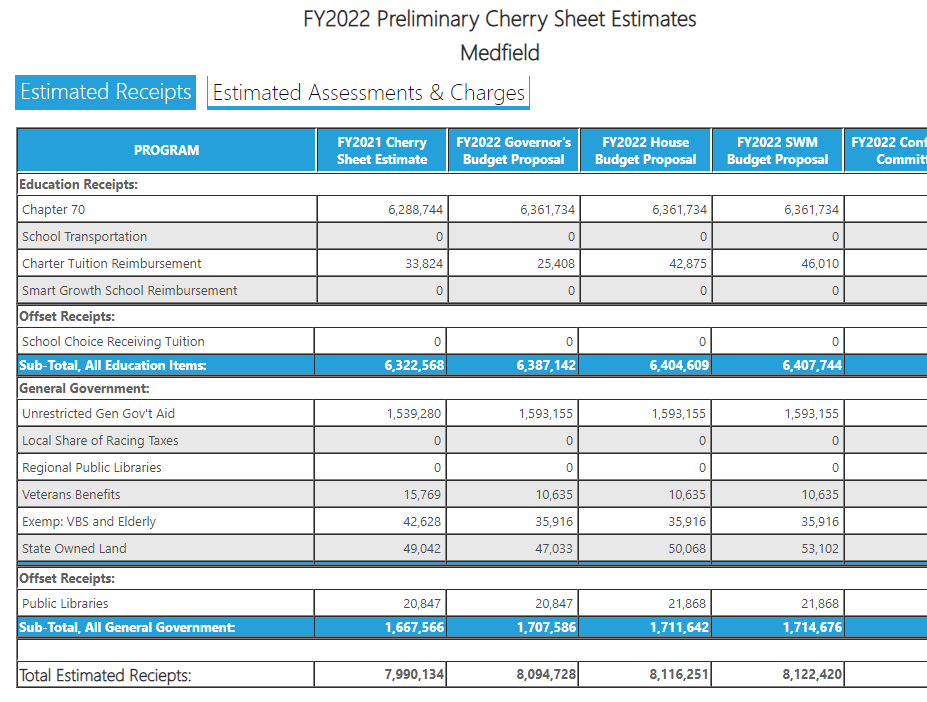

These state aide estimates are from the Division of Local Services (DLS) at the Massachusetts Department of Revenue. Next a conference committee has to reconcile the different amounts proposed by the legislature and the senate. –
Comments Off on Medfield’s FY2022 Preliminary Cherry Sheet Estimates show a $130K increase over last year
Posted in Budgets, Financial, Legislature, State
 |
| SENATE W&M COMMITTEE OFFERS $47.6B FY22 BUDGET WITH KEY INVESTMENTS IN MUNICIPAL & SCHOOL AID • INCLUDES THE FULL $39.5M INCREASE IN UGGA • INCREASES CHAPTER 70 BY $220M ABOVE FY21,FUNDING THE STUDENT OPPORTUNITY ACT ON SCHEDULE • INCREASES CHARTER SCHOOL REIMBURSEMENTS BY $31.7M• ADDS $46M FOR STUDENT ENROLLMENT AND SUMMER SCHOOL GRANTS • INCLUDES $389M TO FUND THE SPECIAL EDUCATION CIRCUIT BREAKER• ADDS $1M TO McKINNEY-VENTO REIMBURSEMENTS OVER FY21 •ADDS $4M TO PILOT May 11, 2021 Dear Osler Peterson, Earlier today, the Senate Ways & Means Committee advanced a $47.6 billion fiscal 2022 state budget plan to the full Senate for consideration later this month. The plan would increase overall state expenditures by 2.6% over the current year’s budget, and reflects a 4.3% increase over the Governor’s January budget proposal. The SW&M budget matches the 3.5% increase in Unrestricted General Government Aid (UGGA) in the Governor’s and House budgets, would significantly increase Chapter 70 school aid, and includes $40 million in a one-time grant program targeting student enrollment decline. The full Senate will start debate on the FY22 budget on Tuesday, May 25, and Senate members must file all budget amendments by 2 p.m. on Friday, May 14. The Senate usually considers over 1,000 amendments during budget debate week. The SW&M budget would increase funding for other major aid programs by adding $220 million to Chapter 70 aid over FY21; $37 million in additional funds for Charter School Mitigation payments, and an additional $1 million for McKinney-Vento transportation for homeless students. To acknowledge student enrollment declines due to the public health emergency, S. 3 would set aside $40 million in a one-time reserve account to assist districts impacted by the decline, as well as $6 million in one-time grant funding for summer school and student mental health support. The proposal would also provide an increase of $1 million for public libraries and $1 million for regional public libraries. S.3 also proposes a $4 million increase for the Payment-in-Lieu-of-Taxes (PILOT) for state-owned land account. Later Today or by the End of the Week, You Can Use This Link to See Your Community’s Local Aid and Preliminary Cherry Sheet Numbers in the Senate Ways & Means Budget, as Posted by the Division of Local Services You Can Link to the SW&M Committee’s Budget Here Chapter 70 The Senate Ways & Means budget would increase Chapter 70 aid by $220 million over FY21, bringing the total to $5.503 billion. S. 3 would fund the “goal rates” originally set forth in the Student Opportunity Act, which set a seven-year schedule that was to begin in FY21 but was sidelined last year due to the public health emergency. To get back on track, the MMA joined with other education advocates to ask the Legislature to fund Chapter 70 at an SOA implementation rate of one-sixth rather than one-seventh in order to return to the intended schedule. The House-Senate local aid agreement included a commitment to fund the Student Opportunity Act increases at one-sixth. S. 3 includes a one-time provision, introduced in the Governor’s budget and supported by the MMA, that would allow municipalities to use a portion of their school district’s Elementary and Secondary School Emergency Relief (ESSER II) federal grant award toward the increase from last year in their required local contribution. The House did not include this language. Rural School Aid Rural School Aid is funded at $3 million, reinserting an important account for rural school districts, especially those struggling with declining enrollment. The Governor funded this account at $1.5 million, half of the FY21 appropriation, and the House did not include the line item. Special Education Circuit Breaker S. 3 provides $387.9 million, including approximately $15 million funds carried over from the previous year, for the Special Education Circuit Breaker, reimbursing school districts for the high cost of educating students with disabilities at the statutorily required 75% reimbursement rate. This reimbursement rate, as well as the inclusion of costs associated with out-of-district transportation, reflect obligations outlined in the Student Opportunity Act. The total appropriation is higher than the budgets offered by the Governor and the House. Charter Schools To address charter school mitigation payments, S. 3 includes $149.1 million to reimburse school districts at 75%, the rate set forth in year one of the Student Opportunity Act implementation schedule, for costs incurred when students leave to attend charter schools, which is $5 million below the House budget. The MMA points out that charter school finance presents a major challenge to many districts, in a number of cases negating the increases districts realize in Chapter 70 aid. School Transportation The Senate Ways and Means budget decreases regional school transportation to $78.6 million. The House budget was higher at $82 million. The Senate Ways and Means budget would increase transportation for homeless students under McKinney-Vento by $1 million over FY21, to $14.4 million. Out-of-district vocational transportation is level-funded at $250,000. PILOT Funding Increased Recognizing the importance of Payments-in-Lieu-of-Taxes (PILOTS) for state-owned land, the Senate Ways & Means Committee increased the line item to $35 million (a $4 million increase over FY21). The Governor’s budget had recommended level-funding at $31 million; the House increased the account to $33 million. Underfunding PILOT over the years has created a significant hardship for smaller communities with large amounts of state-owned property. Shannon Grants, Cybersecurity, and Library Aid S. 3 includes level-funding for the Shannon grants for gang violence prevention and intervention, and includes critical funding for the Mass Cybersecurity Innovation Fund, which provides important outreach and training programs for municipalities. The accounts for public libraries and regional public libraries would each see an increase of $1 million, matching the House proposal. SUMMARY It is clear that Senate leaders are prioritizing K-12 funding, unrestricted municipal aid and other increases for cities and towns, as they advance an agenda to ensure stability during a time of uncertainty. The local funding aid agreement reached by the Joint Ways and Means Committee last month, including commitments to UGGA, Chapter 70, and the acknowledgement of school enrollment challenges, creates a more stable budget-setting process for cities and towns in the weeks and months ahead. This progress is deeply appreciated. During the budget debate and legislative session, the MMA will work to build on this progress, and will continue to advocate for full funding of the education funding priorities outlined in the Student Opportunity Act, fixing the serious problems caused by the current charter school system, securing higher Chapter 70 minimum aid increases, achieving full funding for all municipal and school reimbursement programs including transportation accounts, and providing higher PILOT funding. Please Call Your Senators Today to Thank Them for the Local Aid Investments in the Senate Ways and Means Committee Budget. Please Explain How the Senate Ways and Means Budget Would Impact Your Community, and Ask Your Senators to Build on this Progress During the Budget Debate. |
Comments Off on Senate W&M budget released
Posted in Budgets, Financial, Legislature, State
From DLS about the state aid for our current fiscal year that started 7/1/2020 –
Baseline FY21 UGGA and Chapter 70 Information Now Available
Dear Local Official,
I am writing to share that information about Fiscal Year 2021 (FY21) funding for Unrestricted General Government Aid (UGGA) and Chapter 70 education aid is now available on the Division of Local Services website.
While critical information from the federal government is still needed in order to finalize a full fiscal year budget for the Commonwealth, the Baker-Polito Administration and the Legislature are committing to no less than the Fiscal Year 2020 (FY20) level of funding for UGGA and Chapter 70 education aid as a baseline amount for FY21 funding.
The FY21 funding commitment also includes Chapter 70 increases for inflation and enrollment that will keep all school districts at foundation, under the law as it existed for FY20, providing an additional $107 million in aid over FY20. This increase comes in addition to approximately $450 million in new federal supports for K-12 schools to assist with educating students during the pandemic.
Please click here to view the UGGA and Chapter 70 amounts for each municipality. Local officials with related questions can email databank@dor.state.ma.us.
Sincerely,
Michael J. Heffernan
Secretary of Administration and Finance
Comments Off on DLS on state aid this year
Posted in Budgets, Legislature, State
From the Massachusetts Municipal Association this afternoon –

July 30, 2020
After months of uncertainty regarding the size of the state’s fiscal crisis, state leaders today announced a framework for protecting the two main sources of local aid in the state’s fiscal 2021 state budget. According to a statement issued by A&F Secretary Michael Heffernan, the Governor and Legislature are committing to no less than level funding of Unrestricted General Government Aid and Chapter 70 education aid as the baseline amount for fiscal 2021 funding for each community.
Because of the difficulty in projecting tax collections, unanswered questions about whether the federal government will provide fiscal relief, and the unknown impact that the coronavirus will have this fall, the Legislature has enacted a bill to continue with a temporary budget through October 31. The state had previously adopted a one-twelfth budget through July, and has added a 3-month extension. This will give lawmakers and the Administration more time to gather information and shape their budget plans.
Knowing that local officials need firm information on local aid and school funding in order to finalize their municipal budgets, the state’s top leaders have joined together to provide guidance to cities and towns, and the news is good for communities.
In an alert issued via the Division of Local Services, the Baker-Polito Administration announced that House and Senate leaders and the Governor would be protecting the two major local aid accounts, UGGA and Chapter 70, from cuts as they set the state’s fiscal 2021 budget later this fall.
They announced that the $1.13 billion Unrestricted General Government Aid (UGGA) program will be level funded at fiscal 2020 amounts for all communities, and that all cities and towns will receive at least level funding of their Chapter 70 education aid. Some school districts will receive school aid increases due to inflation and enrollment under the current formula. In total, Chapter 70 school aid will increase by $107 million, bringing that account up to $5.28 billion.
Local officials with questions about the numbers can email DLS at databank@state.ma.us.
The Governor-House-Senate framework closely matches the MMA’s request to state leaders, which the association delivered earlier this week. MMA has asked state leaders to protect local aid from cuts by preserving aid at fiscal 2020 levels at a minimum.
Please click here to read MMA’s July 27 letter to state leaders.
MMA immediately applauded the local aid framework, issuing the following statement:
“This is very welcome news for cities and towns in every corner of Massachusetts. With the state facing a budget shortfall of between $6 billion to $8 billion due to the COVID-19 recession, local leaders have been very concerned about the potential impact on local aid. Today, the Governor, House and Senate have demonstrated that the state-local relationship is a true partnership. “By protecting local aid during this crisis, the state will maintain vital financial support for cities and towns. With this key financial guidance, communities can finalize their fiscal 2021 budgets, allowing them to continue their work fighting the coronavirus pandemic and delivering the essential quality-of-life services that drive our economy. This framework will benefit every resident and business in the Commonwealth, and we are deeply grateful to Governor Baker and Lt. Governor Polito, Speaker DeLeo, President Spilka, House and Senate Budget Chairs Michlewitz and Rodrigues, and their colleagues in the Legislature.”
Comments Off on State aid level funded
Posted in Budgets, Legislature, State

I attended at noon today a meeting of the Massachusetts Municipal Association’s Massachusetts Select Board Association (NB – MSA changed its name this year from “Selectmen”). Bleak news about the state budget and the financial aid we will get from the state next fiscal year starting July 1 – may be down 20% this coming year. The legislative delegation is coming to the Select Board meeting next Tuesday to personally share the bad news.
The only good news was at the end of this slide –
State Revenue and Budget Outlook
• Legislature has Announced that the Fiscal 2021 Budget Process is Delayed
• Administration & Legislative Budget Writers Held New Revenue
Hearing to Revisit Revenue Forecast, with $4B to $6B Shortfall Estimated
• State Budget Process Unclear (Joint Budget? Temporary Budgets?)
• GOOD NEWS … $3.5 Billion in the State Rainy Day Fund should Help to
Mitigate Fiscal 2020 Revenue Shortfalls (and Increased Expenditures)
• GOOD NEWS … Massachusetts Received $2.67 Billion from the Federal
CARES Act to Pay for Unexpected/Unbudgeted COVID-19 Expenses
Comments Off on MMA Zoom meeting
Posted in Budgets, Financial, Legislature, State
Legislature Enacts Bill to Facilitate Municipal Governance and Budgeting During COVID-19 EmergencyGovernor to Sign the Bill Today
April 3, 2020
Last night, the House and Senate enacted a key bill to assist cities and towns with a broad range of governance and budgeting issues during the COVID-19 emergency. This act has an emergency preamble, and will take effect immediately when signed by the Governor, which is expected today. The MMA worked closely with lawmakers and the Baker-Polito Administration on these measures, and deeply appreciates the passage of these important provisions.
The Division of Local Services will have a major role in implementing the finance provisions in the bill, and will be issuing a Bulletin to cities and towns with further details within the coming days. DLS has been a key source of information and guidance during the emergency, and MMA appreciates all of their efforts.
Please click here to download the text of the bill: |
|
The following is MMA’s summary of the key sections of An Act to Address Challenges Faced by Municipalities and State Authorities Resulting from COVID-19:
|
Comments Off on MMA on virus legislation
Posted in health, Legislature, Massachusetts Municipal Association, State
Email today from Representative Denise C. Garlick –
Dear Friends-
I hope that you and all you love are having a wonderful start to 2020. As the State Representative for the 13th Norfolk District, it is an honor to represent the people of Needham, Dover and Medfield and I am proud of our Towns and our Commonwealth.
I am writing to invite you to an annual Report to the Community
which I will present at the
Medfield Public Safety Building
on Thursday, January 30, 2020 from 7:15 – 8:30 PM.
The main topics will be a review of the work and events of 2019, and a preview of 2020.
The evening’s schedule will include a Reception (7:15-7:30), Report (7:30-8:00), and Questions and Discussion (8:00-8:30).
I hope you will be able join us. Please do not hesitate to contact me with any question or concern. With your support, I look forward to continuing this work.
Sincerely,
Denise
Denise C. Garlick
State Representative
Comments Off on Rep. Garlick’s Report to the Community is 1/30
Posted in Information, Legislature, State

Hi Pete.
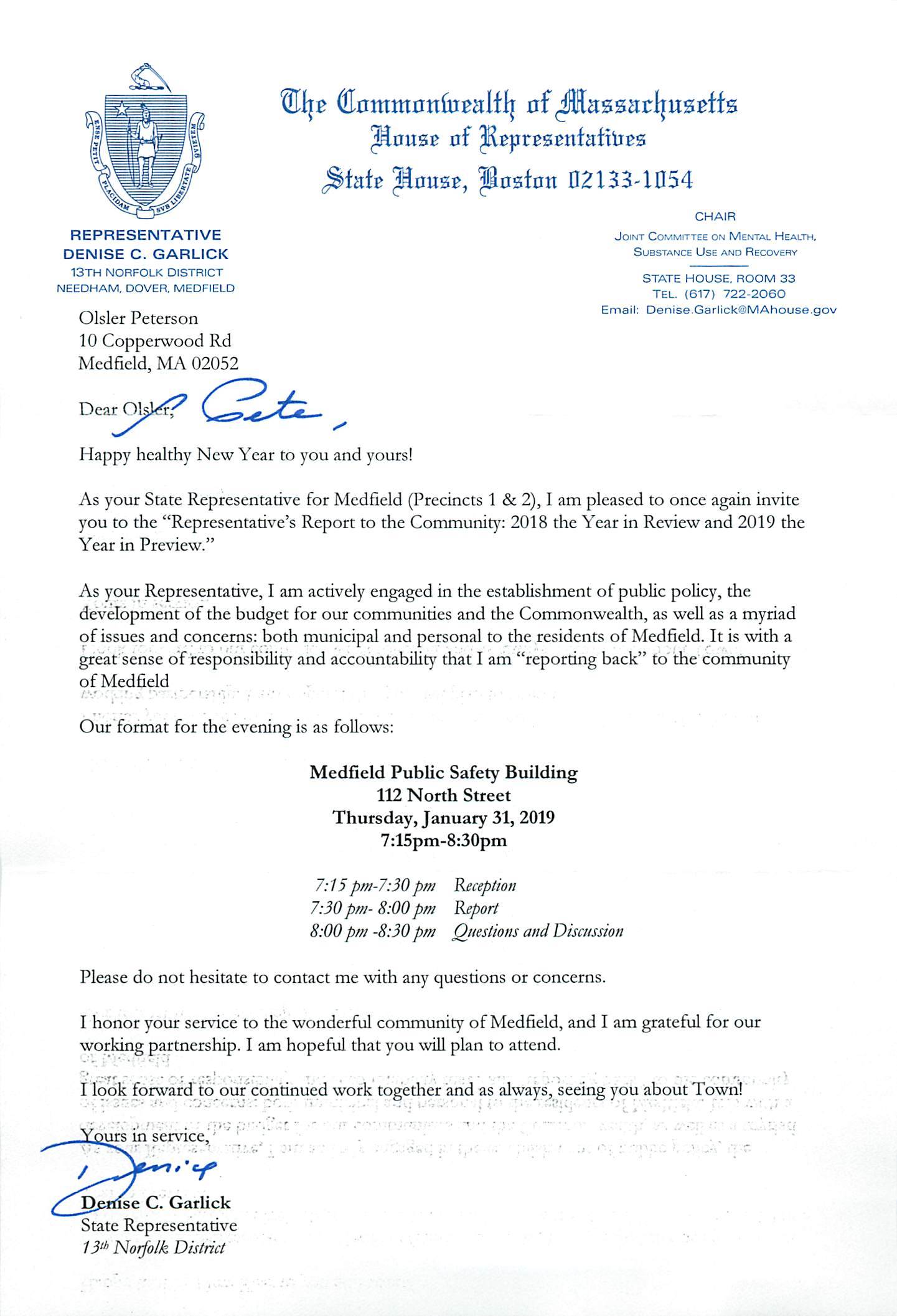
I hope this finds you well! As you may know, Rep. Garlick’s Report to the Community is coming up on Thursday, January 31st.
Please feel free to share this on your blog if you would like! A flyer is attached for your convenience and here is the information:
All are welcome to Representative Garlick’s annual Report to the Medfield Community Thursday, January 31, 2019 from 7:15 – 8:30 PM at the Medfield Public Safety Building.
The main topics will be a review of the work and events of 2018, and a preview of 2019.
The evening’s schedule will include:
Additional Information available at DeniseGarlick.com and by contacting Rep. Denise Garlick, State House, 617-722-2200, Boston, MA.
Anne Weinstein
District Director
Office of Representative Denise C. Garlick
State House, Room 33
Boston, MA 02133
617-722-2060
Comments Off on Rep. Garlick invites all to her report on 1/31
Posted in Information, Legislature, State
The Massachusetts Municipal Association holds legislative breakfasts to allow municipal officials to interact with their legislators. I attended one this morning at the Christa McAuliffe Library in Framingham and the room was chock full of metrowest legislators.
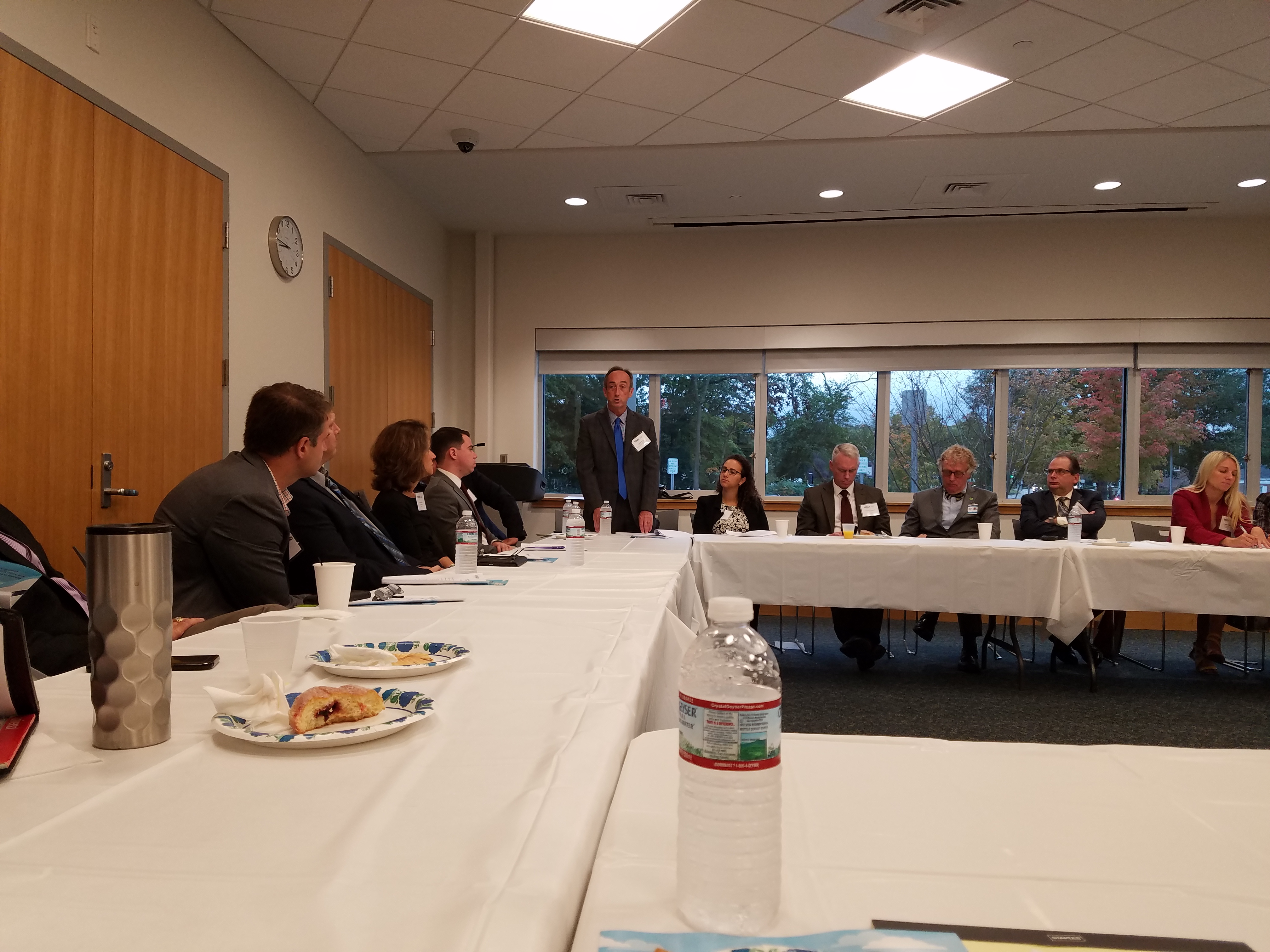
I now see that my water bottle had prime placement. The photo shows about a third of the attendees.
To my left was Representative Bruce Linsky (Natick and Sherborn) who said that Natick and Wellesley are being deluged by Open Meeting Law requests by some gadfly who is taking up way too much time of the town hall workers, and that some corrective legislative action will be needed. I asked him to include allowing we selectmen to communicate by email on platforms where all our emails would appear in an on-line page in the town’s website, similar to a posted meeting, but the use of the emails would allow more efficient handling of the town’s business and the public could read the entire exchange (similar to listening to an in person meeting).
Senator Eldridge, to Linsky’s left, reported that:
Senator Hannah Kim talked about need for more parking at transportation (MBTA) sites and proposing an income tax deduction for farmers who donate produce that alleviates food insecurity.
Rep. Carmen Gentile (Sudbury) is seeking to make the home rule action that allowed Sudbury to give real estate property tax relief to its seniors for the past three years to any town that wants to opt in. BTW, I called and got that Sudbury material and I will organize and share it soon.
Lexington Selectman Michelle Ciccola, who is soon to be a state rep., wants to see the Massachusetts Community Preservation Act (CPA) to get better funded.
Rep. Kate Hogan was concerned about a litany of issues, and I mainly noted about transportation.
Our own Rep. Denise Garlick was not there, but was represented by Anne Weinstein, her Director of Constituent Services (out of the frame to the right).
Selectman Dan Matthews of Needham and I both told the legislators that towns need more revenue. I shared my idea to have the auto excise tax be based on the car’s fair market value, which would likely triple our ca. $2 m. revenues (the statute mandates a steep decline in the car values by year).
Comments Off on MMA legislative breakfast
Posted in Legislature, Massachusetts Municipal Association, Select Board matters
This today from the Massachusetts Municipal Association, with a good summary of the state budget issues –
June 7, 2018
Dear Osler Peterson,
Now that the House and Senate have each passed their own versions of next year’s fiscal 2019 state budget, the next step is for a conference committee to iron out the differences and present a balanced budget for adoption by July 1.
While both budgets would increase municipal and school aid, there are significant differences between the branches, especially in funding for essential K-12 education accounts. It is imperative that you contact your legislators today and ask them to support the full appropriations, and make municipal and education aid a top priority.
Earlier this morning, the MMA delivered a detailed letter to the conference committee emphasizing the key local aid accounts that need to be funded at the highest possible level. Please call your legislators today and ask them to support the highest possible funding amounts for these municipal and school aid programs.
The House and Senate budgets would both add to the municipal and school aid recommendations made by the governor in January, which is good news. When you talk with your local legislators, please thank them for making local aid a priority during the budget process this year, and ask that they contact conference committee members in support of the highest possible funding for municipal and school aid.
Millions of dollars are at stake: if the conference committee agrees on full funding by adopting the higher number for municipal and school aid accounts, this would return over $75 million more to cities and towns, compared to the funding that would result from adopting the lower number.
Here is a summary of the key priorities for cities and towns:
Unrestricted General Government Aid (UGGA)
The House and Senate both appropriated $1.099 billion for the Unrestricted General Government Aid (UGGA) account, an increase of $37.2 million over the fiscal 2018 level of funding. The 3.5 percent increase reflects the policy of increasing general municipal aid at the rate of growth in state tax collections reflected in the consensus tax forecast. This policy has been adopted by the Governor and the House and Senate since fiscal 2016, and is supported by the MMA. The good news is that the $37.2 million UGGA increase has already been agreed to by the House and Senate!
Chapter 70 School Aid and Local Contributions
The House funds the basic requirements of Chapter 70 education aid (7061-0008 and section 3), adopts provisions to continue to implement the recommendations of the Foundation Budget Review Commission, phases in target share funding for those communities where the local contribution exceeds the target share amount, and funds minimum aid at $30 per student. This would provide a Chapter 70 increase of $124.6M – which is significantly higher than the $103.6M increase in the governor’s budget proposal.
The Senate budget builds on the House approach by closing 100% of the target share gap and establishing an enhanced English language learner (ELL) foundation budget factor. These two changes would provide a Chapter 70 increase of $160.6M, or $36M more than the House. The MMA is supporting the Senate funding level.
Both the House and Senate would supplement Chapter 70 by providing $12.5 million to provide assistance to communities impacted by changes in how low-income students are counted. They do this in different accounts. What matters is that the final budget maintain the $12.5 million.
Special Education Circuit Breaker
Please ask your legislators to support the Senate’s full funding of the Special Education Circuit Breaker Program at $319.3 million, through which the state provides a measure of support for services provided to high-cost special education students. This is critically important.
Charter School Impact Mitigation Payments
Please ask your legislators to support the Senate appropriation of $100 million for Charter School Impact Mitigation Payments (7061-9010). This reflects an increase of $19.5 million above the current fiscal 2018 level of funding. This is a vital account for those communities impacted by charter schools.
Charter School Impact Analysis and Accountability
Please ask your legislators to support sections 61 and 62 in the Senate bill, which would bring a much-needed level of accountability related to state decisions to approve new and expanded charter schools that would include an assessment of the impact on local public schools.
Regional School District Student Transportation
Please ask your legislators to support the Senate appropriation of $68.9 million to reimburse regional school districts for a portion of the cost of transporting students.
McKinney-Vento Homeless Student Transportation
Please ask your legislators to support the House appropriation of $9.1 million for this account to reimburse municipalities and school districts for a portion of the cost of transporting homeless students as required under state and federal rules.
Payment in Lieu of Taxes on State-owned Land
Please support the Senate appropriation of $28.5 million to pay a portion of the payment-in-lieu-of taxes amount due to cities and towns to offset the property tax exemption for state-owned land. We support the additional $1.7 million set aside in the Senate appropriation language to ensure that Cherry Sheet PILOT payments next year are not reduced below the fiscal 2018 level due to the revaluation of state-owned land that takes effect next year.
Shannon Anti-Gang Grant Program
Please support the Senate level of funding of $8 million for the highly effective and valuable Shannon Anti-Gang Grant Program that has helped cities and towns respond to and suppress gang-related activities.
Reserve Fund for Municipal Improvements
Please support the House appropriation that would provide $2.8 million for the District Local Technical Assistance Fund (DLTA) that helps support local efforts to regionalize local government services. Please support the Senate appropriation that includes $2 million to support the Community Compact Cabinet program to facilitate the adoption of municipal best practices in cities and towns.
Community Preservation Act
Please support sections 45, 46, 47, 142, 143 and 196 of the Senate bill which would strengthen the Community Preservation Act (CPA) by updating the Registry of Deeds fee schedule to provide adequate revenue to restore the state match to an estimated 30 percent.
Municipal Police Training Fund
Please support sections 13, 14, and 70 in the Senate bill that would create a $2 surcharge on each rental car transaction in the Commonwealth to help fund an expanded police training program.
If you have any questions or need additional information, please contact MMA Legislative Director John Robertson at 617-426-7272 ext. 122 or jrobertson@mma.org.
Thank you very much!
Comments Off on MMA on state budget
Posted in Budgets, Financial, Legislature, Massachusetts Municipal Association, State
Medfield Select Board member
I started this blog to share the interesting and useful information that I saw while doing my job as a Medfield select board member. I thought that my fellow Medfield residents would also find that information interesting and useful as well. This blog is my effort to assist in creating a system to push the information out from the Town House to residents. Let me know if you have any thoughts on how it can be done better.
For information on my other job as an attorney (personal injury, civil litigation, estate planning and administration, and real estate), please feel free to contact me at 617-969-1500 or Osler.Peterson@OslerPeterson.com.
 | pmdunner on Crosswalks & Sidewalks at… |
 | EILEEN DESORGHER on Vote Djuna Perkins for DA |
 | Amy Cohen on Delineator Flexposts – t… |
 | Zach on Warrant Committee’s slid… |
 | Donna Knott on Reading for “Read Across… |


