Posted onOctober 25, 2021|Comments Off on HOUSE BUDGET COMMITTEE ANNOUNCES $3.65B SPENDING PLAN FOR ARPA AND STATE SURPLUS
From the Massachusetts Municipal Association this afternoon –
HOUSE BUDGET COMMITTEE ANNOUNCES $3.65B SPENDING PLAN FOR ARPA AND STATE SURPLUS
October 25, 2021
Dear Osler Peterson,
Today, the House Committee on Ways and Means announced a $3.65 billion spending plan that draws from two revenue sources: the state’s multi-billion dollar fiscal 2021 surplus and its allocation from the American Rescue Plan Act’s State and Local Coronavirus Relief Fund.
The House proposal (H. 4219) targets seven major categories: housing, environment and climate change mitigation, economic development, workforce, health and human services, education, and food insecurity. House members have until 3 p.m. on Tuesday to file amendments, and debate is scheduled to begin on Thursday. After the House approves its proposal, the Senate is expected to offer its own bill in the coming weeks.
The following are the highlights of H. 4219:
Housing The $600 million proposed for housing programs includes targeted investments in supportive housing production, public housing maintenance, homeownership assistance, the CommonWealth Building Program, and affordable housing production.
Environment and climate The bill includes $350 million for environmental infrastructure and development spending, with a focus on environmental justice communities. Targeted investments include Marine Port Development and Offshore Wind, environmental infrastructure projects aimed at bolstering communities’ climate resiliency, water and sewer infrastructure improvements, greening the Gateway Cities, and upgrades to state parks and recreational facilities. Of the $350 million, $100 million would go to low-income, environmental justice and urban communities to improve climate resiliency. A $100 million water and sewer infrastructure component also prioritizes projects that support environmental justice populations and those disproportionately impacted by the public health emergency.
Economic development With $777 million allocated for economic development, the House proposal includes a $500 million investment in the Unemployment Trust Fund, aid for the recovery of the cultural sector of the economy through the Massachusetts Cultural Council, funding for the YouthWorks summer jobs program, tax relief for small businesses, and money to help close the digital divide and assist in the resettlement of Afghan refugees.
Workforce The bill would focus $750 million on workforce issues, including $500 million for premium pay bonuses for essential workers who worked in-person during the state of emergency, as well as funds for the Workforce Competitive Trust Fund and career technical institutes and vocational schools.
Health and human services The bill targets relief for financially strained providers, such as hospital and nursing facilities, and investments in workforce initiatives, behavioral health programs, technical infrastructure for community health center improvements, prison reentry grants, and community-based violence prevention.
Education The House proposal seeks to address disparities in public school facilities, including $100 million for HVAC grants to be distributed through the Department of Elementary and Secondary Education under the guidance of the Racial Imbalance Advisory Council. Additional education investments include higher education capital projects, the endowment incentive program, special education needs, and pathways to educator licensure for Black, indigenous, and people of color.
Food insecurity The bill includes $78 million to address food insecurity, focusing on infrastructure grants.
Massachusetts Municipal Association 3 Center Plaza Suite 610 Boston, MA 02108 (617) 426-7272 | Email Us | View our websiteUnsubscribe from MMA Legislative Alert Emails
Comments Off on HOUSE BUDGET COMMITTEE ANNOUNCES $3.65B SPENDING PLAN FOR ARPA AND STATE SURPLUS
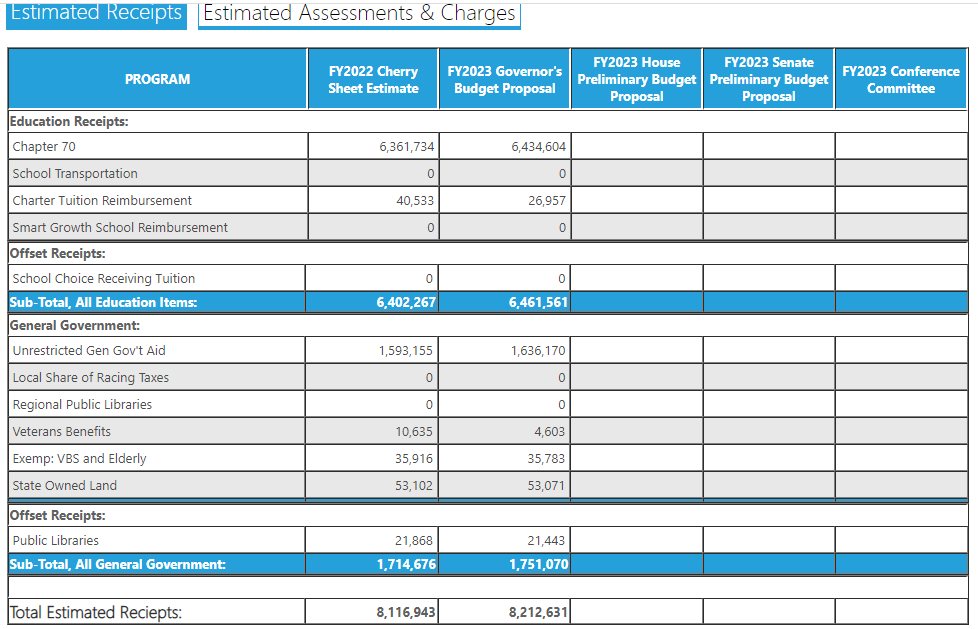
Posted onJuly 12, 2021|Comments Off on State $ support to Medfield up $127K next year
Email received today from the Division of Local Services (DLS), a part of the Massachusetts Department of Revenue:
+++++++++++++++++++++++++++++++++++++++++++++
FY2022 Preliminary Cherry Sheets Estimates
The FY2022 Conference Committee Report was released on Thursday July 8th and approved by both the House of Representatives and Senate Friday July 9th. As a result, DLS has updated the preliminary cherry sheet estimates to reflect these new funding levels. The preliminary cherry sheets can be found on the DLS website.
Click here for Preliminary Municipal Cherry Sheet Estimates or here for Preliminary Regional Cherry Sheet Estimates.
If you have any questions about the preliminary estimates, please contact the Data Analytics and Resources Bureau at databank@dor.state.ma.us.
Comments Off on State $ support to Medfield up $127K next year
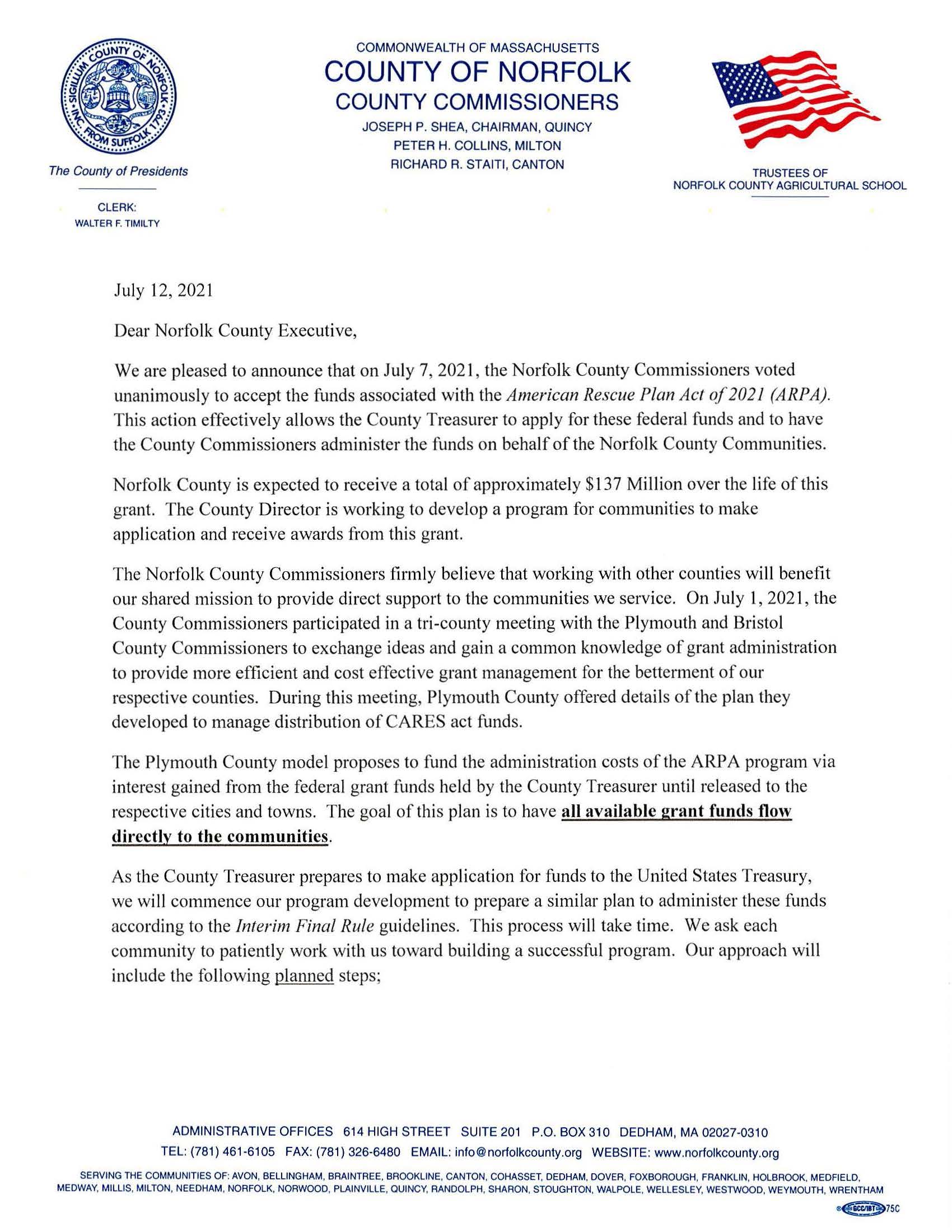
Posted onJuly 12, 2021|Comments Off on County on our ARPA monies
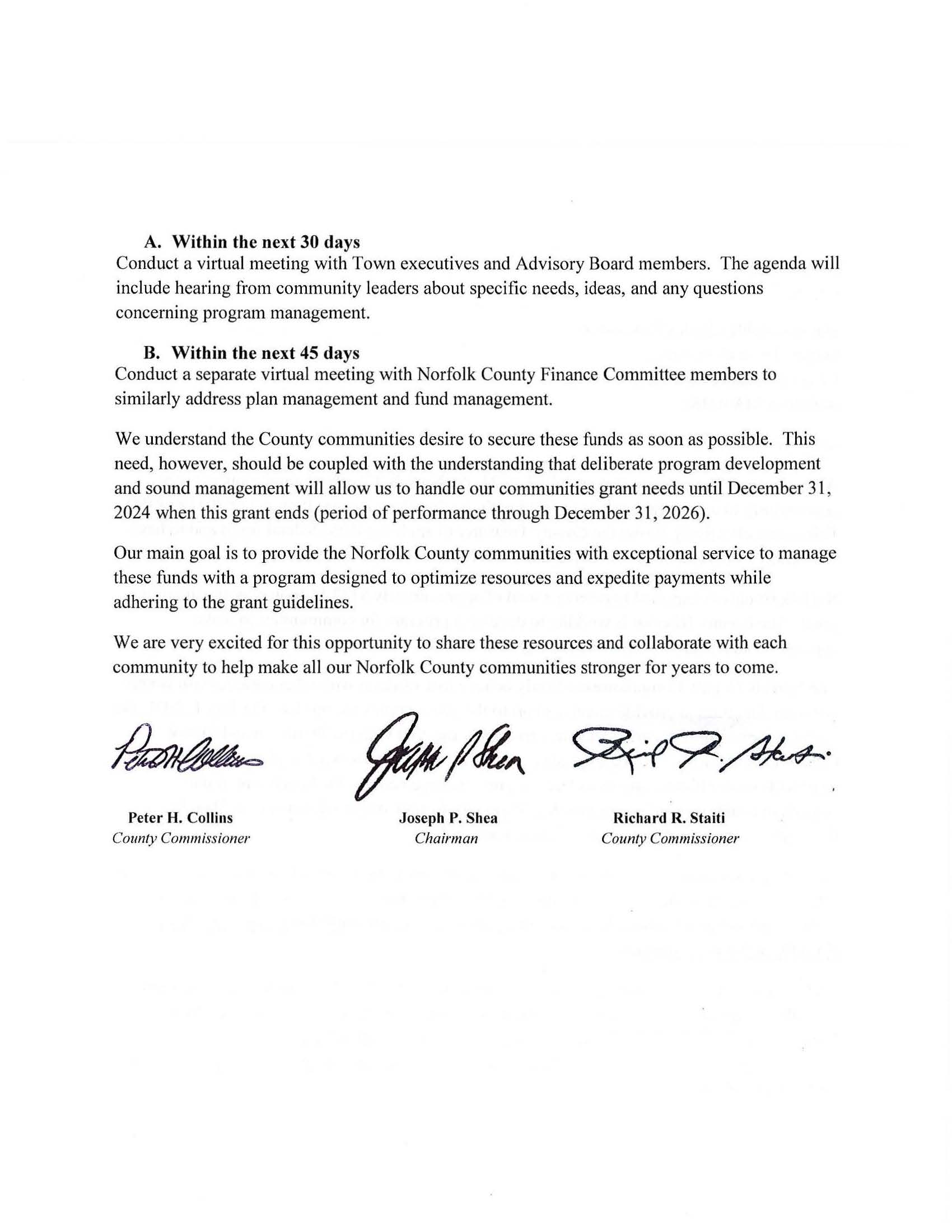
This from the County Commissioners. It is not clear to me how much they intend to administer our ARPA monies, versus just paying us our ARPA monies. Reading the 2024 and 2026 dates causes me some concern about their planned level and length of involvement.
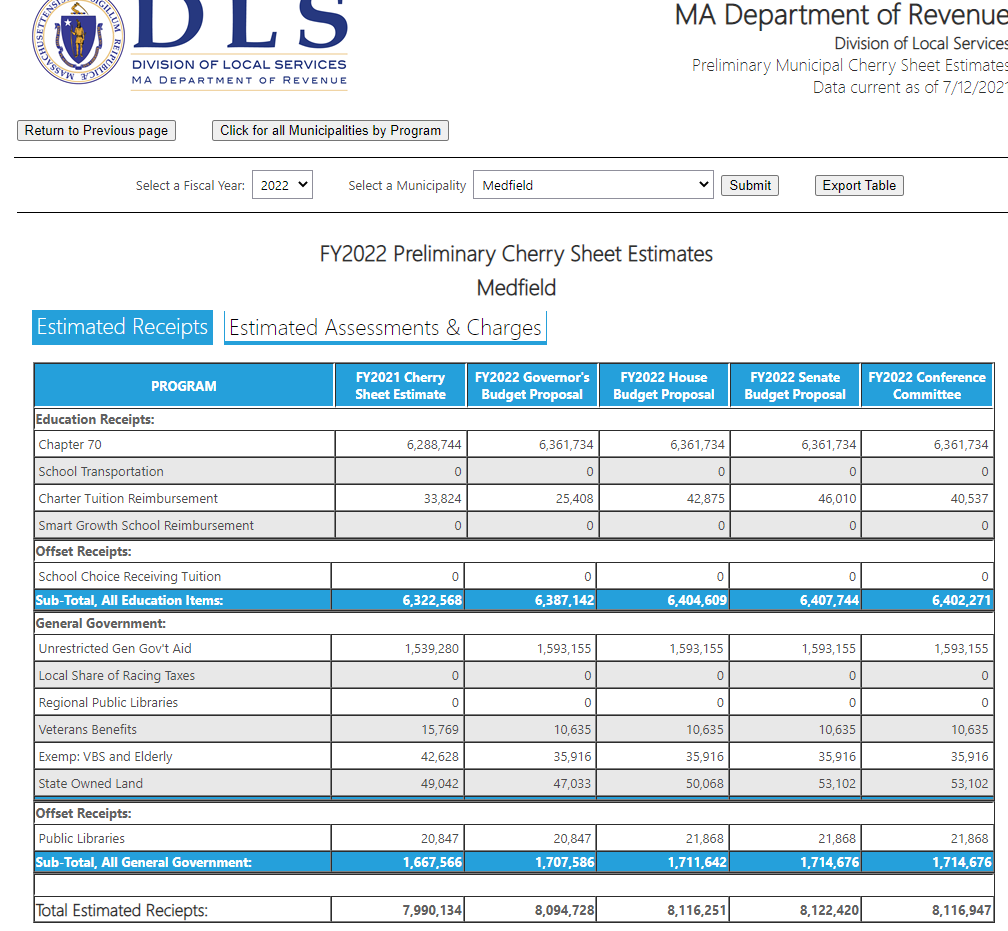
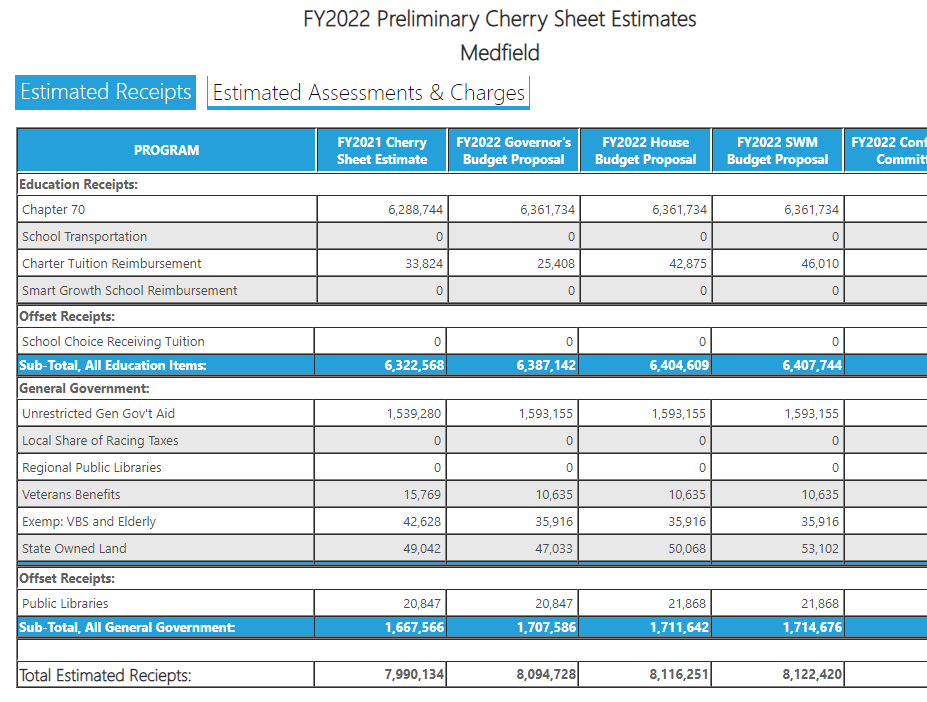
Posted onMay 13, 2021|Comments Off on Medfield’s FY2022 Preliminary Cherry Sheet Estimates show a $130K increase over last year
These state aide estimates are from the Division of Local Services (DLS) at the Massachusetts Department of Revenue. Next a conference committee has to reconcile the different amounts proposed by the legislature and the senate. –
Comments Off on Medfield’s FY2022 Preliminary Cherry Sheet Estimates show a $130K increase over last year
Posted onMay 11, 2021|Comments Off on Senate W&M budget released
SENATE W&M COMMITTEE OFFERS $47.6B FY22 BUDGET WITH KEY INVESTMENTS IN MUNICIPAL & SCHOOL AID
• INCLUDES THE FULL $39.5M INCREASE IN UGGA • INCREASES CHAPTER 70 BY $220M ABOVE FY21,FUNDING THE STUDENT OPPORTUNITY ACT ON SCHEDULE • INCREASES CHARTER SCHOOL REIMBURSEMENTS BY $31.7M• ADDS $46M FOR STUDENT ENROLLMENT AND SUMMER SCHOOL GRANTS • INCLUDES $389M TO FUND THE SPECIAL EDUCATION CIRCUIT BREAKER• ADDS $1M TO McKINNEY-VENTO REIMBURSEMENTS OVER FY21 •ADDS $4M TO PILOT
May 11, 2021
Dear Osler Peterson,
Earlier today, the Senate Ways & Means Committee advanced a $47.6 billion fiscal 2022 state budget plan to the full Senate for consideration later this month. The plan would increase overall state expenditures by 2.6% over the current year’s budget, and reflects a 4.3% increase over the Governor’s January budget proposal. The SW&M budget matches the 3.5% increase in Unrestricted General Government Aid (UGGA) in the Governor’s and House budgets, would significantly increase Chapter 70 school aid, and includes $40 million in a one-time grant program targeting student enrollment decline.
The full Senate will start debate on the FY22 budget on Tuesday, May 25, and Senate members must file all budget amendments by 2 p.m. on Friday, May 14. The Senate usually considers over 1,000 amendments during budget debate week.
The SW&M budget would increase funding for other major aid programs by adding $220 million to Chapter 70 aid over FY21; $37 million in additional funds for Charter School Mitigation payments, and an additional $1 million for McKinney-Vento transportation for homeless students. To acknowledge student enrollment declines due to the public health emergency, S. 3 would set aside $40 million in a one-time reserve account to assist districts impacted by the decline, as well as $6 million in one-time grant funding for summer school and student mental health support. The proposal would also provide an increase of $1 million for public libraries and $1 million for regional public libraries. S.3 also proposes a $4 million increase for the Payment-in-Lieu-of-Taxes (PILOT) for state-owned land account.
The Senate Ways & Means budget would increase Chapter 70 aid by $220 million over FY21, bringing the total to $5.503 billion. S. 3 would fund the “goal rates” originally set forth in the Student Opportunity Act, which set a seven-year schedule that was to begin in FY21 but was sidelined last year due to the public health emergency. To get back on track, the MMA joined with other education advocates to ask the Legislature to fund Chapter 70 at an SOA implementation rate of one-sixth rather than one-seventh in order to return to the intended schedule. The House-Senate local aid agreement included a commitment to fund the Student Opportunity Act increases at one-sixth. S. 3 includes a one-time provision, introduced in the Governor’s budget and supported by the MMA, that would allow municipalities to use a portion of their school district’s Elementary and Secondary School Emergency Relief (ESSER II) federal grant award toward the increase from last year in their required local contribution. The House did not include this language.
Rural School Aid Rural School Aid is funded at $3 million, reinserting an important account for rural school districts, especially those struggling with declining enrollment. The Governor funded this account at $1.5 million, half of the FY21 appropriation, and the House did not include the line item.
Special Education Circuit Breaker S. 3 provides $387.9 million, including approximately $15 million funds carried over from the previous year, for the Special Education Circuit Breaker, reimbursing school districts for the high cost of educating students with disabilities at the statutorily required 75% reimbursement rate. This reimbursement rate, as well as the inclusion of costs associated with out-of-district transportation, reflect obligations outlined in the Student Opportunity Act. The total appropriation is higher than the budgets offered by the Governor and the House.
Charter Schools To address charter school mitigation payments, S. 3 includes $149.1 million to reimburse school districts at 75%, the rate set forth in year one of the Student Opportunity Act implementation schedule, for costs incurred when students leave to attend charter schools, which is $5 million below the House budget. The MMA points out that charter school finance presents a major challenge to many districts, in a number of cases negating the increases districts realize in Chapter 70 aid.
School Transportation The Senate Ways and Means budget decreases regional school transportation to $78.6 million. The House budget was higher at $82 million. The Senate Ways and Means budget would increase transportation for homeless students under McKinney-Vento by $1 million over FY21, to $14.4 million. Out-of-district vocational transportation is level-funded at $250,000.
PILOT Funding Increased Recognizing the importance of Payments-in-Lieu-of-Taxes (PILOTS) for state-owned land, the Senate Ways & Means Committee increased the line item to $35 million (a $4 million increase over FY21). The Governor’s budget had recommended level-funding at $31 million; the House increased the account to $33 million. Underfunding PILOT over the years has created a significant hardship for smaller communities with large amounts of state-owned property.
Shannon Grants, Cybersecurity, and Library Aid S. 3 includes level-funding for the Shannon grants for gang violence prevention and intervention, and includes critical funding for the Mass Cybersecurity Innovation Fund, which provides important outreach and training programs for municipalities. The accounts for public libraries and regional public libraries would each see an increase of $1 million, matching the House proposal.
SUMMARY It is clear that Senate leaders are prioritizing K-12 funding, unrestricted municipal aid and other increases for cities and towns, as they advance an agenda to ensure stability during a time of uncertainty. The local funding aid agreement reached by the Joint Ways and Means Committee last month, including commitments to UGGA, Chapter 70, and the acknowledgement of school enrollment challenges, creates a more stable budget-setting process for cities and towns in the weeks and months ahead. This progress is deeply appreciated. During the budget debate and legislative session, the MMA will work to build on this progress, and will continue to advocate for full funding of the education funding priorities outlined in the Student Opportunity Act, fixing the serious problems caused by the current charter school system, securing higher Chapter 70 minimum aid increases, achieving full funding for all municipal and school reimbursement programs including transportation accounts, and providing higher PILOT funding.
Please Call Your Senators Today to Thank Them for the Local Aid Investments in the Senate Ways and Means Committee Budget.
Please Explain How the Senate Ways and Means Budget Would Impact Your Community, and Ask Your Senators to Build on this Progress During the Budget Debate.
Posted onApril 14, 2021|Comments Off on State budget clears House
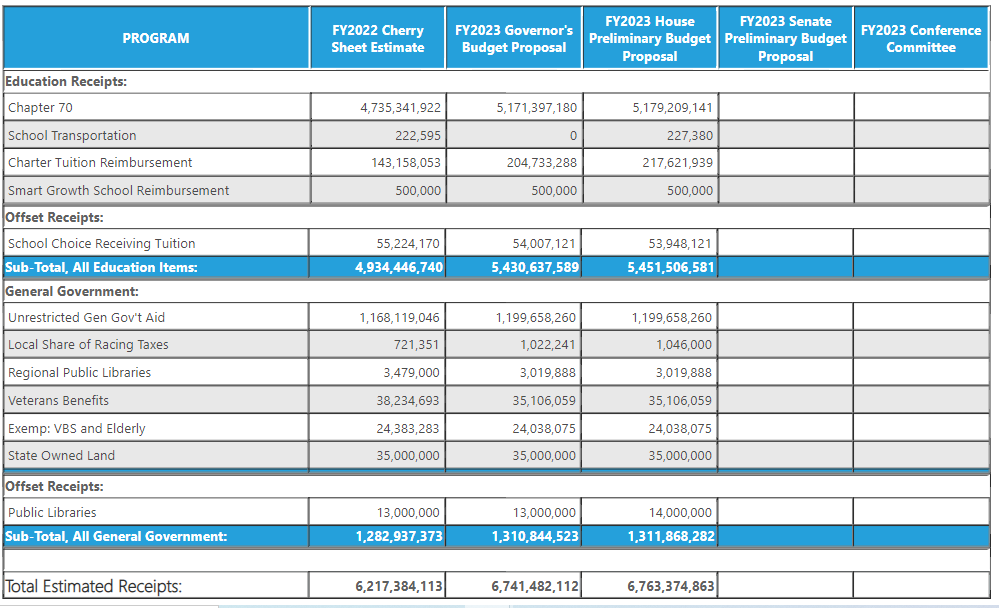
Medfield’s #s in the budget proposal –
Contact Your Legislator Today!
HOUSE W&M COMMITTEE OFFERS $47.65B FY22 BUDGET WITH KEY INVESTMENTS IN MUNICIPAL & SCHOOL AID• INCLUDES THE FULL $39.5M INCREASE IN UGGA• INCREASES CHAPTER 70 BY $21M ABOVE GOV’S BUDGET TO FUND THE STUDENT OPPORTUNITY ACT ON SCHEDULE• INCREASES CHARTER SCHOOL REIMBURSEMENTS BY $37M• ADDS $55M FOR STUDENT ENROLLMENT AND SUMMER SCHOOL GRANTS• INCLUDES $367M TO FUND THE SPECIAL EDUCATION CIRCUIT BREAKER• RESTORES $6M TO LEVEL FUND REGIONAL SCHOOL TRANS. AT FY21 LEVEL• ADDS $1M TO McKINNEY-VENTO REIMBURSEMENTS OVER FY21•ADDS $2M TO PILOT
April 14, 2021
Dear Osler Peterson,
Earlier today, the House Ways & Means Committee advanced a $47.65 billion fiscal 2022 state budget plan to the full House for consideration later this month. The plan would increase overall state expenditures by 2.6 percent over the current year’s budget, and reflects a 3.9 percent increase over the Governor’s January budget proposal. The HW&M budget matches the 3.5% increase in Unrestricted General Government Aid (UGGA) in the Gov’s budget, adds a significant increase to Chapter 70 school aid and Charter School reimbursements, and includes $55 million in important new grant programs.
The full House will start debate on the FY22 budget on April 26, and House members must file all budget amendments by 5:00 p.m. on Friday, April 16. The House usually considers over 1000 amendments during budget debate week.
H. 4000, the House Ways & Means budget, provides progress on many important local aid priorities, including the full $39.5 million increase in Unrestricted General Government Aid that the Governor proposed and communities are counting on. The House Ways & Means budget also mirrors the Governor’s proposed increase for Special Education Circuit Breaker, with an increase over FY 2021 of $22.5 million.
The HW&M budget would increase funding for other major aid programs, by adding $21 million to Chapter 70 aid above the House One recommendation, for a total increase of $219 million; $37 million in additional funds for Charter School Mitigation payments, and an additional $1 million for McKinney-Vento transportation for homeless students. To acknowledge student enrollment declines due to the public health emergency, H. 4000 would set aside $40 million in a one-time reserve account to assist districts impacted by the decline, as well as $15 million in one-time grant funding for summer school and student mental health support. The proposal would also provide an increase of $1 million for public libraries and $1 million for regional public libraries. H. 4000 also proposes a $2 million increase for the Payment-in-Lieu of Taxes (PILOT) for state-owned land account.
$39.5 MILLION INCREASE IN UNRESTRICTED MUNICIPAL AID
In January, the Administration kept its commitment to cities and towns to tie the increase in Unrestricted General Government Aid to the projected rate of growth in state tax revenues. This year, that increase was 3.5%, representing an increase of $39.5 million. The House Ways and Means FY 2022 plan would provide $1.168 billion for UGGA, reflecting the same increase proposed by Governor Baker. In a statement released by the Chairs of the Joint Ways and Means Committee last week, the two chambers have reached an agreement on this amount and every city and town will see their UGGA funding increase by 3.5%. This is welcome news to provide stability and predictability in municipal budgeting.
CHAPTER 70 AID RETURNS TO ORIGINAL STUDENT OPPORTUNITY ACT SCHEDULE
The House budget committee is proposing a $219 million increase in Chapter 70 education aid ($21 million higher than the $197.7 million increase in H. 1), which would fund the “goal rates” originally set forth in the Student Opportunity Act. The SOA schedule set a 7-year schedule beginning in FY 2021, but that was sidelined last year due to the public health emergency. To get back on track, the MMA joined with other education advocates to ask the Legislature to fund Chapter 70 at an SOA implementation rate of 1/6th rather than 1/7th in order to return to the intended schedule. Last week, House and Senate leaders reached a local aid funding agreement, which included this commitment to fund the increases in the SOA at 1/6th, funding Chapter 70 at a total of $5.503 billion. While this is important progress for districts, most districts remain at minimum aid.
CHARTER SCHOOL MITIGATION PAYMENTS WOULD INCREASE BY $37 MILLION
House Ways & Means is proposing a total of $154 million for Charter School Mitigation Payments, which reflects an increase of $37 million over the current fiscal year. In keeping with the first year of a 3-year phase-in funding schedule outlined in the Student Opportunity Act, this investment meets the Legislature’s statutory obligation to fund charter school reimbursements at 75%. Charter school finance still presents a major challenge to many districts, in a number of cases negating the increases districts realize in Chapter 70 aid.
$367 MILLION FOR SPECIAL EDUCATION CIRCUIT BREAKER
In line with the Governor’s budget recommendation in January, the House Ways & Means Committee’s budget includes the Governor’s recommendation of $367 million for Special Education Circuit Breaker, a $22.5 million increase over FY 2021. The Student Opportunity Act expanded the circuit breaker by including out-of-district transportation, an important enhancement for cities and towns.
HW&M PROVIDES MIXED FUNDING FOR SCHOOL TRANSPORTATION ACCOUNTS
The House Ways & Means budget level funds regional transportation at $82 million. The budget would increase transportation for homeless students under McKinney-Vento by $1million to $14.4 million. There is no line item for out-of-district vocational transportation, which last year was funded at $250,000.
PAYMENTS-IN-LIEU-OF-TAXES (PILOT) AND LIBRARY AID
Recognizing the importance of Payments-in-Lieu-of-Taxes (PILOTS) for state-owned land, the House Ways & Means Committee increased the line-item by $2 million to $33 million. The Governor’s budget had recommended level-funding at $31 million. Underfunding PILOT over the years has created a significant hardship for smaller communities with large amounts of state-owned property. The accounts for public libraries and regional public libraries would each see an increase of $1 million.
SUMMARY
It is clear that House leaders are prioritizing K-12 funding and other increases for cities and towns, as they advance an agenda to ensure stability during a time of uncertainty. The local funding aid agreement reached by the Joint Ways and Means Committee last week, including commitments to UGGA, Chapter 70, and the acknowledgement of school enrollment challenges, will create a more stable budget-setting process for cities and towns in the weeks and months ahead. This progress is deeply appreciated. During the budget debate and legislative session, the MMA will work to build on this progress, and will continue to advocate for full funding of the education funding priorities outlined in the Student Opportunity Act, fixing the serious problems caused by the current charter school system, securing higher Chapter 70 minimum aid increases, achieving full funding for all municipal and school reimbursement programs, and providing higher PILOT funding.
Please Call Your Representatives Today to Thank Them for the Local Aid Investments in the House Ways and Means Committee BudgetPlease Explain How the House Ways and Means Budget Would Impact Your Community, and Ask Your Representatives to Build on this Progress During the Budget DebateThank You!
Posted onApril 12, 2021|Comments Off on Federal covid monies for Medfield
This email today from the Division of Local Services (DLS) contains a link to a spreadsheet that details the Federal covid related monies the Town of Medfield and the 350 other Massachusetts cities and towns have been allocated and have received – by clicking here;
COVID-Related Federal Funding Information
On behalf of Governor Baker, Lieutenant Governor Polito, and Secretary Heffernan, please find information about COVID-related federal funding that is available to or has already been claimed by the municipalities. The goal of these documents is to consolidate existing information and present it in a format that can be a resource for you.
Please be advised that this information changes regularly as the federal government provides updates and additional guidance.
The information provided, which is current as of April 1, 2021, includes: An excel spreadsheet with information broken down by municipality available by clicking here; A companion document, entitled “Municipality Program Descriptions”, which explains each source of funding and their eligible uses as determined by the federal government available here.For additional details on general Covid-19 Federal Funds, you can also refer to this website: http://www.mass.gov/federalfunds.
Town Administrator, Kristine Trierweiler, reports that the County has not determined what the County will do with their share and how it will be distributed.
This email is from Congressman Auchincloss’ office about the third item:
From: O’Neil, Kevin Date: Fri, Mar 19, 2021 at 12:29 PM Subject: FW: American Rescue Plan- Estimated ESSER Funds To:
Good morning Superintendent, State Senator, State Representatives, and Town Administrator,
The Congressional Research Service recently released estimates for grants expected to be issued to Local Education Agencies under the Elementary and Secondary School Emergency Relief (ESSER) Fund included in the American Rescue Plan. Below is the estimated amount your school district can expect to receive, along with information on how funds can be used. As the Department of Education and Department of Elementary and Secondary Education (DESE) release further guidance, our office will continue to update you all and answer any outstanding questions.
Medfield School District estimated funds under the ESSER Fund – $414,000
How funds can be used (please note this list is not exhaustive and will be subject to further agency guidance)-
At least 20% of funds received by an LEA must be used to address learning loss through the implementation of evidence-based interventions, including summer learning, extended day or afterschool programs, or extended school year programs.
Remaining funds may be used for any activities under current law, and other key activities including but not limited to:
Purchasing sanitation and PPE, training school staff on pandemic preparedness measures and developing health protocols in alignment with CDC guidelines;
Repairing school facilities to reduce virus transmission and exposure to environmental health hazards;
Providing technology for online learning to all students, including hardware, software and connectivity, and meals to eligible students engaged in remote learning;
Providing mental health services for students;
Other activities necessary to maintain continuity of services for school districts and employment of staff
Additionally, school districts must solicit public input on and publish plans for the safe return to in-person instruction within 30 days after receipt of funds.
Please reach out if you have any questions or concerns.
Best,
Kevin O’Neil
Kevin O’Neil | District Representative Office of Congressman Jake Auchincloss, MA-4
Posted onMarch 13, 2021|Comments Off on Medfield to get $1.28 million of Federal $
Congressman Auchincloss’s office sends explanation of the Medfield monies in the American Rescue Plan
I have inserted below the email and both of its attachments that came last night.
From: Hanson, Dana Date: Fri, Mar 12, 2021 at 6:56 PM Subject: American Rescue Plan Info for Medfield To: CC: osler.peterson@verizon.net
Dear Ms. Trierweiler,
Attached are a couple of resources that Congressman Auchincloss asked me to forward over to you regarding the American Rescue Plan passed by Congress and just signed by President Biden. The good news is that help is on the way! Medfield will receive an estimated $1.28 million directly from the federal government. This does not include other American Rescue Act funding that will come from the Commonwealth, Norfolk County, and additional dedicated school funding.
The first attachment is a baseline summary of this critical legislation that is going to help us get shots in arms, kids back in school, Americans back to work, and much needed relief to state and local governments.
The second attachment is a slide deck on the total funding that Medfield will receive from the American Rescue Plan’s Coronavirus State & Local Fiscal Relief fund. Please note this is a preliminary estimate. This also includes details on when funds are expected to be disbursed, when the funding will expire, how it may be spent, and an explanation of why Medfield is receiving this amount. The deck also includes information on school funding that the state will distribute to districts.
1 The American Rescue Plan The COVID-19 pandemic and the corresponding economic crisis have undermined the health and economic wellbeing of American workers. Millions of Americans, many of whom are people of color, immigrants, and low-wage workers, continue to put their lives on the line every day to keep the country functioning through the pandemic. And more than 9.5 million workers have lost their jobs in the wake of COVID-19, with 4 million out of work for half a year or longer. Without additional government assistance, the economic and public health crises could drag on and our national vaccination program will be hobbled at a critical moment. The American Rescue Plan will change the course of the pandemic and deliver immediate relief for American workers. The plan will build a bridge to an equitable economic recovery and immediately reduce child poverty. In fact, a Columbia University study found that passing the plan will lift more than 5 million children out of poverty this year, cutting the poverty rate by 50%. The bill is one of the most progressive pieces of legislation in history, with more than two thirds of its tax cuts and direct payments going to families making less than $90,000 per year. It will: Mount a national vaccination program, contain COVID-19, and safely reopen schools. American workers should not have to lie awake at night wondering if they’ll make it home from work safely the next day, or if they’ll bring home the virus to their loved ones and communities. President Biden has a comprehensive plan to address the pandemic that will: • Invest about $160 billion to provide the supplies, emergency response, testing, and public health workforce to stop the spread of COVID-19, while distributing vaccines as quickly as possible and addressing racial disparities in COVID-19 outcomes. These emergency measures will help combat the heavy toll this virus is exacting, and will deliver community-based and culturally competent care. • Provide $130 billion to help schools serve all students, no matter where they are learning, and help achieve President Biden’s goal to safely open the majority of K-8 schools within the first 100 days of his Administration. These investments include set asides at the local and state level to ensure states and districts address the learning loss and social and emotional needs of students disproportionately impacted by COVID-19, including students of color, English learners, and students with disabilities. Deliver immediate relief to American families bearing the brunt of this crisis. The American Rescue Plan devotes about $1 trillion towards building a bridge to economic recovery for working families. All told, a single parent with one young child making the minimum wage could see her income increase from the equivalent of $7.25 to around $11 per hour. The plan will: • Give working families a $1,400 per-person check, bringing their total relief payment from this and the December down payment to $2,000. More than 85% of households will receive a check and checks in this bill are bigger than the checks in the CARES Act or in the December bill. And, for the first time, adult dependents are entitled to a check as well. This 2 means a lower or middle-income family of four will see an additional $5,600 in their pockets. • Extend current unemployment insurance benefits and eligibility to September 6 (saving 11 million Americans from losing benefits starting in about a week), provide a $300 per week supplement, and help protect Americans from surprise tax bills on unemployment insurance they received last year. • Help Americans stay in their homes by providing emergency aid to cover back rent. In addition, the bill provides assistance to help struggling homeowners catch up with their mortgage payments and utility costs through the Homeowners Assistance Fund. And, it provides additional funding for families and individuals who are recovering from or at risk of homelessness. • Increase the value of Supplemental Nutrition Assistance Program (SNAP) benefits. The American Rescue Plan will increase SNAP benefits by 15 percent through September 2021. The bill also funds partnerships with restaurants to feed American families and keep workers in the restaurant industry on the job. And, it provides U.S. territories like Puerto Rico additional nutrition assistance funding, in addition to funding to make sure women, infants and children get the food they need to help address food insecurity. • Increase the Child Tax Credit from $2,000 per child to $3,000 per child ($3,600 for a child under age 6) and make 17-year-olds qualifying children for the year. This means a typical family of four with two young children will receive an additional $3,200 in assistance to help cover costs associated with raising children. The families of more than 66 million kids will benefit. • Increase the Earned Income Tax Credit for 17 million workers by as much as $1,000. The top occupations that will benefit are cashiers, food preparers and servers, and home health aides – frontline workers who have helped their communities get through the crisis. • Expand child care assistance, help hard-hit child care providers cover their costs, and increase tax credits to help cover the cost of childcare. This is the single biggest investment in child care since World War II. • Give families an additional tax credit to help cut child care costs. Families will get back as a refundable tax credit as much as half of their spending on child care for children under age 13, so that they can receive a total of up to $4,000 for one child or $8,000 for two or more children. • Provide an additional $1 billion for states to cover the additional cash assistance that Temporary Assistance to Needy Families (TANF) recipients needed as a result of the crisis. • Lower or eliminate health insurance premiums for millions of lower- and middle-income families enrolled in health insurance marketplaces. A family of four making $90,000 could see their monthly premium come down by $200 per month. This will help well over a million uninsured Americans gain coverage. The plan also subsidizes premiums for continuation health coverage (COBRA). Support communities that are struggling in the wake of COVID-19. Millions of American workers reside in communities that suffered disproportionately in recent months. The Plan provides critical support to these communities. It will: 3 • Provide emergency grants, lending, and investment to hard-hit small businesses so they can rehire and retain workers and purchase the health and sanitation equipment they need to keep workers safe. This includes a Small Business Opportunity Fund to provide growth capital to main street small businesses in economically disadvantaged areas, including minority-owned businesses. • Distribute more than $360 billion in emergency funding for state, local, territorial, and Tribal governments to ensure that they are in a position to keep front line public workers on the job and paid, while also effectively distributing the vaccine, scaling testing, reopening schools, and maintaining other vital services. State and local employment has fallen by around 1.4 million jobs since the pandemic began including layoffs of 1 million educators, compared to around 750,000 job losses during the Great Recession. • Help hard-hit public transit agencies avoid layoffs and service reductions, which disproportionately harm workers who are more likely to be dependent on public transportation.
Comments Off on Medfield to get $1.28 million of Federal $
I started this blog to share the interesting and useful information that I saw while doing my job as a Medfield select board member. I thought that my fellow Medfield residents would also find that information interesting and useful as well. This blog is my effort to assist in creating a system to push the information out from the Town House to residents. Let me know if you have any thoughts on how it can be done better.
For information on my other job as an attorney (personal injury, civil litigation, estate planning and administration, and real estate), please feel free to contact me at 617-969-1500 or Osler.Peterson@OslerPeterson.com.