Late last night, the Legislature sent a compromise bill to the governor to extend certain special allowances that were tied to the COVID-19 state of emergency, which had expired nearly 24 hours earlier.
The Senate passed its version of the bill last Thursday, and the House approved its version yesterday afternoon. A six-member conference committee worked out differences between the two bills into the evening.
In the end, the committee decided to leave some items on the table for further discussion in order to fast-track the more time-sensitive provisions, like extending the allowance for public bodies to hold remote meetings, which ended at 12:01 a.m. on Tuesday.
PETERSON | Law Osler “Pete” Peterson 617-969-1500 – Newton June 2021
How to Avoid COVID-19 on Playgrounds
Thanks to national vaccinations, COVID-19 numbers are declining for adults. But vaccines are not currently available to children under 12, meaning they are still vulnerable to the virus. The question then: Is it safe to take your kids to the park? Doctors say “yes,” as long as you follow basic precautions such as:
* Wear masks and practice social distancing. * Bring your own toys and food, and don’t let your kids share these with others. * Wash or sanitize your kids’ hands before and after play. * Find a different playground if the park is especially crowded or come back later. Continue reading.
Don’t Let a Playground Injury Ruin Outdoor Fun This Summer
Ah, playgrounds and summer – the perfect combo for millions of children on school break and bursting to get outside. Not surprisingly, playground injuries spike in June, some serious and most preventable. Don’t let a playground injury ruin outdoor fun for the kids in your life this summer with these tips on equipment, clothing and safe behavior. READ MORE
BY THE NUMBERS
5 to 9
Children ages 5 to 9 have the highest rate of emergency room visits among the more than 200,000 kids injured each year on playgrounds. READ MORE
VIDEO BOOKMARK
Join the Danger Rangers Before Playtime
The first step to protecting children from playground injury is to talk to them about safety. Here’s a video to watch together before hitting the monkey bars. VIEW VIDEO
This website will help caregivers find playgrounds that are safe and accessible for kids with disabilities or help DIYers build their own! READ MORE
You Should Know is a copyrighted publication of Voice2News, LLC, and is made possible by the attorney shown above. This newsletter is intended for the interest of past and present clients and other friends of this lawyer. It is not intended as a substitute for specific legal advice.
Comments Off on Don’t Let a Playground Injury Ruin Outdoor Fun
Gov. Charlie Baker is filing legislation today to extend certain emergency measures currently in place by executive order that are set to expire on June 15, when the state of emergency will be rescinded. The governor’s legislation would extend measures providing for a temporary suspension of certain open meeting law requirements, special permits for expanded outside dining at restaurants, and billing protections for COVID-19 patients. Temporarily extending these measures, the governor said, would give communities and businesses time to transition, but extending them requires legislation. …
Comments Off on Gov. seeks extensions of some covid measures
Saying that the state will likely meet a key vaccination goal by early June, Gov. Charlie Baker announced today that the state will lift most remaining COVID-19 restrictions — including allowing for full capacity for industries and removing gathering limits — and adopt new federal guidance on mask wearing on May 29.
In a press conference Monday morning, Baker said that the state is now “safer, smarter and better equipped in this fight,” and is in a position to accelerate its full reopening and to rescind its current mask order. He said that the state expects to meet its goal of vaccinating 4.1 million people by the first week of June. …
Posted onApril 12, 2021|Comments Off on Federal covid monies for Medfield
This email today from the Division of Local Services (DLS) contains a link to a spreadsheet that details the Federal covid related monies the Town of Medfield and the 350 other Massachusetts cities and towns have been allocated and have received – by clicking here;
COVID-Related Federal Funding Information
On behalf of Governor Baker, Lieutenant Governor Polito, and Secretary Heffernan, please find information about COVID-related federal funding that is available to or has already been claimed by the municipalities. The goal of these documents is to consolidate existing information and present it in a format that can be a resource for you.
Please be advised that this information changes regularly as the federal government provides updates and additional guidance.
The information provided, which is current as of April 1, 2021, includes: An excel spreadsheet with information broken down by municipality available by clicking here; A companion document, entitled “Municipality Program Descriptions”, which explains each source of funding and their eligible uses as determined by the federal government available here.For additional details on general Covid-19 Federal Funds, you can also refer to this website: http://www.mass.gov/federalfunds.
Posted onMarch 20, 2021|Comments Off on 20 cases over the last 14 days.
Medfield’s COVID-19 Data Dashboard has been updated with case and testing data as of 3/18/2021. Medfield remains in the yellow category and has a case count of 20 cases over the last 14 days.
Medfield’s COVID-19 Data Dashboard has been updated with case and testing data as of 3/18/2021. Medfield remains in the yellow category and has a case count of 20… Read on
A law signed by Gov. Charlie Baker today provides a three-month extension for a number of changes to voting procedures that were enacted last spring due to the COVID-19 pandemic, including early voting by mail.
The new law does the following: • Allows a city or town with a municipal caucus or annual or special municipal election scheduled before June 30, 2021, to postpone such municipal caucus or municipal election to a date certain not later than Aug. 1, 2021
• Allows the select board, board of selectmen, town council or board of registrars to vote to eliminate a municipal caucus scheduled to occur before July 31, 2021, and, in the alternative, use nomination papers to nominate candidates …
Posted onMarch 13, 2021|Comments Off on Medfield to get $1.28 million of Federal $
Congressman Auchincloss’s office sends explanation of the Medfield monies in the American Rescue Plan
I have inserted below the email and both of its attachments that came last night.
From: Hanson, Dana Date: Fri, Mar 12, 2021 at 6:56 PM Subject: American Rescue Plan Info for Medfield To: CC: osler.peterson@verizon.net
Dear Ms. Trierweiler,
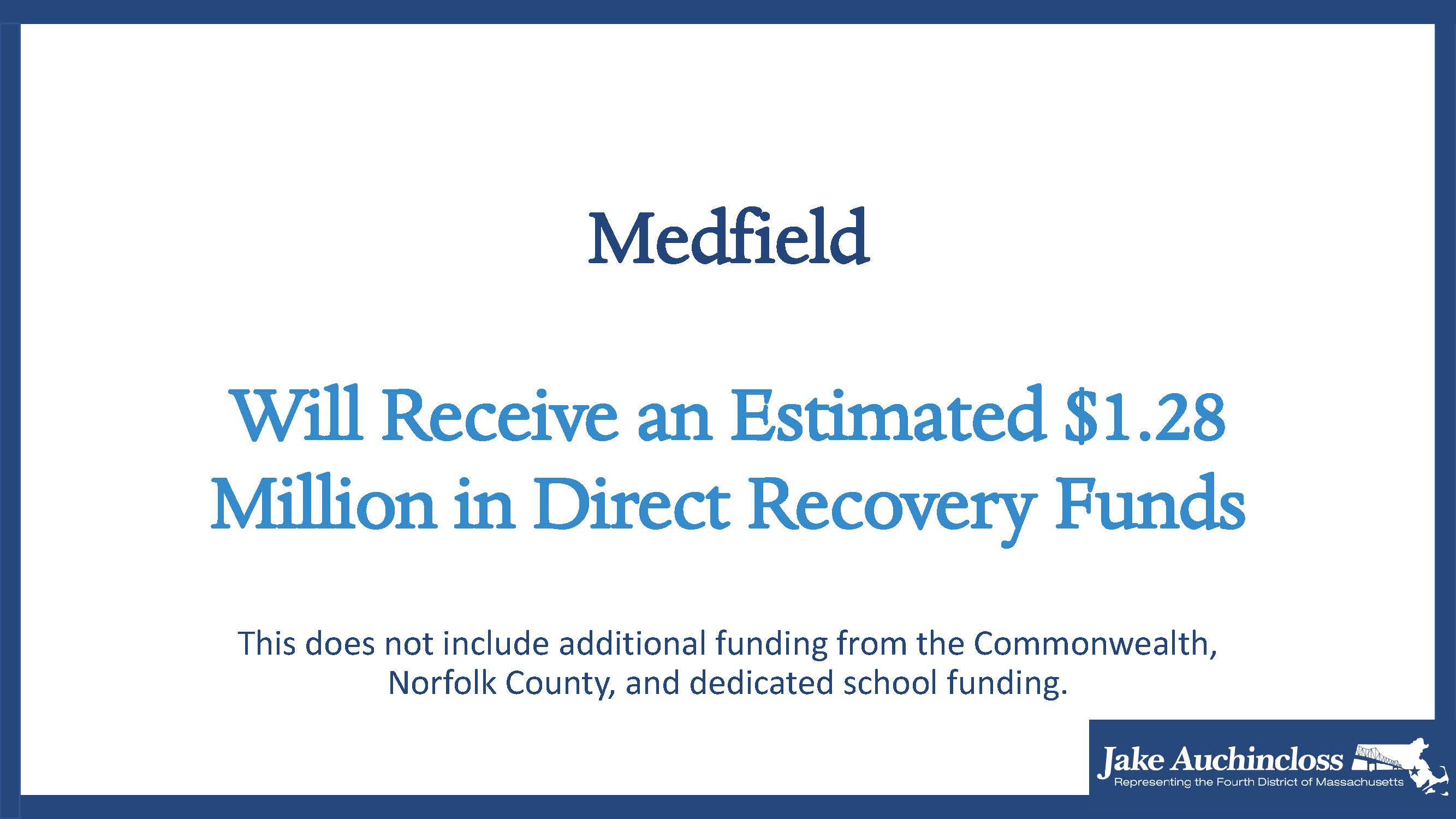
Attached are a couple of resources that Congressman Auchincloss asked me to forward over to you regarding the American Rescue Plan passed by Congress and just signed by President Biden. The good news is that help is on the way! Medfield will receive an estimated $1.28 million directly from the federal government. This does not include other American Rescue Act funding that will come from the Commonwealth, Norfolk County, and additional dedicated school funding.
The first attachment is a baseline summary of this critical legislation that is going to help us get shots in arms, kids back in school, Americans back to work, and much needed relief to state and local governments.
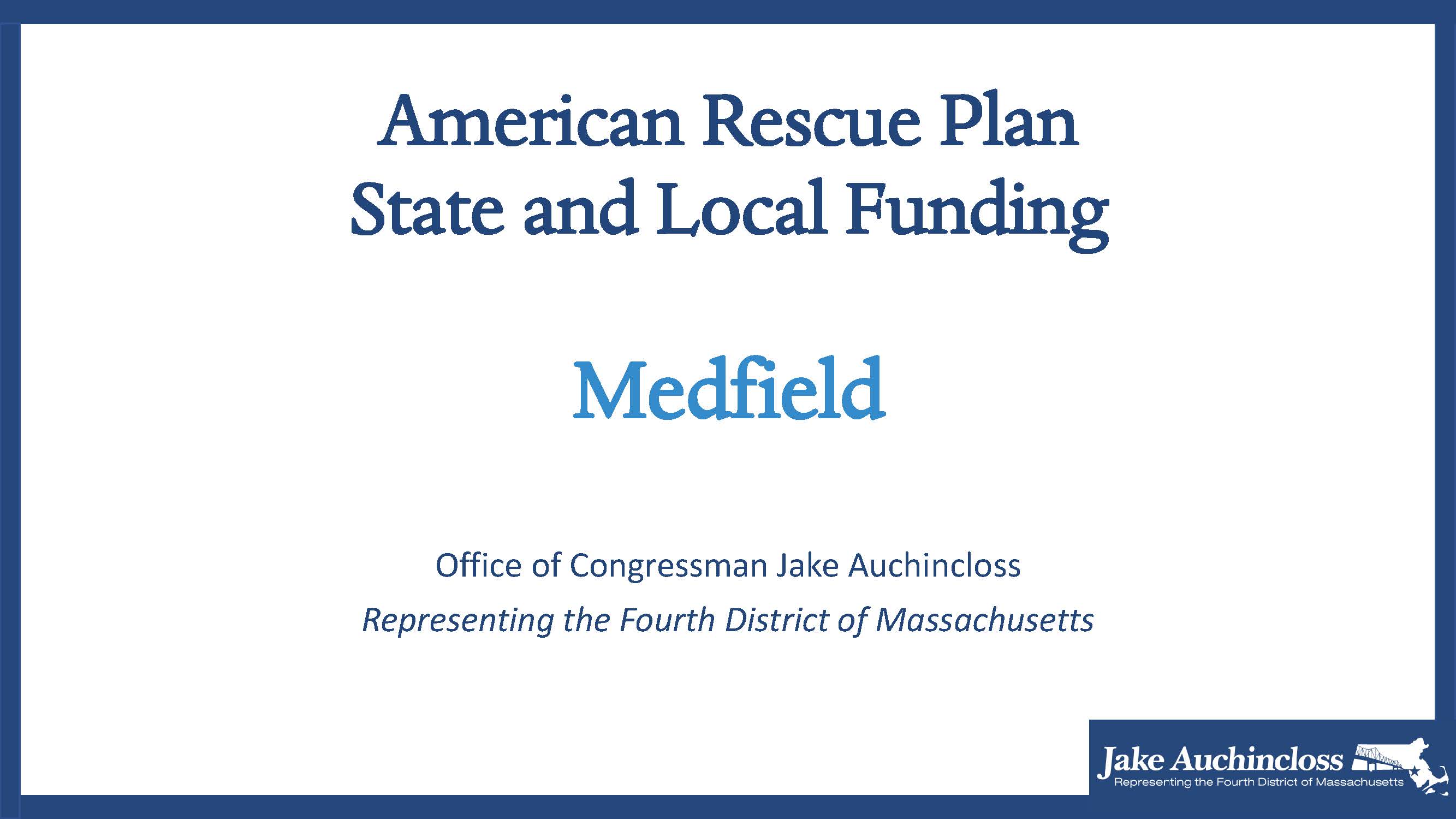
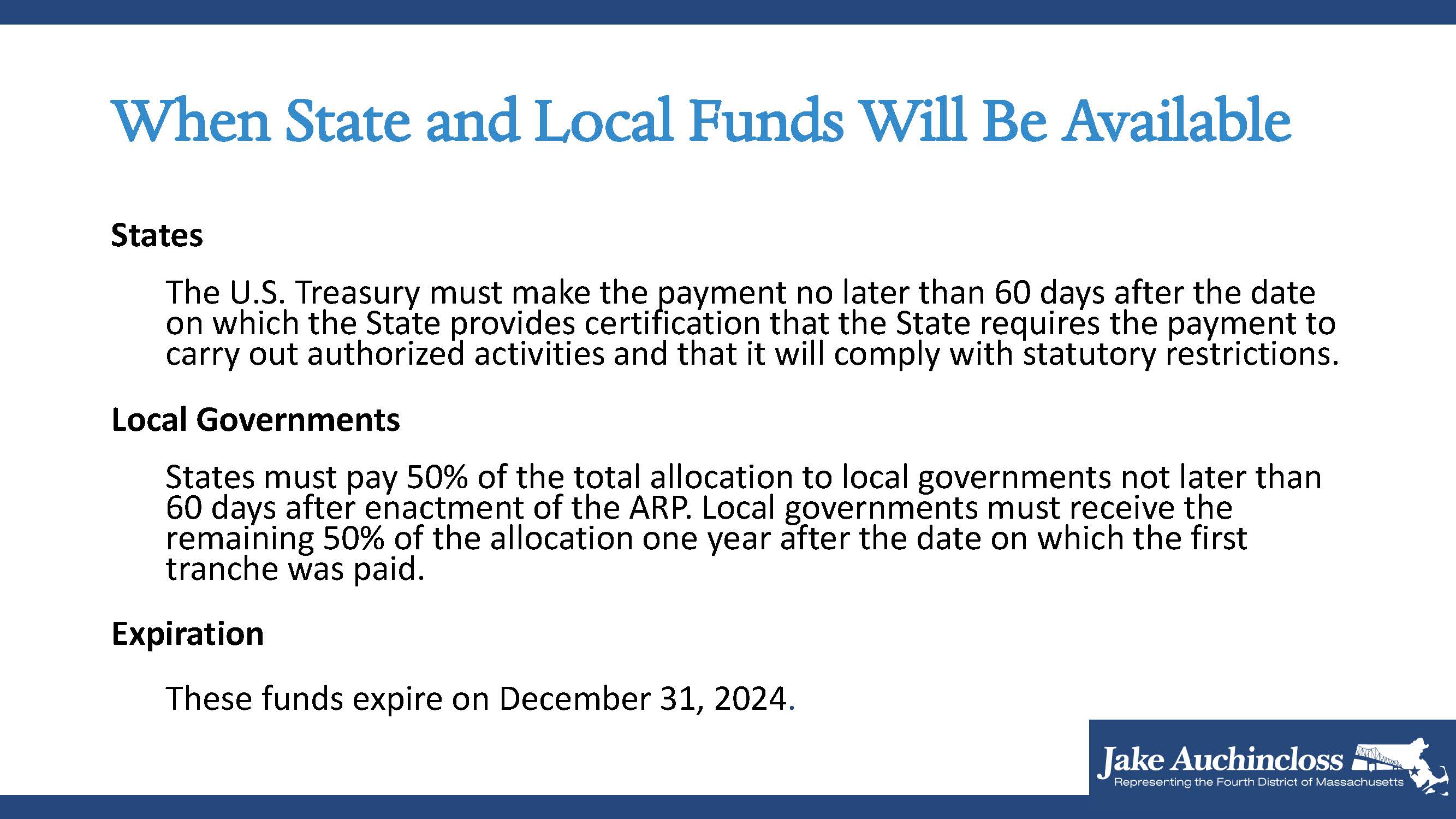
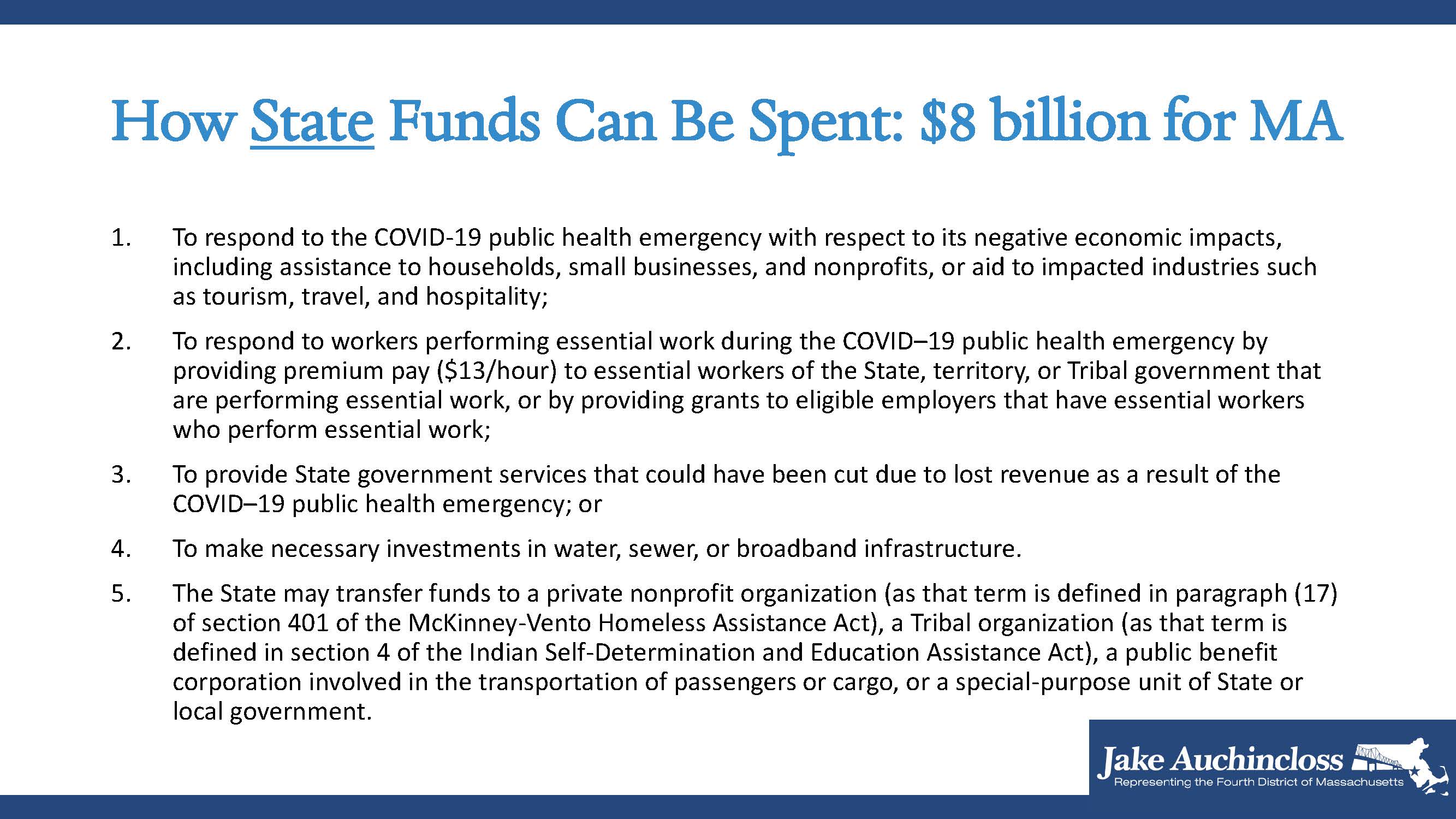
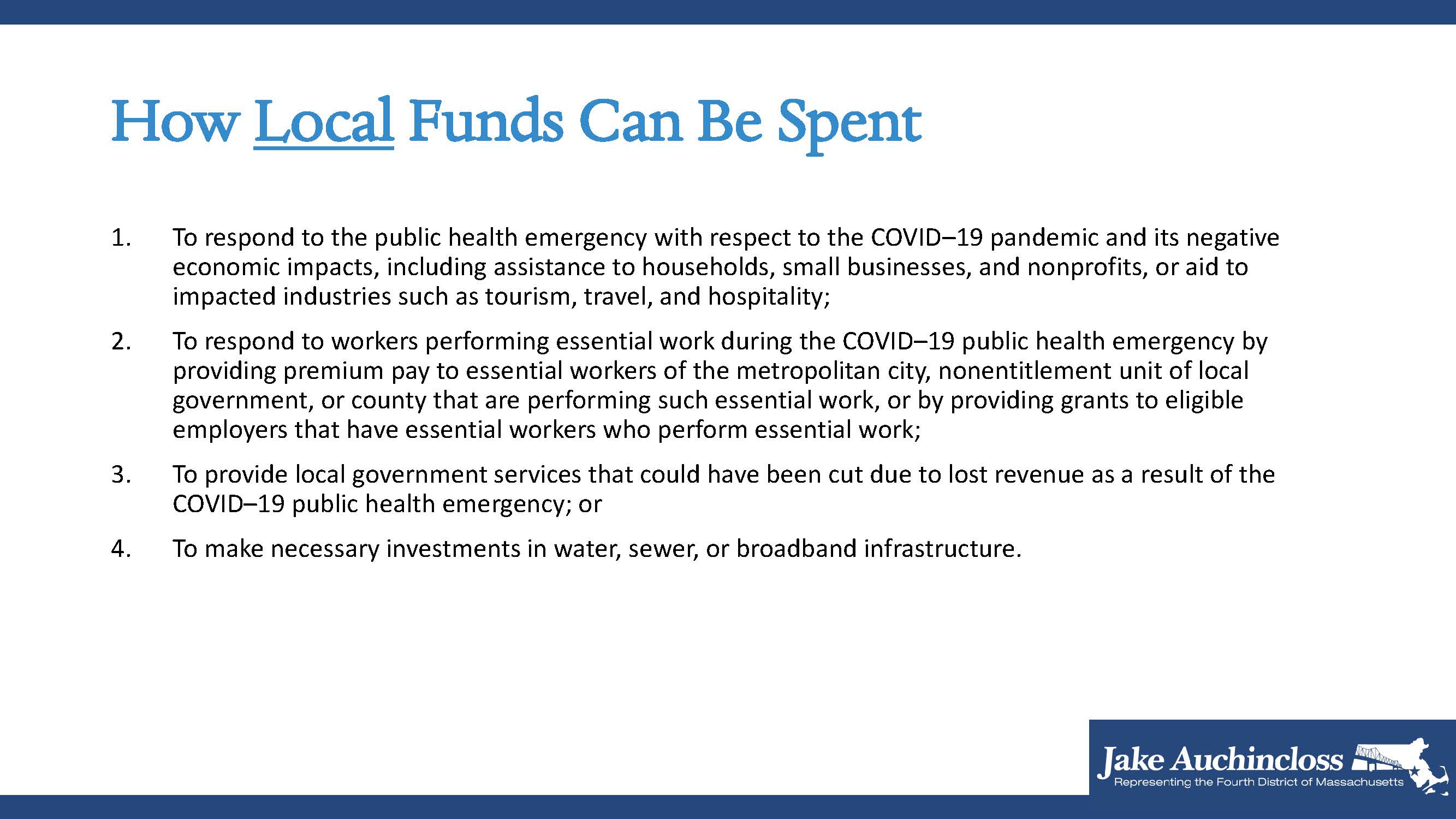
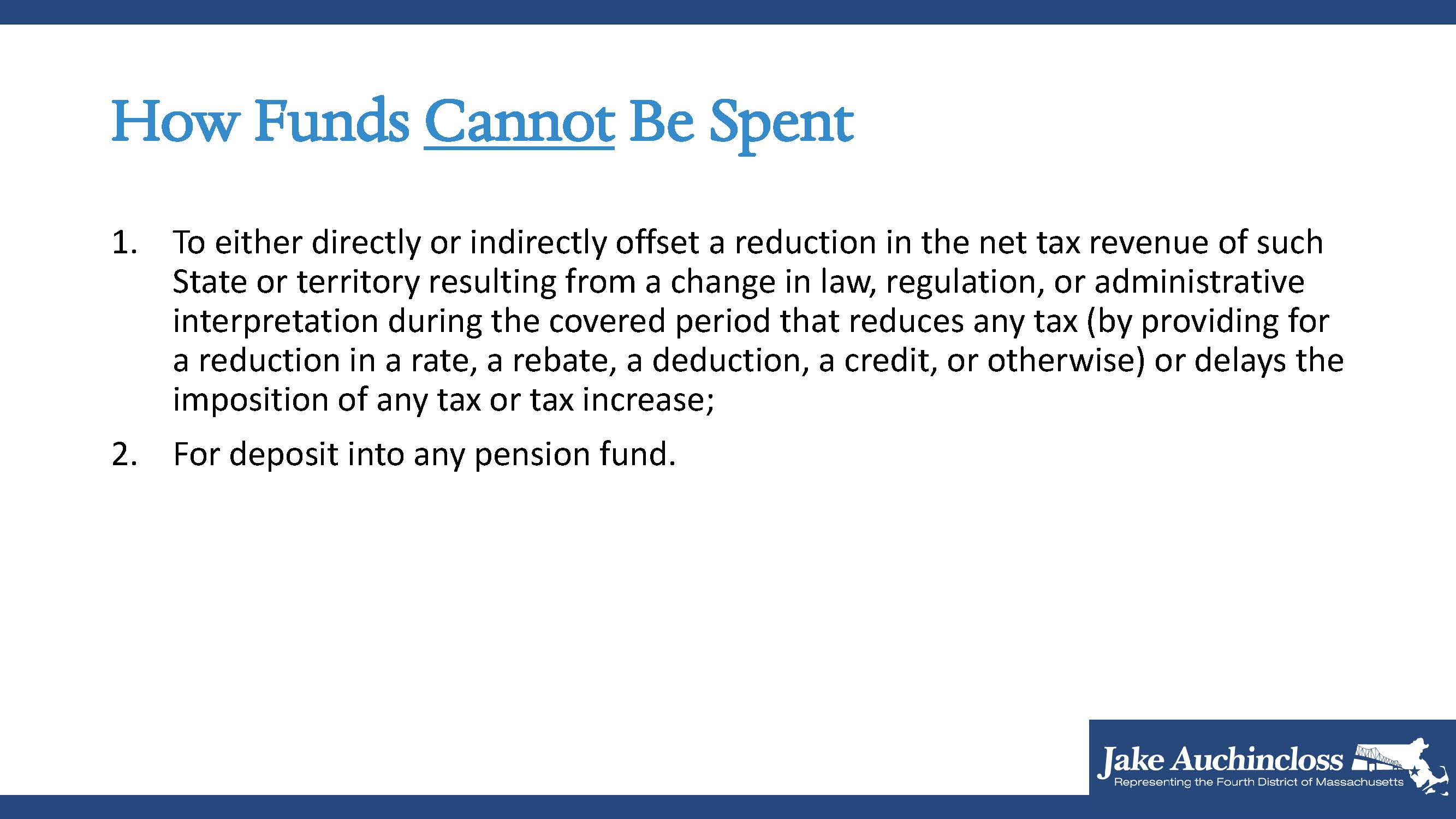
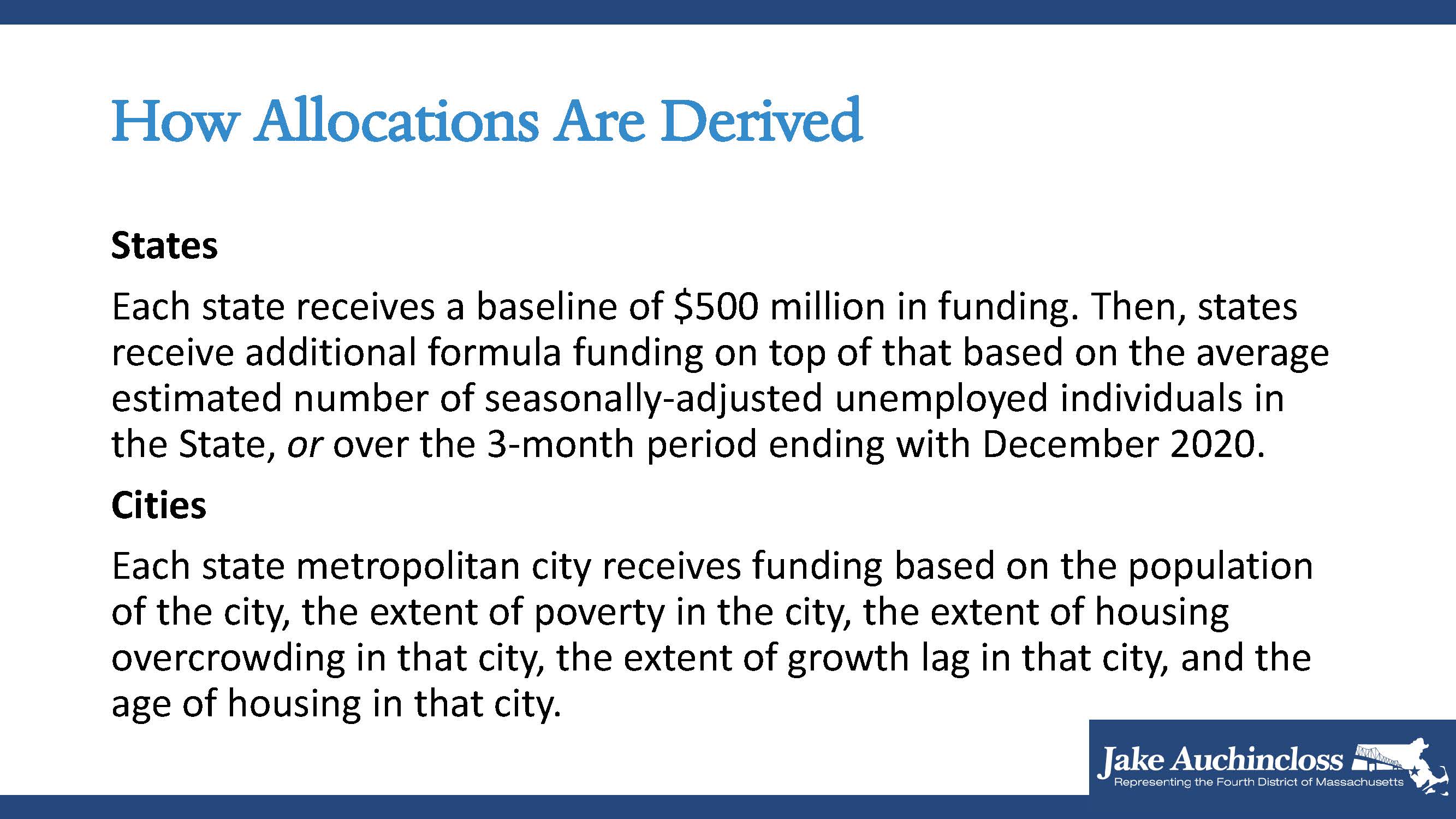
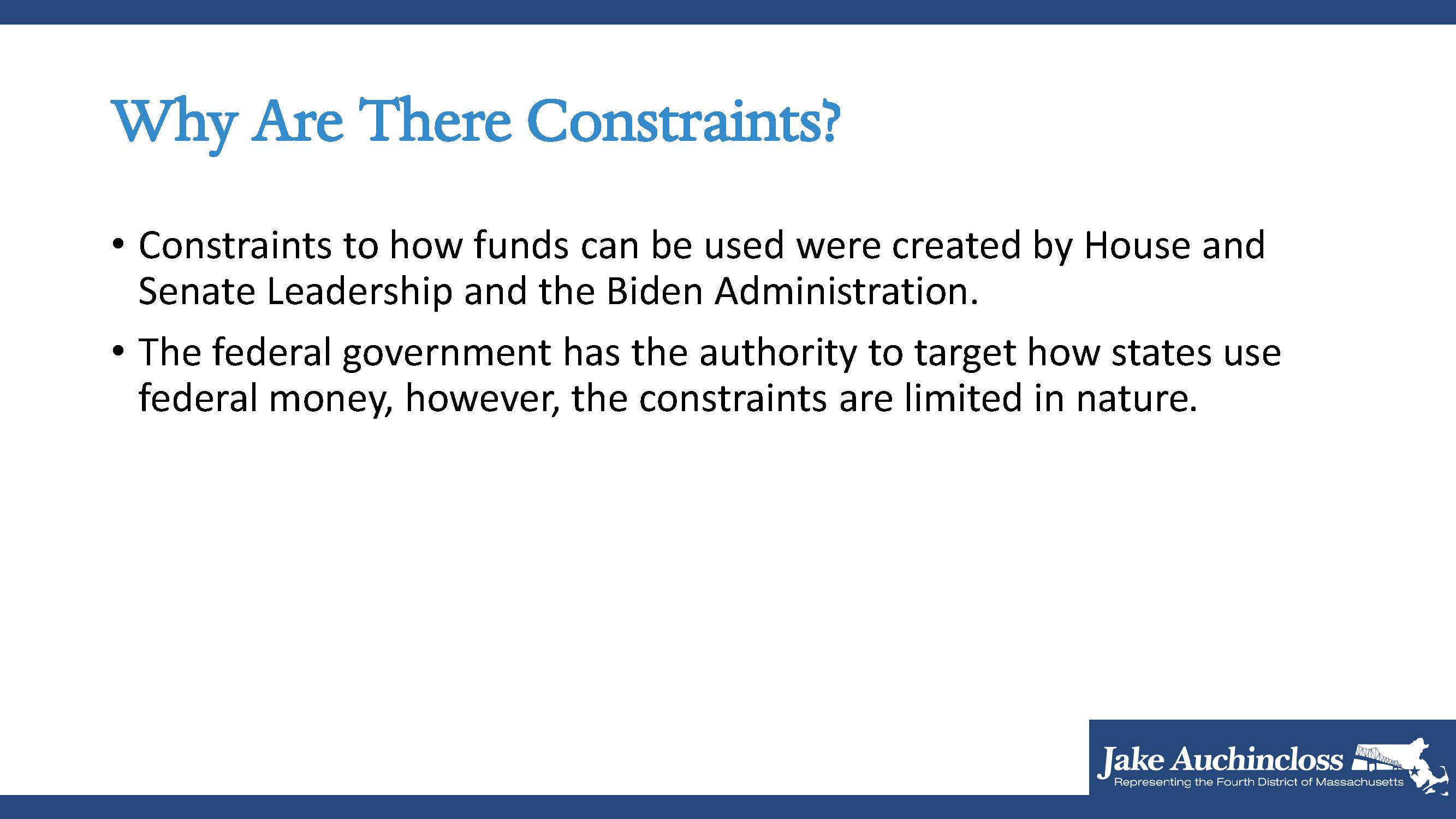
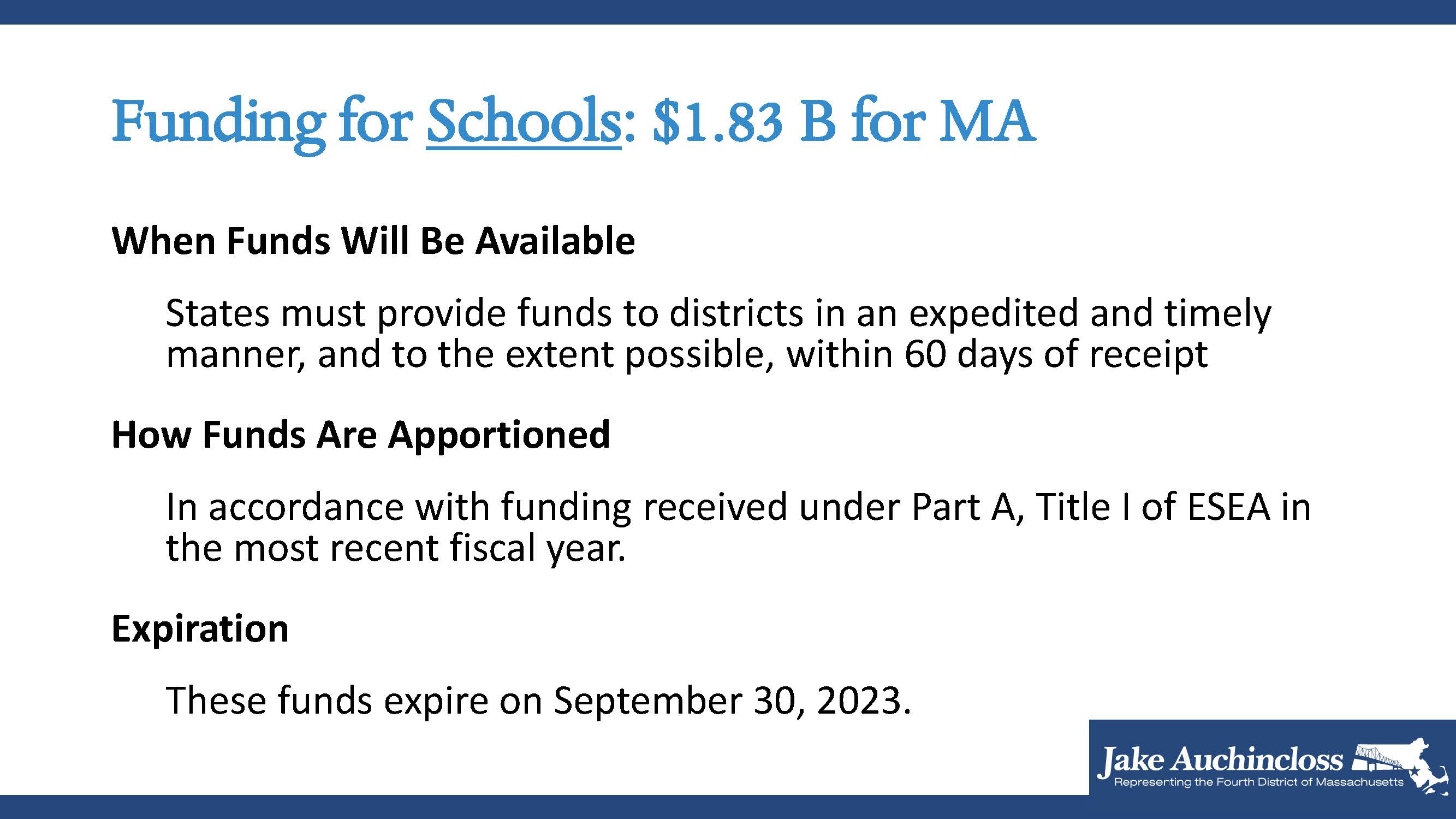
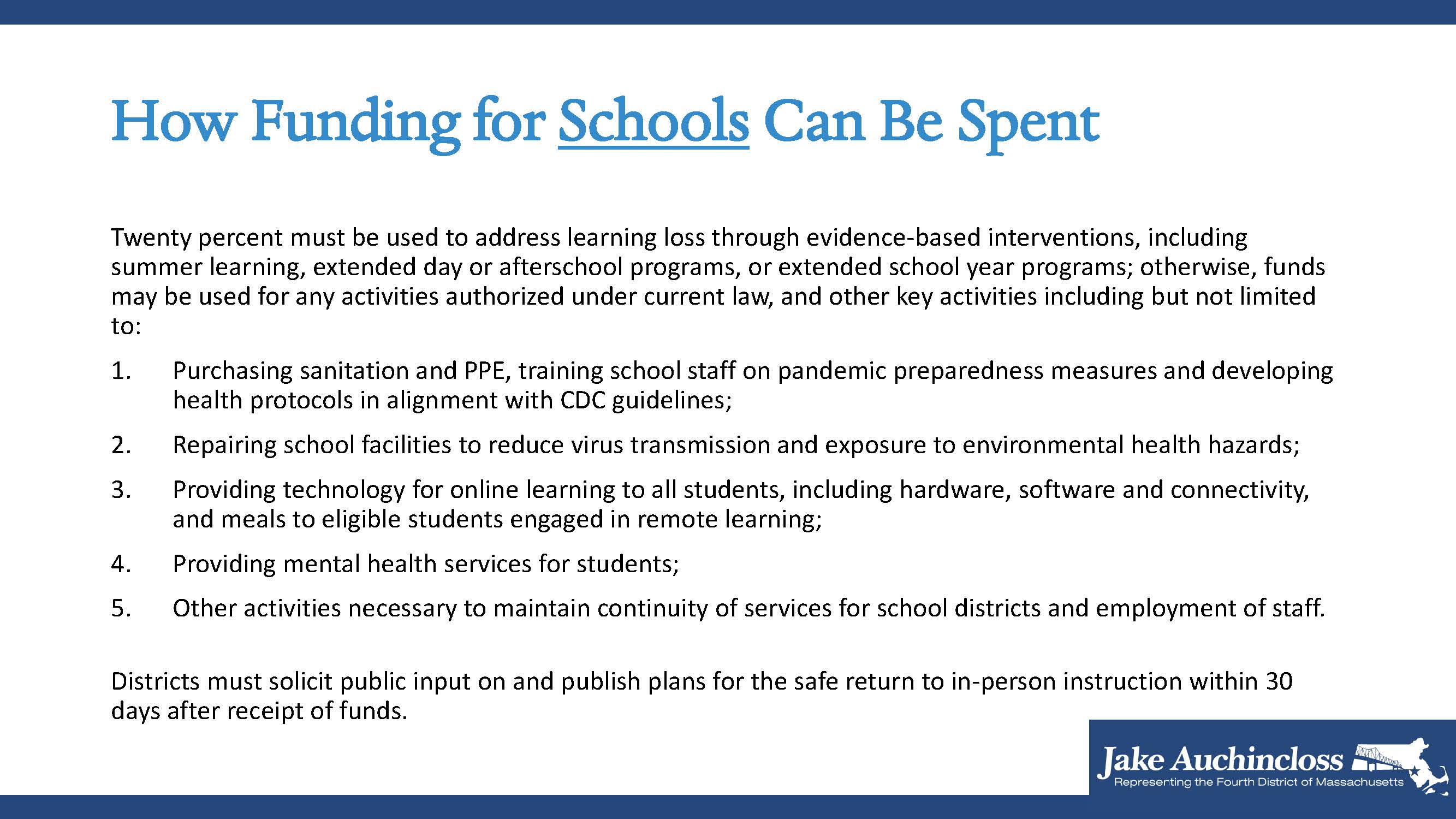
The second attachment is a slide deck on the total funding that Medfield will receive from the American Rescue Plan’s Coronavirus State & Local Fiscal Relief fund. Please note this is a preliminary estimate. This also includes details on when funds are expected to be disbursed, when the funding will expire, how it may be spent, and an explanation of why Medfield is receiving this amount. The deck also includes information on school funding that the state will distribute to districts.
1 The American Rescue Plan The COVID-19 pandemic and the corresponding economic crisis have undermined the health and economic wellbeing of American workers. Millions of Americans, many of whom are people of color, immigrants, and low-wage workers, continue to put their lives on the line every day to keep the country functioning through the pandemic. And more than 9.5 million workers have lost their jobs in the wake of COVID-19, with 4 million out of work for half a year or longer. Without additional government assistance, the economic and public health crises could drag on and our national vaccination program will be hobbled at a critical moment. The American Rescue Plan will change the course of the pandemic and deliver immediate relief for American workers. The plan will build a bridge to an equitable economic recovery and immediately reduce child poverty. In fact, a Columbia University study found that passing the plan will lift more than 5 million children out of poverty this year, cutting the poverty rate by 50%. The bill is one of the most progressive pieces of legislation in history, with more than two thirds of its tax cuts and direct payments going to families making less than $90,000 per year. It will: Mount a national vaccination program, contain COVID-19, and safely reopen schools. American workers should not have to lie awake at night wondering if they’ll make it home from work safely the next day, or if they’ll bring home the virus to their loved ones and communities. President Biden has a comprehensive plan to address the pandemic that will: • Invest about $160 billion to provide the supplies, emergency response, testing, and public health workforce to stop the spread of COVID-19, while distributing vaccines as quickly as possible and addressing racial disparities in COVID-19 outcomes. These emergency measures will help combat the heavy toll this virus is exacting, and will deliver community-based and culturally competent care. • Provide $130 billion to help schools serve all students, no matter where they are learning, and help achieve President Biden’s goal to safely open the majority of K-8 schools within the first 100 days of his Administration. These investments include set asides at the local and state level to ensure states and districts address the learning loss and social and emotional needs of students disproportionately impacted by COVID-19, including students of color, English learners, and students with disabilities. Deliver immediate relief to American families bearing the brunt of this crisis. The American Rescue Plan devotes about $1 trillion towards building a bridge to economic recovery for working families. All told, a single parent with one young child making the minimum wage could see her income increase from the equivalent of $7.25 to around $11 per hour. The plan will: • Give working families a $1,400 per-person check, bringing their total relief payment from this and the December down payment to $2,000. More than 85% of households will receive a check and checks in this bill are bigger than the checks in the CARES Act or in the December bill. And, for the first time, adult dependents are entitled to a check as well. This 2 means a lower or middle-income family of four will see an additional $5,600 in their pockets. • Extend current unemployment insurance benefits and eligibility to September 6 (saving 11 million Americans from losing benefits starting in about a week), provide a $300 per week supplement, and help protect Americans from surprise tax bills on unemployment insurance they received last year. • Help Americans stay in their homes by providing emergency aid to cover back rent. In addition, the bill provides assistance to help struggling homeowners catch up with their mortgage payments and utility costs through the Homeowners Assistance Fund. And, it provides additional funding for families and individuals who are recovering from or at risk of homelessness. • Increase the value of Supplemental Nutrition Assistance Program (SNAP) benefits. The American Rescue Plan will increase SNAP benefits by 15 percent through September 2021. The bill also funds partnerships with restaurants to feed American families and keep workers in the restaurant industry on the job. And, it provides U.S. territories like Puerto Rico additional nutrition assistance funding, in addition to funding to make sure women, infants and children get the food they need to help address food insecurity. • Increase the Child Tax Credit from $2,000 per child to $3,000 per child ($3,600 for a child under age 6) and make 17-year-olds qualifying children for the year. This means a typical family of four with two young children will receive an additional $3,200 in assistance to help cover costs associated with raising children. The families of more than 66 million kids will benefit. • Increase the Earned Income Tax Credit for 17 million workers by as much as $1,000. The top occupations that will benefit are cashiers, food preparers and servers, and home health aides – frontline workers who have helped their communities get through the crisis. • Expand child care assistance, help hard-hit child care providers cover their costs, and increase tax credits to help cover the cost of childcare. This is the single biggest investment in child care since World War II. • Give families an additional tax credit to help cut child care costs. Families will get back as a refundable tax credit as much as half of their spending on child care for children under age 13, so that they can receive a total of up to $4,000 for one child or $8,000 for two or more children. • Provide an additional $1 billion for states to cover the additional cash assistance that Temporary Assistance to Needy Families (TANF) recipients needed as a result of the crisis. • Lower or eliminate health insurance premiums for millions of lower- and middle-income families enrolled in health insurance marketplaces. A family of four making $90,000 could see their monthly premium come down by $200 per month. This will help well over a million uninsured Americans gain coverage. The plan also subsidizes premiums for continuation health coverage (COBRA). Support communities that are struggling in the wake of COVID-19. Millions of American workers reside in communities that suffered disproportionately in recent months. The Plan provides critical support to these communities. It will: 3 • Provide emergency grants, lending, and investment to hard-hit small businesses so they can rehire and retain workers and purchase the health and sanitation equipment they need to keep workers safe. This includes a Small Business Opportunity Fund to provide growth capital to main street small businesses in economically disadvantaged areas, including minority-owned businesses. • Distribute more than $360 billion in emergency funding for state, local, territorial, and Tribal governments to ensure that they are in a position to keep front line public workers on the job and paid, while also effectively distributing the vaccine, scaling testing, reopening schools, and maintaining other vital services. State and local employment has fallen by around 1.4 million jobs since the pandemic began including layoffs of 1 million educators, compared to around 750,000 job losses during the Great Recession. • Help hard-hit public transit agencies avoid layoffs and service reductions, which disproportionately harm workers who are more likely to be dependent on public transportation.
Comments Off on Medfield to get $1.28 million of Federal $
Posted onFebruary 26, 2021|Comments Off on 23 cases over the last 14 days
Medfield’s COVID-19 Data Dashboard has been updated with case and testing data as of 2/25/2021. Medfield remains in the yellow category and has a case count of 23 cases over the last 14 days.
February 26, 2021 02:07 PM Medfield’s COVID-19 Data Dashboard has been updated with case and testing data as of 2/25/2021. Medfield remains in the yellow category and has a case count of 23… Read on Click here to open the dashboard.
I started this blog to share the interesting and useful information that I saw while doing my job as a Medfield select board member. I thought that my fellow Medfield residents would also find that information interesting and useful as well. This blog is my effort to assist in creating a system to push the information out from the Town House to residents. Let me know if you have any thoughts on how it can be done better.
For information on my other job as an attorney (personal injury, civil litigation, estate planning and administration, and real estate), please feel free to contact me at 617-969-1500 or Osler.Peterson@OslerPeterson.com.



 Copyright © 2021 Massachusetts Municipal Association, All rights reserved.







 Medfield02052's Blog