Category Archives: Affordable housing / 40B

ZBA’s 40B hearing tonight postponed to 11/5

This email just received from ZBA’s Norma Cronin –

The ZBA meeting regarding the 40B The Parc at Medfield scheduled for this evening (Oct. 30th) is postponed until Monday, November 5, 2012 at 7:30 p.m.


Norma J. Cronin

Planning & Zoning Administrator

459 Main Street

Medfield, MA  02052

508-906-3027

Beacon Communities LLC buys Wilkins Glen

MassHousing Finances $50.6 Million to Preserve Affordable Housing in Boston, Beverly, Maynard and Medfield

(Source: MassHousing) — MassHousing announced today that it has closed $50.6 million in financing for the acquisition and preservation of four affordable housing developments in Boston, Beverly, Maynard and Medfield.

Beacon Communities LLC of Boston used the MassHousing financing to help purchase the four affordable apartment communities from their former owner, Equity Residential.

The 351 apartments involved in the transaction will remain affordable for at least 40 years under the terms of the financing and the four developments will receive varying amounts of capital improvements.
“These loans will help keep 351 apartments for working families and seniors affordable for at least the next 40 years,” said MassHousing Executive Director Thomas R. Gleason. “We worked hard with Beacon Communities under a tight deadline to complete these loan closings and make sure this quality housing remained affordable for the long term.”

The properties purchased and preserved by Beacon Communities with the MassHousing loans are:
 Conway Court in Boston: $3.3 million in short-term acquisition financing and long-term construction and permanent financing for 28 units of affordable family housing.
 Jaclen Tower in Beverly: $11.7 million in short-term acquisition financing and long-term construction and permanent financing for 100 units of affordable elderly housing.
 Summer Hill Glen in Maynard: $17.8 million in short-term acquisition financing and long-term construction and permanent financing for 120 units of affordable elderly housing.
 Wilkins Glen in Medfield: $17.7 million in short-term acquisition financing and long-term construction and permanent financing for 103 units of affordable family housing.

“Beacon’s acquisition and renovation of these properties will enable us to continue to provide high-quality affordable housing in these communities,” said Mark Epker, President of Beacon Communities Investments LLC. “MassHousing’s responsiveness and dedication to get these transactions done demonstrates the Agency’s continued commitment to preserving affordable housing in the Commonwealth.”
MassHousing Closes on $50.6 Million in Financing for the Acquisition and Preservation
of Affordable Housing in Boston, Beverly, Maynard and Medfield

About Beacon Communities LLC
Beacon’s team of highly experienced residential real estate professionals develop, own and manage over 70 communities and 12,000 apartments throughout New England, PA, NY, VA and MD. We have a proud 40-plus year history of providing exceptional, award-winning residential communities that serve a diverse cross-section of society and make enduring contributions to the vitality of the cities and towns where they are located. The diversity of our portfolio speaks to our ability to form joint ventures with an array of partners including landowners, community groups, colleges and equity investors, as well as our ability to work cooperatively with public officials and concerned citizens. For more information about Beacon Communities LLC, please visit www.beaconcommunitiesllc.com.

About MassHousing
MassHousing (The Massachusetts Housing Finance Agency) is an independent, quasi-public agency created in 1966 and charged with providing financing for affordable housing in Massachusetts. The Agency raises capital by selling bonds and lends the proceeds to low- and moderate-income homebuyers and homeowners, and to developers who build or preserve affordable and/or mixed-income rental housing. MassHousing does not use taxpayer dollars to sustain its operations, although it administers some publicly funded programs on behalf of the Commonwealth. Since its inception, MassHousing has provided nearly $14 billion for affordable housing. For more information, visit the MassHousing website at www.masshousing.com, follow us on Twitter @MassHousing, subscribe to our blog and Like us on Facebook.

Media Contacts
Eric Gedstad: 617.854.1079 | egedstad (at) masshousing (dot) com
Tom Farmer: 617.854.1843 | tfarmer (at) masshousing (dot) com

Source: MassHousing

Town 40B consultants summary

The town’s consultants on the Gatehouse 40B project proposed for West Street submitted the attached summary regarding the requested waivers sought by Gatehouse.  SUMMARY

Gatehouse offers compromises

At the Zoning Board of Appeals of the Town of Medfield’s continued hearing on the Gatehouse 40B project on West Street last night, Gatehouse submitted a letter in which it lays out the compromises that it is willing to effect in its proposed project.  Here is that letter.

Gatehouse at ZBA tonight

The hearing continues before the ZBA on the Gatehouse 40B.  A letter was received from Gatehouse with its proposals of what it is willing to do.  Next meeting dates were to be10/23 and 10/30, but decision was made that they will not have enough new information from Mr. Jacobs, the town’s financial consultant by that date to make it worth keeping, so the next date will be 10/30.  Gatehouse agreed to continue the date by which the ZBA must close its hearing by five days, to 11/5, so as to accommodate the ZBA hearing schedule needs and decision timing constraints by which the decision must be issued.

Architectural review of Gatehouse 40B

The town”s architectural consultant reported on his review of the Gatehouse 40B tonight.  Major points =

Residential use makes sense, versus industrial zoning.

Setbacks of industrial uses to the west are good.  Deep lawns in front.

Walking facilities would be good.

Parking lots at street makes it difficult to screen the buildings with landscaping.

Skinny buildable area makes site difficult.

Generally parking should not be between buildings and street.

Opportunity exists to turn this stretch of West Street into a beautiful area.

Plantings every five spaces.

Rotate buildings 90 degrees so short sides face street.

Place smallest buildings at the street.

Improve landscaping plans, to make better use of site and its possibilities.

Flat roofs would make buildings appear smaller.

Traffic calming within development and on West Street.

Make the wetlands an amenity.

Generally likes the architectural detail and design of the buildings.

Suggests use of more than one design of windows, to make facades more interesting.

Use cement board siding instead of vinyl.

Make buildings greener by building to the Stretch Building Code.

Buildings are “shoehorned” into the site.  9+ acre site, but due to wetlands, only 5+ are usable.

ZBA chair questions whether there are too many buildings on too small a site to be able to make the site work sell and whether the one stairway is sufficient for the three story buildings.

Next continued hearings on September 24 and October 1.

9/24/12 will be the opportunity for public comments.  If possible, there will also be the financial review by the town’s consultant.

Gatehouse spokesperson suggests that they disagree with the vast majority of the consultant’s comments.

Size of development not dissimilar to industrial buildings to the north and west.

Keep mature tree last line along West Street to provide the best buffer.

There was a disagreement over the 5+ acres of uplands noted by the ZBA chair as available versus Gatehouse’s engineer saying 7+ acres were available.  Heated comments were made about the disagreement.

Gatehouse attorney makes point that their project is not supposed to be subjected to greater review than other projects, and suggest that Medfield does not subject regular projects to similar peer review.

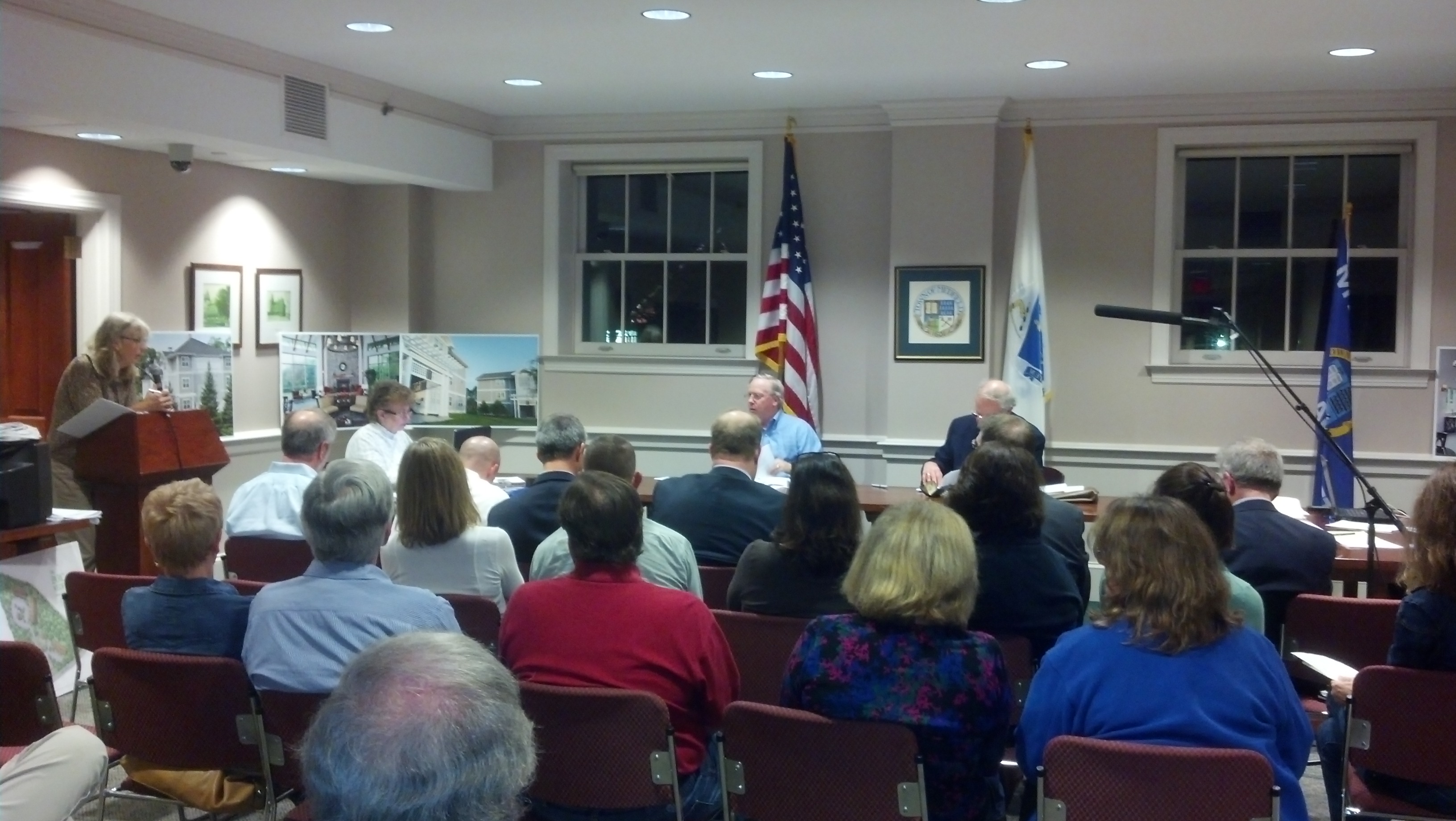
40B architect’s review

The town’s architecture consultant submitted its review of the Gatehouse 40B proposal.  This will be review by the architect consultants at the continued Zoning Board of Appeals of the Town of Medfield hearing next  Monday evening.

Suggestions –

  • turn buildings 90 degrees to have short side face West Street
  • flat roofs to reduce scale
  • bike path to downtown
  • traffic calming on West Street
  • landscaping breaks in parking lots
  • enclose breezeways
  • cement clapboards
  • met Massachusetts Stretch Code
  • use water saving fixtures
  • use something other than rugs
  • air exchange system
  • solar DHW system

ZBA continued hearing on West Street 40B

ZBA water issues consultant Tom Houston presented his analysis of the sixty odd issues he had with the proposal.  Tom Houston first said the plans were better than usual.  He then reviewed those comments where he and the developer differed.

Six inches over cover is too little over a sewer.  However, increasing that cover may require raising the elevation of the buildings.

Light fixtures illumination should not be visible from off site.

ZBA chair, Bob Sylvia, asked Hoston’s opinions as to the risks to the wetlands and the aquifer.  Houston noted his specific suggestions for separators at the site to protect the wetlands, which also protects the aquifer.  He said that any development has risks, and that the higher the density the higher the risks.  However, he noted that these plans follow generally accepted engineering practices.  To this observer, he was saying that this is the current state of the art, but that does not mean that it is without risks.

I asked about what I understood to be a major water related risk, namely that the whole development is located within 100 flood levels, i.e. the development will be under water during a 100 year flood.  I was told that there are written submissions on that issue, and that there are differing opinions.

The next continued hearing date for the ZBA hearings on Gatehouse’s 40B proposal is August 27, when it was said that architecture will be the focus.

CPA benefits strengthened

Recent amendments of the Community Preservation Act (CPA) make it even more appealing to towns to adopt.  The CPA has towns committing to taxing themselves form 1 – 3% more each year in order to gain state matching funds.  Those matching funds were generated by surcharges on recording fees at the registry of deeds, and the % match had dropped from the initial 100% match as fewer transactions were recorded and more towns adopted the CPA, such that the match went down to about 1/3 if I recall right.

The state both better funded the match and amended the uses to which the monies can be put – the following is from the DOR’s Division of Local Services newsletter –

==========================

Governor Patrick Signs Changes to Community Preservation Act

Gov. Deval Patrick has signed into law an expansion of the Community Preservation Act (CPA) and a $25 million transfer from the state’s FY13 budget surplus to the statewide CPA Trust Fund, for distribution to communities in the fall of 2013.

The one-time transfer would supplement the existing source of revenue from the fund which comes from surcharges on fees paid to the record certain documents at the Registry of Deeds. Matching CPA grants paid from the trust to cities and towns adopting the CPA have decreased in recent years due to more participating communities and lower Registry collections reflecting a softened housing market.

The amendments, signed as part of the budget the governor signed on July 8, contains a number of changes relative to allowable CPA expenditures for recreation and housing assistance to individuals. The law also provides more options for paying into a CPA fund. The amendments are found in Chapter 139 of the Acts of 2012, Sections 69-83, 155 and 218. They took effect on July 1, 2012.

Here are highlights of these new provisions.

CPA Fund Uses:

  • Permit rehabilitation of existing recreational land not created or acquired with CPA funds
  • Expand the definition of rehabilitation to allow for capital improvements and replacement of recreational equipment
  • Add definition of capital improvement as reconstructions or alterations that materially add value or prolong the property’s life, are part of the real estate and are intended as permanent or indefinite installationsProhibit use of CPA funds to acquire artificial turf for athletic fields
  • Allow communities to include allowable recreational projects in meeting their annual 10% open space spending requirement
  • Define prohibited maintenance, as incidental repairs that do not add value or prolong the property’s life but keep the property in a condition of fitness, efficiency or readiness
  • Add definition of support of community housing as including grants, loans, rental assistance, security deposits, interest-rate write downs or other forms of assistance provided directly to individuals who qualify for community housing or entities that own or operate community housing
  • Allow communities to use in the first year only some of their CPA administrative and operating expenses to cover costs associated with tax billing software upgrades, but in an amount including other administrative expenses not greater than 5% of the annual revenues in the CPA fund

Other Revenue Sources

  • Allow communities to adopt the CPA at ballot with a minimum 1% property tax surcharge and then dedicate additional municipal revenue sources (such as local option tax revenue) to their CPA fund up to the full 3% of the real estate tax levy against real property
  • Allow communities that have already accepted CPA at a surcharge level above the 1% the option of reducing their CPA surcharge to 1% while committing additional municipal revenues their CPA Preservation Fund

Surcharge Exemptions

  • Add a new optional commercial exemption for the first $100,000 of property value for commercial and industrial properties, mirroring current exemption for residential property

Property Restrictions

  • Clarify that a real property interest acquired (rather than simply purchased) by a city or town by any mechanism using CPA funds must be bound by a separately recorded permanent restriction limiting its use to the CPA purpose for which it was acquired
  • Clarify that CPA funds may be appropriated to non-profit organizations to hold, monitor, and enforce restrictions limiting the use of land to CPA purposes

The above summary was prepared by DLS staff.

Gatehouse response to town – my #2

OK, yesterday afternoon my review of the submission to the ZBA on behalf of Gatehouse got interrupted by a call from Kristen needing a ride.  This morning I finished reviewing what was submitted, and I can tell you that it is actually 57 pages, when one includes the attached materials.  Attached are Phase I and II reports by the LSP’s hired by Gatehouse to evaluate the site for hazardous materials.  To this uneducated person, the reports say that the site is essentially clean, except for possible spill over from spills at adjoining sites.

I have become accustomed to the format of this report, as it is the same essential method used by the state’s consultants in the Medfield State Hospital clean up, where they issue a report, the town comments upon that report, and the report author then either adjusts their report or, more likely, justifies their original plan.  I look forward to the town consultants’ responses to what has been put forward for Gatehouse.