Monthly Archives: September 2012

Friends of the Needham Rail Trail Greenway

Email today from the Friends of the Needham Rail Trail Greenway with lots of information and links about what is going on with respect to the Bay Colony Rail Trail.  Needham has a special town meeting coming up on 10/29/12, and has two articles on its warrant about the Bay Colony Rail Trail.

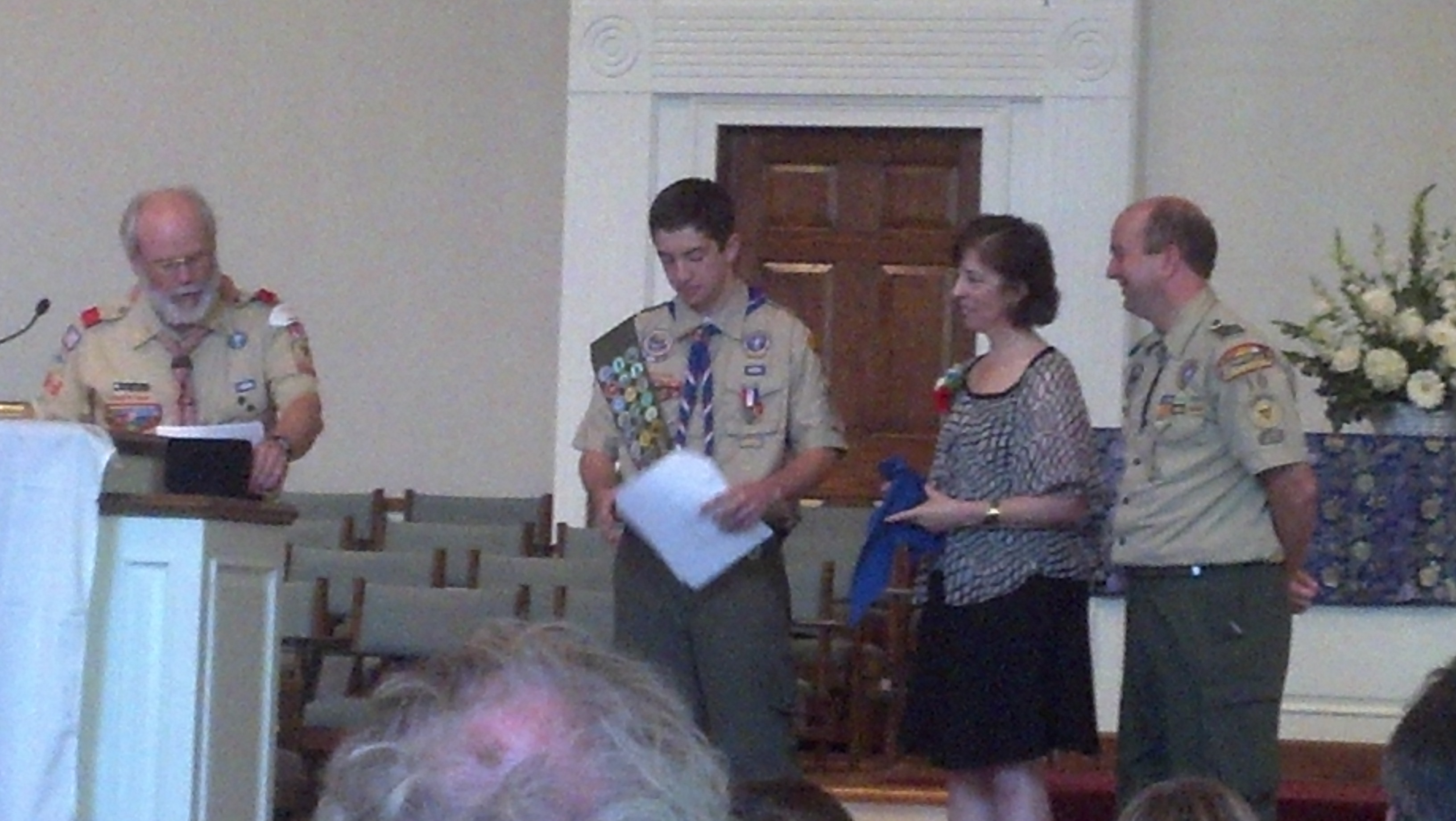
Nick Derian’s Eagle COH

Eagle Scout Badge, Type 3

Eagle Scout Badge, Type 3 (Photo credit: Wikipedia)

Nick Derian received his Eagle Scout award at a Troop 10 BSA court of honor this afternoon at the UCC.  Nick built a 17′ bridge over Vine Brook to provide better access to Hinkley Pond.  Troop 10 had many of its scouts assist in running the COH, which is great experience for them.

Enhanced by Zemanta

Congressman Lynch at Westwood Day

I spoke to Congressman Lynch today at Westwood Day, and teased him about dropping Medfield from his district, and he assured me that it was Barney Frank who asked to get Medfield, Easton, and (I think) Needham added to his own district.

Westwood Day looked to be a huge success for a first time effort.  Booths and food, like Medfield Day, but sports clinics, big trucks, antique cars, a WHS evening football game, followed by fireworks.  Makes me wish MEMO would bring  back the Medfield Night Fireworks.

Stop using Internet Explorer

This from WindowsSecrets.com newsletter today –
====================
If you use IE, don’t — at least not for now

Susan BradleyBy Susan Bradley

A serious vulnerability in Internet Explorer 6 through 9 has come to light, and there’s no patch at this time.

If you must use Internet Explorer for specific applications, use another browser as much as possible and remove or disable Java.

Yet another zero-day exploit targets IE

Microsoft Security Advisory 2757760, dated Sept. 17, warns of a newly disclosed IE vulnerability that could allow remote-code execution — which means an attacker could take over a targeted PC with the same rights as the current user. (This type of threat is why we recommend setting up a non-admin account on the PC you use most of the time.)

According to the advisory, Internet Explorer 10 (included with Windows 8) is not threatened. But that caveat is irrelevant because few Windows users are running Win8 for any purpose other than testing the new OS.

- What to do: Here, in a nutshell, are your options:

1) Use another browser. Until Microsoft releases a patch for this new threat, simply do all your Web browsing with Firefox or Chrome — and make sure they’re fully updated.

2) Remove Java. If you must use IE, ensure that Java is fully disabled or not installed. I discussed this in my Sept. 6 Patch Watch column.

3) Use the Enhanced Mitigation Experience Toolkit. If you can’t operate without IE and Java, Microsoft’s EMET software can help. A RationallyPARANOID blog has a helpful how-to guide for installing EMET. Brian Krebs also has an excellent post on using the toolkit to protect IE.

Look for more on EMET — what it is and how it protects you — in next week’s regularly scheduled Patch Watch. And if Microsoft releases an out-of-cycle IE update before then, I’ll let you know. In the meantime, keep an eye out for a soon-to-be-released Microsoft fixit for Internet Explorer; it should provide protection until a patch is ready. I’ll post an update in the lounge when it’s released.

Enter you Medfield photos in MMA calendar contest

Calendar Contest Flyer


BoS asks town boards and departments to review their regulations

I got the following copy from the Medfield Energy Committee today.  My understanding was that the Board of Selectmen especially wanted this bylaw review done with an eye on the potential developments at the Medfield State Hospital, but that part got left out.

+++++++++++++++++++++

Memo
MEDFIELD BOARD
OF SELECTMEN
To: Department Heads, Boards, Commissions and Committees
From: Board of Selectmen
Dale: 8/6/2012
Re: Charter and By-law Review Committee

Last year, the Board of Selectmen appointed a Charter and By-law Review Committee to undertake a review of the Town Charter and By-laws and to suggest any changes or updates that might be appropriate. This Committee, chaired by Scott McDermott, has been meeting regularly and is in the process of hiring a consultant to assist with codifying the charter, by-laws and departmental regulations.
It has met with many town department heads, board, commission and committee members to obtain input as to what changes, if any, should be made. As part of this process, and in anticipation of future developments throughout the Town, the Selectmen would like you to review state and federal statutes, town by-laws and regulations for areas under your jurisdiction and suggest any changes which would
improve service delivery and would protect the interests of the Town of Medfield and its residents. This might include changes to existing statues, bylaws and regulations, as well as new ones which you feel
should be adopted by the Town. Such items as noise, air pollution, zoning, environmental quality, traffic, parking, or any other areas of concern may be appropriate for review. In the process of reviewing potential changes, you may wish to contact colleagues in other cities and towns, who might be able to offer some insight as to what would be helpful. The Committee has collected by-laws and regulations from several nearby communities. It would be happy to share them with you.

Please send any suggestions for additions, deletions and/or revisions to the Charter and By-law Review Committee by the end of September. Your assistance in this endeavor would be greatly appreciated.

From the Joe Kennedy campaign

Email today from the Joe Kennedy for Congress campaign –

++++++++++++++++++++

Hi Team Medfield!

Joe had a fantastic time at Medfield Day this past Saturday- thank you to all that came to show support and meet our future Congressman!

After a great showing in the primary, we’re now charging ahead into the general election– only 48 days away! Our focus is on identifying support for Joe with unenrolled voters through phone calls and knocking on neighbor’s doors.

We need your help now more than ever- here are ways to get involved:

1. Call voters— Join us at our Medway office (116 Main St.) as we call unenrolled voters Monday-Fridays 10am-1pm and 5-9pm and also Sundays 4-8pm.

2. Knock doors — The best way to talk to voters is neighbor to neighbor- can you help us canvass your neighborhood? We canvass every Saturday and Sunday at 10am.

3. Show your support— Display a lawn sign- email Eileen Desorgher (eileen.desorgher@verizon.net) to request a sign.

4. Fuel the Team— donate dinner or snacks for our volunteers at our Medway Office.

5. Spread the word— forward this email to your friends and family to get them involved!

We have a lot of work to do over the next 7 weeks and now is the time to get involved! Email me at rgoldenberg@joekennedy2012 or call me at 585-330-8221 to join our team!

Best,
Rachael

Rachael Goldenberg
Field Organizer
Joe Kennedy for Congress
585-330-8221 (c)
617-964-2012 (o)

Congressional debate 10/10/14 at 4PM

Email from Commonwealth Magazine this afternoon –

CommonWealth magazine presents:

An Issues Debate in Massachusetts’ 4th Congressional District

The American Dream:
Jobs, the economy, and the future of the middle class

With Sean Bielat and Joseph Kennedy III

Wednesday, October 10th, 4:00 p.m.
UMass Darthmouth’s Advanced Technology and Manufacturing Center
151 Martine Street, Fall River, MA

Debate Partner

UMass Dartmouth

Moderator: Michael Goodman, Chair of the Department of Public Policy at UMass Dartmouth

Questions will be posed by CommonWealth magazine, the Fall River Herald News, and the Taunton Daily Gazette.

The event is open to members of the public who register in advance. Please click here or email us to register.

Registration is required and seating is limited, so prompt registration is suggested.

Media are encouraged to RSVP to Christina Prignano at Cprignano@massinc.org.

Ann & Mark reject review for best practices by former selectmen

At my request the Board of Selectmen constituted the town’s former selectmen as a Board of Advisers, so that the town could continue to benefit from the depth of knowledge and understanding of municipal governments that they had acquired as selectmen.  Last night I suggested that the Board of Selectmen ask that group to review how we operate the town departments, to make sure that we were using the best practices and the town was being well served in all instances.

Ann and Mark rejected doing so, for the same stated reason, that the former selectmen had been gone too long from town government to still have any useful information.  Too bad, as it is a real lost opportunity for the town.

This was my email to the former selectmen to ask them if they would consider serving in the capacity I envisioned –

++++++++++++++++++++++++++

John, Richard, Ed, Harry, and Paul,

I do not know if Mike Sullivan ever informed you, but at my request, the Board of Selectmen appointed all the town’s former selectmen to a Board of Advisers, in an effort to harness and take advantage of all that you learned as a result of being selectmen.  My thought was that there was so much learning and institutional memory that happens from being a selectman, that the Town of Medfield should try to make use of those skills that you developed.

Mike and I have talked about asking you to look at the issue of the town’s liability for post employment benefits for medical care, which the actuaries say is something like a $40m. liability number for Medfield, but a state appointed commission is looking into that issue on a state wide basis now (given that every city and town in the state is hugely effected) and they are supposed to report back some time this fall, so we thought it best to hear what the commission says first.

The second task that has occurred to me to ask you all to do, and one that I am going to ask at our selectmen meeting next Tuesday be delegated to your Board of Advisers, is that we ask you to do a top to bottom review of the policies and procedures of every town department, so that we can be assured that the town is using the best practices that are available.  I could envision you meeting with someone like Medfield resident Jeremy Marsette, who is the town engineer for Framingham and the chair of our Water & Sewer Board, to learn what he has seen done elsewhere, and then meet with Ken to see if we are doing those things.  Similarly with Rachel Brown of the Personnel Board, whose consulting practice has her dealing with towns all over the state.

This is the item that I have put on the agenda:

Referral by the Board of Selectmen to our Board of Advisers (comprised of all former selectmen) the request that they conduct a top to bottom review of the policies and procedures of all town departments, to see if Medfield is using best practices, and to report back to the Board of Selectmen on their findings and to recommend what changes should be made, if any.

Please feel free to join the Board of Selectmen at our meeting next Tuesday evening when I will be asking Ann and Mark to join me in asking you to undertake this task and to discuss any details.

BTW, I asked Sandra Muncey about this idea of a council of former selectmen, and she had no interest in participating.

Please let me know if you have any questions.

Best,
Pete

+++++++++++++++++++++++

Ann and Mark indicated that they were willing to entertain future discrete tasks being assigned to the former selectmen to perform.

Medical marijuana ballot issue

Massachusetts has a November citizen petition ballot question about legalizing medical marijuana, that has basically been totally paid for personally by the CEO of Progressive Insurance.  He contributed $990,000 of the $996,000 the vote “Yes” effort has raised.
According to Marilyn G. Belmonte, Executive Director of Healthy Outcomes, Inc.,P. O. Box 1290,Burlington, MA 01803 (781-572-1478) http://www.gethealthyoutcomes.org/  many people are concerned by the data showing that legalizing medical marijuana will likely increase marijuana use by our young people, which statistically increases their likelihood of disrupted brain development.   Her group has put out the following materials to oppose the ballot question –
=====================

In November, voters will have the opportunity to vote on Ballot Question 3, Medical Use of Marijuana.

 We are opposed to Question 3 because the language of this proposed law will cause problems for our young people.

As a community coalition working to prevent youth substance abuse, an essential priority is to reduce teen marijuana use through environmental strategies that decrease access to marijuana and increase perception of harm of the drug.  Current research shows:

  • There is a direct correlation between “medical” marijuana initiatives and decreases in perception of harm and social disapproval. States that have “medical” marijuana programs have among the lowest perceptions of harm among youth in the nation.[1]  The 2011 Monitoring the Future Survey reports that 22.7 percent of U.S. high school seniors thought that there was a great risk of harm from smoking marijuana occasionally, down from 26.6 percent in 2003.[2]  Efforts to pass “medical” marijuana initiatives further normalize marijuana use among youth and thereby lessen the perceptions of its dangers and negative effects, which will result in increases in youth
    marijuana use.
  • State that have legalized marijuana as medicine are experiencing widespread use and abuse of marijuana.  States with “medical” marijuana laws have higher marijuana abuse and dependence rates almost twice as high than states without such laws.[3]
  • Medical marijuana is being diverted to youth through increased supply and easy access.  The 2008-2009 State Estimates of Drug Abuse show that four of the top five states, and 14 of the 18 states with the highest percentage of past month marijuana users ages 12-17 are states with “medical marijuana” programs.[4]  A 2012 study shows that among adoles­cents in substance abuse treatment in Denver, Colorado, 74% had used someone else’s medical marijuana a median of 50 times.[5]
  • Marijuana is addictive. The National Institutes of Health found that the earlier marijuana use is initiated, the higher the risk for drug abuse and dependence. Those who begin using the drug in their teens have approximately a one-in-six chance of developing marijuana dependence.[6] In fact, children and teens are six times likelier to be in treatment for marijuana than for all other illegal drugs combined.[7] Addiction rates among 12-17 year olds are among the highest levels nationally in states that have “medical marijuana” programs.[8]
  • Marijuana use negatively impacts adolescent brain development. A study by the Children’s Hospital of Philadelphia, and the National Institute on Mental Health, found that adolescents and young adults who are heavy users of marijuana are more likely than non-users to have disrupted brain development. Researchers found abnormalities in areas of the brain that interconnect brain regions involved in memory, attention, decision-making,

language and executive functioning skills.  A new, 2012 study indicates an average eight-point drop in IQ among teens who use marijuana.[9]

  • Marijuana Use Negatively Impacts Academic Achievement.  Youth with an average grade of D or below were more than four times as likely to have used marijuana in the past year than youth with an average grade of A.[10] The more a student uses drugs such as marijuana, the lower their grade point average is likely to be and the more likely they are to drop out of school.[11]
  • Marijuana use negatively impacts employability.  More than 6,000 companies nationwide and scores of industries and professions require a pre-employment drug test, according to The Definitive List of Companies that Drug Test (available at www.testclear.com). 6.6% of high school seniors already smoke marijuana on a daily basis would fail any required pre-employment drug test at the more than 6,000 companies that require it. “Medical” marijuana initiatives would exacerbate this problem.
  • States that have approved “medical marijuana” use have experienced costly highway safety issues. 20% of crashes in the U.S. are caused by drugged driving.[12] Marijuana is the most prevalent illegal drug detected in impaired drivers, fatally injured drivers, and motor vehicle crash victims. The Colorado Department of Transportation found that after passing “medical marijuana” legislation in the state, drivers who tested positive for marijuana in fatal car crashes DOUBLED between 2006 and 2010.  In 2010, six cities in California conducted nighttime weekend voluntary roadside surveys and found that the percentage of drivers who tested positive for marijuana (8.4%) was greater than the percentage that were using alcohol (7.6%).[13]

Massachusetts’ youth already smoke marijuana at a rate 30% higher than the national average, where one in three high school students currently smoke marijuana.  Our local youth marijuana use rates reflect the state numbers.  Ballot Question 3 to legalize marijuana as medicine would increase both access to marijuana, and social acceptability of the drug – and the research clearly shows that these two variables have direct causal link to increased teen marijuana use.

WaylandCares cannot support legislation that has the strong, likely potential to increase youth marijuana use.  Further,

, opposes the legalization of medicinal marijuana and cannot support legislation t

This experiment is failing in other states.

We know from other states that have passed “medical” marijua­na laws, that this is a failed public health and safety experiment. Marijuana is illegal under federal law. Let’s not join the states that are now spending enormous resources to address the legal conflicts, addiction and exploitation that Question 3 would promote. Real compassion means real medicine determined through scientific process. Drugs should not circumvent the rigorous study, clinical trials and research that determines what true medicine is, and they should be dispensed properly through our pharmaceutical system. Anything less puts our public at risk and results in unforeseen, unintended consequences that are harmful to people and the communities in which they live.

For the health and welfare of our youth and neighborhoods____________ opposes Ballot Question 3 and its system for dispensing marijuana in communities across the Commonwealth.


[1] Substance Abuse and Mental Health Services Administration (SAMHSA), State Estimates from the 2008- 2009 National Surveys on Drug Use and Health

[2] Johnston, L. D., O’Malley, P. M., Bachman, J. G., & Schulenberg, J. E. (December 14, 2011). University of Michigan, 2011 Monitoring the Future Study

[3] Cerda, M. et al. (2011). Medical marijuana laws in 50 states: investigating the relationship between state legalization of medical marijuana and marijuana use, abuse and dependence. Drug and Alcohol Dependence. Found at http://www.columbia.edu/~dsh2/pdf/MedicalMarijuana.pdf; and Wall, M. et al (2011). Adolescent Marijuana Use from 2002 to 2008: Higher in States with Medical Marijuana Laws, Cause Still Unclear, Annals of epidemiology, Vol 21 issue 9 Pages 714-716

[4] Substance Abuse and Mental Health Services Administration (SAMHSA), State Estimates from the 2008- 2009 National Surveys on Drug Use and Health

[5] Salomonsen-Sautel, S. et al (2012).  Medical Marijuana Use Among Adolescents in Substance Abuse Treatment, Journal of the American Academy of Child and Adolescent Psychiatry. Vol 51, Issue 7, pages 694-702

[6] Wagner, F.A. & Anthony, J.C. (2002). From first drug use to drug dependence; developmental periods of risk for dependence upon marijuana, cocaine, and alcohol. Neuropsychopharmacology, 26, 479-488.

[7] The National Center on Addiction and Substance Abuse (CASA) at Columbia University. CASA white paper, Non-Medical Marijuana II: Rite Of Passage Or Russian Roulette? 2008.

[8] Substance Abuse and Mental Health Services Administration (SAMHSA), State Estimates from the 2008- 2009 National Surveys on Drug Use and Health

[9] Mieir, Madeline, H., et al (2012). Persistent Cannabis Users Show Neuropsychological Decline from Childhood to Midlife.  Proceedings of the National Academy of Sciences of the United States of America.  Published on line at http://www.pnas.org/content/early/2012/08/22/1206820109.abstract.

[10] Substance Abuse and Mental Health Services Administration’s (SAMHSA), 2010 National Survey on Drug Use and Health (NSDUH).

[11]Johnston, L. D., O’Malley, P. M., Bachman, J. G., & Schulenberg, J. E.. University of Michigan, 2011. Monitoring the Future Study

[12]  National Highway Traffic Safety Administration, 2010.

[13] Office of Traffic Safety, California, 2010. Press Release: “Drug Use Rises in California Fatal Crashes”.External link, please review our disclaimer.

==============================

The Commonwealth will be voting on Question 3 in November. If passed, Question 3 would set up an extensive system of marijuana storefronts in our state, allow people to grow marijuana in their homes and apartments, and provide a defense to those carrying hundreds of joints under the guise of medicine. This is not about the terminally ill – it is about widespread marijuana abuse.

Specifically, the law would:

Set up 35 marijuana retail stores throughout Massachusetts
This number could increase in future years. These stores would be owned and operated by anyone 21 years old or older and would sell marijuana ice cream, candy, cookies, joints, and other items. There is no requirement in the law to have a physician or licensed pharmacist on site.

Allow people to grow marijuana in their home
Your neighbor could grow marijuana plants in their backyard, on their veranda, in their window flower boxes. Your children’s friends could have marijuana growing in their home study, bathroom or garage.
Allow people to carry up to a 60-day (2 month) supply of marijuana on their person
A daily dose is undefined in the law. If a daily dose is two joints (most likely it will be more like three to five joints, or 3 marijuana infused brownies), this means a person could have as many as 120 joints (or brownies) on their person or transport this amount of marijuana in their vehicle. Large amounts of marijuana could be issued, possessed and protected under the guise of “medicine.”

Allow virtually anyone to obtain marijuana
The proposed legislation lists a few specific conditions for which marijuana can be obtained, but then opens it up to “other conditions as determined in writing by a qualifying patient’s physician.” This is the loophole that is promoting widespread pot use in other states that have passed this type of law – the chronically ill are not the people using existing state programs. In fact, in these programs, less than 5% of people list cancer, HIV/AIDS, or glaucoma as reasons for obtaining marijuana.

Increase Marijuana Use Among Youth
Since decriminalization passed in 2008, Massachusetts has seen a considerable rise in youth marijuana use; rates are now 30% higher than that of the nation.1 Currently, one in three teenagers use marijuana regularly in the Commonwealth. Major studies by researchers at Columbia University and elsewhere have found that states with “medical” marijuana had marijuana abuse/dependence rates almost twice as high than states without such laws.2,3

Other Massachusetts organizations who have joined in opposing Question 3.
Massachusetts Medical Society, Worcester District Medical Society, Center for Adolescent Substance Abuse, Research at Children’s Hospital – Boston, Massachusetts Organization for Addiction Recovery, Massachusetts Prevention Alliance, Massachusetts Major City Police Chiefs Association, Massachusetts Family Institute, Healthy Outcomes Incorporated

Other associations that do NOT support the use of marijuana as medicine, include:
American Medical Association, American Society for Addiction Medicine, American Academy of Pediatrics, National Multiple Sclerosis Society, The American Glaucoma Society, The American Academy of Ophthamology, The American Cancer Society

We know from other states that have passed “medical” marijuana laws, that this is a failed public health and safety experiment. Let’s not join the states that are now spending enormous resources to address the crime, addiction and exploitation that Question 3 would promote. Real compassion means real medicine determined through scientific process. Drugs should not circumvent the rigorous study, clinical trial and research process that determines what true medicine is through a public voting process. And they should be dispensed properly through our pharmaceutical system. Anything less puts our public at risk and bears unforeseen, unintended consequences that are harmful to people and the communities in which they live.

1. CDC, Youth Online, High School YRBSS, http://apps.nccd.cdc.gov/youthonline/App/Default.aspx
2. Cerda, M. et al. (in press). Medical marijuana laws in 50 states: investigating the relationship between state legalization of medical marijuana and marijuana use, abuse and dependence. Drug and Alcohol Dependence. Found at http://www.columbia.edu/~dsh2/pdf/MedicalMarijuana.pdf
3. Wall, M. et al (2011). Adolescent Marijuana Use from 2002 to 2008: Higher in States with Medical Marijuana Laws, Cause Still Unclear, Annals of epidemiology, Vol 21 issue 9 Pages 714-716.

Enhanced by Zemanta