CRWA’s comments on DCAM’s Phase IV proposals at MSH

CRWA has submitted its comments to DCAM regarding DCAM’s Phase IV clean up proposals for the C&D area.  CRWA says that removal is the best solution, and indicates frustration with DCAM for not listening to the past comments that have been submitted.  The CRWA letter can be found at –

https://medfield02052.blog/wp-content/uploads/2012/05/20120503-crwa-msh_phaseiv_commentletter_050212_final1.pdf

DOR’s Div of Local Services on-line comparison of town data

From the e-newsletter from the DOR’s Div of Local Services –

========================

Unveiling the Community Comparison Report

Municipal Data Management and Technical Assistance Bureau

 ;

With the introduction of a new application, local officials and others will now have the ability to create customized community comparison reports directly from the DLS website. Developed by Lisa Juszkiewicz and Mike Briggs of the Municipal Databank, the application is an easy-to-use means of extracting comparative municipal finance and demographic data for multiple communities. Unlike previous sources, the application draws data by direct query of the information that resides in DLS’ Gateway system. As a result, users will have ready access to the most current data available. ;
 ;
Among the strengths of this reporting tool, users can quickly collect and view data for any number of cities and towns they select or regard as peer communities. These selections can be based on traditional peer communities, proximity, county boundaries, or the search can be narrowed by selecting minimum and maximum data ranges for certain criteria.  For example, a search can identify all communities with a population between 10,000 and 20,000 people and with an annual budget between $30 million and $50 million. In addition, other available criteria include average single-family tax bill, EQV per capita and DOR income per capita. The user can set data ranges in one or all criteria.  ;
 ;
The community comparison application automatically extracts extensive pre-selected information for each city and town identified by the search. Eliminated is the often frustrating exercise of opening numerous spreadsheets and sorting, cutting and pasting data from each into a single spreadsheet. With over 65 data elements, the report includes data on assessed valuations, levies and tax rates by class, revenues by source, actual spending, receivables, reserves, debt levels and bond ratings. After the report is generated, the user can export it to Excel with the click of a button. There, it can be refined, sorted and analyzed or the information can be displayed in charts or graphs and pasted into documents or other spreadsheets for presentation. ;
 ;
For local leaders, the community comparison application can be valuable tool for identifying peer communities, measuring performance and establishing benchmarks. For DLS, the ability to directly query Gateway data will eliminate regular, labor intensive updates to static Excel spreadsheets. Looking ahead, DLS hopes to use the underlying community comparison programming as a foundation to produce additional web-based data reporting tools for the benefit of internal and external customers.  ;
 ;
Click here to access the Community Comparison Report application on the DLS website. If you have any questions or comments, please contact the Municipal Databank at databank@dor.state.ma.us.

MSH clean up chart by Bill Massaro

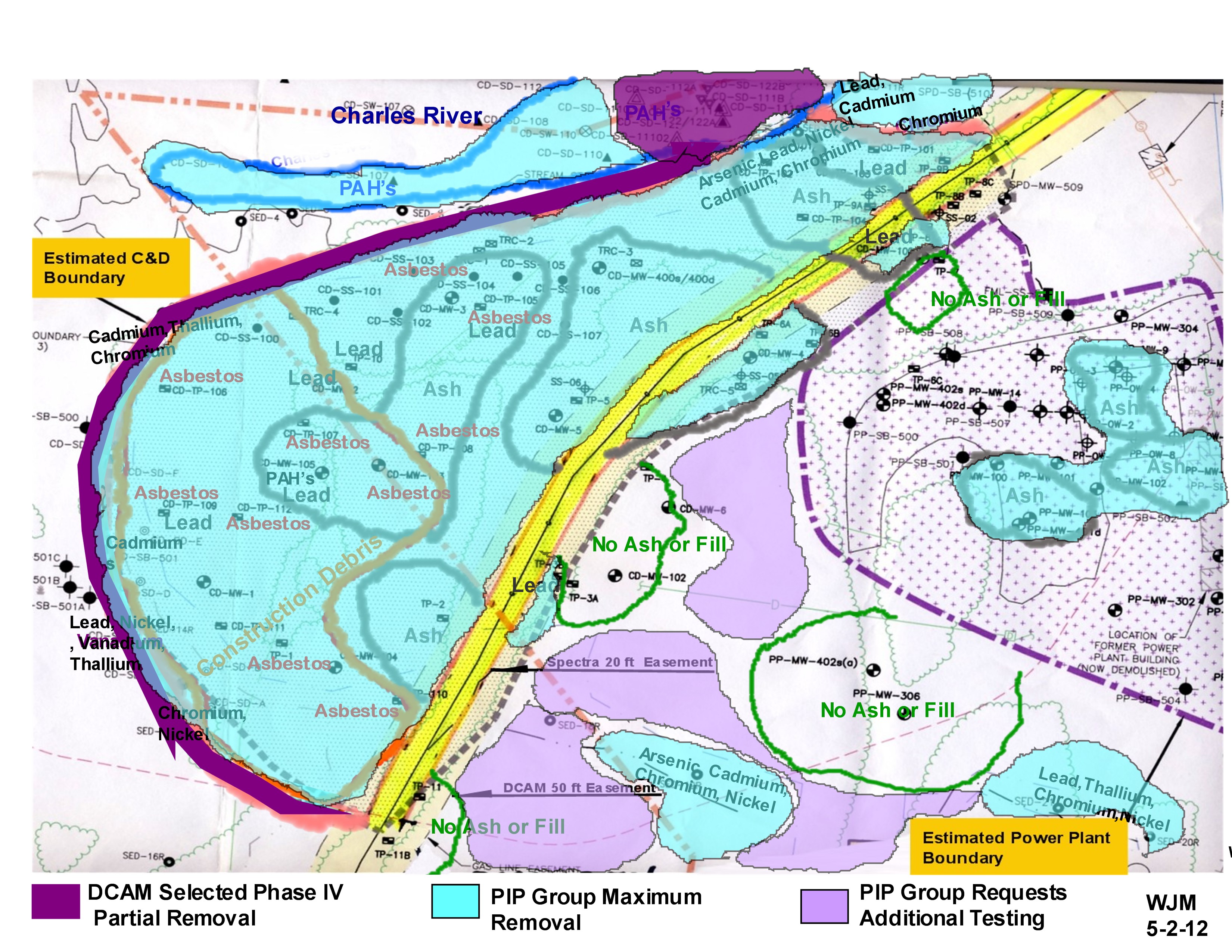
Bill Massaro has prepared a useful chart that graphically shows the dramatic difference between DCAM’s proposed removal of materials from the C&D area, versus what the town requests be removed.

Per Bill’s email –

=====================

Attached is the next stage in the C&D Waste Overlay I passed out last night.  That prior one was intended to clarify that the DCAM drawing showing the yellow area around the “donut hole” did not represent what DCAM is planning to take out, but  just showed the flexible membrane cover over what they were leaving.

This one shows my conception of what DCAM is removing in dark plum;   what I think our residents’  “maximum extent feasible removal”  is in blue;  and areas where we need additional testing ( likely also to need to be removed) in light purple.  I also added some additional contaminants of concern  with input from Andrea.  It should pretty much agree with Town and PIP Phase II & Phase III comments submitted on 4/24/12.

===================================

See Bill’s chart at –

https://medfield02052.blog/wp-content/uploads/2012/05/20120502-wjm-remediation-positions.jpg

On being a Selectman

My first post by email (thanks Tim).

Long phone call from Bill Massaro. I think we solved both the MSH and the 40B issues.

Boston Globe reporter is looking at doing an article on the clean up at MSH. Mediator may meet with town team next Monday.

On being a selectman

Exchanged emails today with the chair of the Dover Board of Selectmen and the chair of the Medfield Rail Trail Study Committee regarding a suggested meeting with the Norfolk Hunt Club.

Discussed with Jim James of Park Street Books his need for new space for his operation, and several possible alternatives.

Reported back to a resident on information gathered in response to a complaint.

DCAM to seek its MSH permits by 5-7-12

Andrea D. Stiller, LSP of ADS Environmental Engineering, LLC, one of the town’s consultants on the clean up of the Medfield State Hospital site reports today about the DCAM Medfield State Hospital clean up, that the C&D  Phase IV states that they plan to Submit for Permits on 5-7-12. She questions that maybe they will be delayed since the deadline for the town’s comments on the Phase IV have been extended.

On being a selectman

I thought that I would try a new line of writing, that would give a flavor of what it is like to be a selectman, by describing the things that I do as a selectman.  Much of being a selectman is just the many meetings, but much of it is also work done away from the public meetings.

Some weeks seem more about surviving, because of the extra time commitments caused by town meeting.  Last week on Tuesday I attended the Energy Committee meeting because I wanted to hear their discussion about municipal photovoltaic (PV) solar arrays, because I have come to think solar offers the town a money making opportunity that we need to investigate.  That caused me to miss the first half of the SHERC meeting that night, but I caught the second half, which got over at 10:15 PM.  Both Wednesday and Thursday evenings I had three hour meetings related to a scholarship because of my being a selectman.  Sunday I marched in the Medfield Youth Baseball and Softball parade – a fun and happy event.

This week looks to be a long one too, starting last night with the Annual Town Meeting (6:30 – 10:00 PM), tonight is a regular Board of Selectmen meeting, and tomorrow night will be the completion of the  scholarship meetings.

This morning I touched base by telephone with (1) the chair of the Dover selectmen to share with her the results of our ATM vote of the Bay Colony Rail Trail (Dover has an ATM warrant article on the Bay Colony Rail Trail next Monday evening), and (2) Mike Sullivan to confirm the status of the individuals being considered for the new committee to study the Medfield State Hospital purchase, related a resident complaint heard last night, and to remind about the need to get the DCAM documents on its sale of state properties to other towns.  Then I reported back to the resident on the complaint.

Sen. Timilty seeks full clean up of MSH & state funds

Senator Timilty’s (1) email to Shawn Colins today and (2) letter to Governor Patrick about the proper clean up of the Medfield State Hospital –

=============================

Dear Mr. Collins,

Thank you for your email.  I have attached a letter I recently sent to Governor Patrick outlining my serious objections  to the current plant for a partial cleanup of the Medfield State Hospital site.  Please do not hesitate to contact me should you have any questions or require more information.

With every good wish,

State Senator Jim Timilty

============================

MASSACHUSETTS SENATE
SENATOR JAMES E. TIMILTY
Bristol and Norfolk
STATE HOUSE, ROOM 507
BOSTON, MA 02133-1053
TEL. (617) 722-1222
FAX (617) 722-1056

April 28, 2012

His Excellency Deval Patrick
Governor of the Commonwealth
State House, Room 360
Boston, MA 02133

Dear Governor Patrick:

I write today regarding the disposition of the site of the former Medfield State Hospital. After years of involvement with this issue, I remain outraged and extremely concerned about the Department of Capital Asset Management and Maintenance’s current Phase IV remediation plan for the site. Under the plan, DCAM would not fully remove all of the hazardous materials (including, among other toxic substances, construction and demolition debris and hospital waste) from the land on the banks of the Charles River.

First and foremost, as a Commonwealth we share a moral imperative to ensure that residents are able to live and raise their families in a safe, clean  environment. Massachusetts has long been a leader in environmental stewardship, and I believe the incomplete cleanup planned for Medfield State Hospital site is inconsistent with the stated goals of the Administration to move toward a greener future.

Specifically, the Climate Change Adaptation Report, required under the Global Warming Solutions Act of2008 and issued in September 2011, identifies restoring  and managing flood plains as a priority in protecting the Commonwealth from impacts of climate change. The Report notes the risks posed by former landfills and other contaminated sites with respect to flooding, recommending that the health of flood plains be preserved and restored in preparation for rising water levels in order to limit the potential economic and environmental damage flooding may cause. The Medfield State Hospital site sits on 3.2 acres of flood plain along the Charles River, putting the watershed and community at risk under DCAM’s current plan. This has implications not only for Medfield but also for homes and businesses in municipalities all along the Charles.

In terms of cost, the expense of a total removal of hazardous materials from the site would be a comparatively modest increase over the current remediation plan. The Fiscal Year 2013 budget engrossed this week by the House of Representatives is over $32 billion; the estimated difference between DCAM’s current Phase IV remediation plan and the cost of a total cleanup is $5 million. Certainly, $5 million is no small amount in this economy, but given the grave implications of leaving toxic materials at the site and in comparison to the overall budget, it is absolutely our duty to protect the well-being of those who choose to make Medfield their home.

Most importantly, nothing short of complete removal of all toxic material will guarantee the safety of current and future residents. Labeling town land in close proximity to residences and water resources labeled as limited use, with the potential for severe environmental problems 10, 20, or even 50 years down the road, is simply unacceptable, particularly given the site’s location in Zone II of the town well. And, as you might imagine, it is incredibly frustrating to have the same entity responsible for polluting the site make the decisions as to how to address the problem. If a private company were in the same position, I would argue any cleanup plan addressing less than 100% of the waste left behind would not be approved by state regulators charged with upholding strict environmental protection standards.

Many town residents with professional expertise in environmental matters strongly disagree with DCAM’s current plan and with the rationale behind the plan, and I wholeheartedly share their concerns. I do intend to seek funding for this project during the Senate budget debate next month, and I am hopeful I will receive support from my colleagues in the Legislature and from the Administration in doing so. We must put our words into action and affirm our commitment to a clean and healthy environment by restoring the Medfield State Hospital site to a fully accessible, useful, and beautiful property.

Thank you for your attention to this extremely important matter, and I look forward to working with you to resolve this problem in a way that appropriately protects the citizens of Medfield and surrounding communities.

With every good wish,

James E. Timilty
State Senator
Bristol & Norfolk District

Town’s MSH clean up supported by State’s s own flood storage initiatives

The town’s newly hired attorney for the environmental issues at the Medfield State Hospital site sent the following email to Senator Timilty explaining why the state should follow the state’s own report on climate change, to remove all the waste so as to recreate the flood storage misplaced by that dumped waste.

==============================

From: Margaret Stolfa
Date: Apr 27, 2012 9:09:59 AM
Subject: Medfield State Hospital
To: James.Timilty

Senator Timilty

As mentioned at Tuesday’s meeting of Medfield’s State Hospital Environmental Review Committee, below is a short description of the Commonwealth’s Climate Change Adaptation Report and how it supports Medfield’s position that DCAM should commit to a more thorough cleanup at the landfill/dump on the State Hospital property.  The Administration’s Climate Change Adaptation Report includes specific suggestions on how best to manage just such a situation as this one. DCAM should embrace the recommendations in this report.  The Commonwealth has the opportunity to restore needed flood plain, protect the water supply and prevent future flood damage by cleaning up this property. (See http://www.mass.gov/eea/air-water-climate-change/climate-change/climate-change-adaptation-report.html)

The Legislature passed, and the Governor signed, the Global Warming Solutions Act in August of 2008.  Section 9 of that Act directed the Secretary of Energy and Environmental Affairs, and an advisory committee, to analyze strategies for adapting to predicted impacts of climate change.  The resulting Climate Change Adaptation Report was issued in September 2011.  This comprehensive Report provides both short term and long term suggestions on how to prepare for and how to adapt to, the effects of climate change.  The Report details the climate change impacts already observed and documented and includes specific examples of the impacts these changes have had on the Commonwealth’s economic, transportation and local infrastructure as well as on natural resources.  The strategies recommended include cost-effective and risk based approaches to address known risks and vulnerabilities.  Included in the identified risks and vulnerabilities are increased damage due to lost flood storage, the location of “old” landfills/dumps near rivers or in wetlands, and flood impacts to water supplies, transportation infrastructure and businesses.

The Report specifically identifies the need to restore flood plains in order to better manage floods that impact the Commonwealth’s economy.    The Report notes the risk posed by landfills/dumps that sit in flood plains in terms of lost flood-storage capacity as well as the risk they pose in releasing debris during floods.  The Report references successful storm management projects that manage flooding by maintaining (and restoring) the health of wetlands and flood plains and that are credited with saving millions in flood damages.   One of these projects includes portions of the Charles River.

Here, the State Hospital’s landfill/dump is located on 3.2 acres of flood plain along the Charles River.  It consists of approximately 12-15 feet of mixed wastes that include incinerator ash, construction and demolition debris, and hospital wastes.  It sits not only in the flood plain but also in groundwater within the zone II, the area of contribution for Medfield’s water supply. The landfill inhibits 12.5 million gallons of flood storage – meaning that 12.5 million gallons of flood waters that would normally occupy that space end up somewhere else.

The current DCAM proposal does not restore this flood plain and leaves the majority of the landfill/dump in place.   Instead, DCAM should implement the recommendations in the Administration’s own Report and remove the landfill/dump from the flood plain.

Please do not hesitate to contact us if you would like additional information.

Thank you, Margaret R. Stolfa, Esq.

Cherry Sheets – based on House budget numbers

Below and at https://medfield02052.blog/wp-content/uploads/2012/04/20120427-cherrysheet-housenumbers.doc

From –

Massachusetts Department of Revenue

Division of Local Services

FY2013 Local Aid Estimates


MEDFIELD


FY2012 Cherry Sheet Estimate

FY2013 Governor’s Budget (H2)

FY2013 HWM Budget

Education:
  Chapter 70

5,620,214

5,620,214

5,730,534

  School Transportation

0

0

0

  Charter Tuition Reimbursement

965

1,765

60

  Smart Growth School Reimbursement

0

0

0

Offset Receipts:
  School Lunch

10,893

10,116

10,116

  School Choice Receiving Tuition

0

0

0

Sub-Total, All Education Items

5,632,072

5,632,095

5,740,710

General Government:
  Unrestricted General Government Aid

1,137,437

1,137,437

1,226,088

  Local Share of Racing Taxes

0

0

0

  Regional Public Libraries

0

0

0

  Urban Renewal Projects

0

0

0

  Veterans’ Benefits

520

13,884

13,333

  State Owned Land

31,347

31,357

31,357

  Exemptions: Vets, Blind, Surviving Spouses& Elderly

26,482

26,472

26,472

Offset Receipts:
  Public Libraries

13,336

13,728

13,728

Sub-Total, All General Government

1,209,122

1,222,878

1,310,978


Total Estimated Receipts

6,841,194

6,854,973

7,051,688


FY2013 Local Aid Assessments

MEDFIELD


FY2012 Cherry Sheet Estimate

FY2013 Governor’s Budget (H2)

FY2013 HWM Budget

County Assessments:
County Tax

106,268

108,925

108,925

Suffolk County Retirement

0

0

0

Sub-Total, County Assessments

106,268

108,925

108,925


State Assessments and Charges:


  Retired Employees Health Insurance

0

0

0

  Retired Teachers Health Insurance

0

0

0

  Mosquito Control Projects

51,322

60,936

60,936

  Air Pollution Districts

4,200

4,280

4,280

  Metropolitan Area Planning Council

3,735

3,788

3,788

  Old Colony Planning Council

0

0

0

  RMV Non-Renewal Surcharge

6,220

6,560

6,560

Sub-Total, State Assessments

65,477

75,564

75,564


Transportation Authorities:


  MBTA

246,561

254010

254010

  Boston Metro. Transit District

0

0

0

  Regional Transit

0

0

0

Sub-Total, Transportation Authorities

246,561

254,010

254,010


Annual Charges Against Receipts:


  Special Education

0

0

0

  STRAP Repayments

0

0

0

Sub-Total, Annual Charges

   0

   0

   0


Tuition Assessments


  School Choice Sending Tuition

33,593

10,000

10,000

  Charter School Sending Tuition

10,073

11,136

0

  Essex County Tech Sending Tuition

0

0

0

Sub-Total, Tuition Assessments

43,666

21,136

10,000


Total Estimated Charges

461,972

459,635

448,499