Category Archives: Massachusetts Municipal Association

MMA’s May 2020 Beacon

MMA

The Massachusetts Municipal Association provides huge amounts of information to municipalities, provides opportunities to share experiences, and publishes a monthly magazine, called the Beacon, which has become a digital document this month – read the May 2020 edition here  MMA_Beacon_May2020.

MMA on our status

Good data in the slides –

MMA-3

Thank you for registering for the COVID 19 Update for city and town councillors and select board members and selectmen.  I’ve attached the Powerpoint presentation.

MMA Update for MSA MMCA Geoff Slides April 10

We will be posting the video link of the webinar to the MMA website.  That will be available Monday in the COVID 19 resource area.  Be sure to check this area often for updates.


Please be in touch if you have any questions.


Best,

Denise Baker

Senior Member Services Coordinator

MMA on virus legislation

MMA-3

Legislature Enacts Bill to Facilitate Municipal Governance and Budgeting During COVID-19 Emergency

Governor to Sign the Bill Today


April 3, 2020


Last night, the House and Senate enacted a key bill to assist cities and towns with a broad range of governance and budgeting issues during the COVID-19 emergency. This act has an emergency preamble, and will take effect immediately when signed by the Governor, which is expected today. The MMA worked closely with lawmakers and the Baker-Polito Administration on these measures, and deeply appreciates the passage of these important provisions.


The Division of Local Services will have a major role in implementing the finance provisions in the bill, and will be issuing a Bulletin to cities and towns with further details within the coming days. DLS has been a key source of information and guidance during the emergency, and MMA appreciates all of their efforts.


Please click here to download the text of the bill:

https://www.mma.org/wp-content/uploads/2020/04/H4617.pdf


The following is MMA’s summary of the key sections of An Act to Address Challenges Faced by Municipalities and State Authorities Resulting from COVID-19:

  • Town Meeting Delay Beyond June 30. Allows Town Meetings to be delayed beyond June 30 if Governor has declared a state of emergency related to public health or safety. (Section 1).
  • Recess and Continuance of Town Meeting. Allows the Moderator to recess and continue an already-called Town Meeting during (and until 5 days after) a public health, safety or weather emergency for up to 30 days, renewable for up to 30 days at time during the emergency, but not to a date more than 30 days following the rescission of the state of emergency. If a town does not have a moderator, the Select Board may recess and continue Town Meeting accordingly. A public safety or public health official designated by the Select Board shall submit a report to the Attorney General providing justification for the recess and continuance. These changes are effective as of March 10, 2020. (Sections 2, 3 and 4).
  • Adoption of Temporary Fiscal 2021 Budgets. If Town Meeting is unable to adopt an annual budget by June 30 due to a declared emergency, the Select Board shall notify the Director of Accounts at DLS, and the Director may approve expenditures from any appropriate fund or account of an amount sufficient for the operations of the Town during the month of July of not less than 1/12 of the total budget approved in the most recent fiscal year, pursuant to a plan approved by the Select Board, with such authority continuing for each successive month that the emergency prevents the adoption of a budget by Town Meeting. (Section 5).
  • Use of Free Cash and Undesignated Fund Balances. If a Town is delayed from adopting an annual budget due to the COVID-19 emergency, the Director of Accounts may authorize the Town to appropriate (for use in fiscal 2021) from the available undesignated fund balance or free cash certified by DLS as of July 1, 2019, including undesignated fund balances in enterprise funds or special revenue accounts. (Section 6).
  • Amortization of Fiscal 2020 Deficits. Allows cities and towns to amortize its fiscal 2020 deficit resulting from the COVID-19 emergency over fiscal years 2021 to 2023, to be funded in equal or more rapid installments, such amortization to be adopted prior to setting the fiscal 2021 tax rate. (Section 7).
  • Use of Revolving Funds. Allows cities and towns that are unable to adopt their fiscal 2021 annual budget due to the COVID-19 emergency to expend amounts from revolving funds not to exceed the authorized expenditure in fiscal 2020. The legislative body shall vote on the total amount to be expended from each revolving fund when the annual budget is adopted. (Section 8).
  • Tolling Required Action on “Chapter” Lands. Suspends the time period that municipalities are required to act, respond, effectuate or exercise an option to purchase Chapter 61 forest land, Chapter 61A agricultural land, or Chapter 61B recreational land until 90 days after the governor’s March 10, 2020 emergency declaration is terminated. (Section 9).
  • Option to Delay Property Tax Due Date to June 1. Allows the municipal chief executive to delay the due date for municipal property tax bills to June 1. (Section 10).
  • Option to Waive Interest and Penalties for Late Payments. Allows the municipal chief executive to waive the payment of interest and other penalties on late payments that were due after March 10, 2020 and paid before June 30, 2020, for any excise, tax, betterment assessment, water or sewer bill, or other charge added to a tax. (Section 11).
  • Non-Termination of Services to Residents Due to Late Payment. Cities and towns shall not terminate an essential service of a resident, including water, trash collection or electricity, for nonpayment of taxes or fees due on or after March 10, 2020 and paid after the due date but before June 30, 2020, if the nonpayment resulted from a demonstrated inability to pay due to the COVID-19 outbreak or the March 10, 2020 emergency declaration by the governor, provided that the inability to pay shall include a demonstrated financial hardship of a resident, including but not limited to loss of employment, serious illness or death of someone within the home. (Section 11).
  • State Income Tax Deadline Delayed. Postpones the deadline for filing Massachusetts state income tax returns and payments from April 15, 2020 to July 15, 2020. (Section 12).
  • Sale of Alcohol by Take-Out Restaurants. Allows restaurants licensed to sell alcoholic beverages on-premises may sell sealed containers of alcoholic beverages for off-premises consumption as part of take-out food transactions. (Section 13).
  • Facilitating Return to Service by Retirees. Allows state and municipal employees to return to work for the state or a municipality regardless of mandatory retirement ages or a statutory limit on hours worked and earnings received, to help with workforce needs. Those on disability retirement are not eligible. (Section 14).
  • Remote Meetings for Shareholder Corporations. Allows public corporations (private shareholder entities) to hold annual or special meetings of shareholders remotely for up to 60 days after the termination of the March 10, 2020 state of emergency. (Section 15).
  • Provisions for Nonprofit Corporations. Allows nonprofit entities (incorporated under Chapter 180) to conduct or postpone necessary business and meet remotely for up to 60 days after the termination of the March 10, 2020 state of emergency. (Section 16).
  • Tolling Municipal Requirements on Permits and Quasi-Judicial Public Meetings and Hearings (the “constructive approval” issue). Tolls required municipal actions on permits until 45 days after the termination of the COVID-19 emergency, and no permit shall be considered granted, approved or denied, constructively or otherwise due to the failure of a permit granting authority to act within timelines that would otherwise be in effect. This section also clarifies that permit granting authorities may conduct meetings and public hearings remotely during the COVID-19 emergency, consistent with the Governor’s March 12 Executive Order regarding the Open Meeting Law. This section also applies to the conduct of public meetings, public hearings or other actions taken in a quasi-judicial capacity by all local boards and commissions during the emergency declaration by the governor. (Section 17).

Coronavirus resources

An Massachusetts Municipal Association email worth sharing with information worth knowing.  There is also good information at the suggested websites –

MMA-2

Coronavirus resources for local government leaders


Governments, agencies and communities around the globe are currently responding to an outbreak of respiratory disease caused by a novel (new) coronavirus that was first detected in China in December.


The virus is named “SARS-CoV-2,” and the disease it causes is “coronavirus disease 2019,” commonly known as COVID-19.


Because communities and municipal leaders are often on the front lines in emergency situations, the following are some helpful resources to inform local leaders and help them respond.

Examples of local outreach, preparedness and response

Additional information

The Massachusetts Department of Public Health reports that the risk of COVID-19 to the general public in Massachusetts remains low.


In response to the coronavirus outbreak, the DPH has:

  • Established an Incident Command Structure to facilitate regular dissemination of information from federal and state partners to statewide stakeholders
  • Launched a new website that provides up-to-date information on the status of novel coronavirus for all residents (www.mass.gov/2019coronavirus)
  • Developed and disseminated clinical advisories to all Massachusetts health care providers and issued guidance to hospitals, health systems and Emergency Medical Services
  • Scheduled calls with other key health care partners including local boards of health

On Feb. 28, the Massachusetts State Public Health Laboratory received approval to begin testing patients for COVID-19, in accordance with guidance from the U.S. CDC. Only those who are experiencing flu-like symptoms and have recently traveled to China or have had close contact with someone diagnosed with COVID-19 should be tested, according to the DPH.


Those who have traveled to affected areas within the past 21 days are advised to contact their local board of health or health department. Those who have recently traveled to affected areas and are experiencing lower respiratory illness symptoms, such as, but not limited to, fever, cough, and shortness of breath, are advised to also contact their health care provider immediately.


Clinicians who have patients they think may have symptoms consistent with COVID-19 should contact the DPH via the 24/7 EPI line (617-983-6800).


Individuals who are in voluntary self-quarantine continue to be monitored by their local boards of health.


Currently, there is no vaccine available to prevent COVID-19 and no medication available to treat the disease. Treatment is supportive care and relief of symptoms.


Local officials are encouraged to remind residents and businesses of the following best practices to avoid exposure to the virus:

  • Wash your hands frequently with soap and water for at least 20 seconds at a time.
  • Using alcohol-based hand rubs and gels.
  • Avoiding touching your eyes, nose, and mouth with unwashed hands.
  • Avoiding close contact with people who are sick.
  • Clean and disinfect frequently touched objects and surfaces.
  • Avoid sharing food utensils, containers and other personal items.

Those who have any cold or flu symptoms can help others by:

  • Staying home when you are sick.
  • Covering your cough or sneezes.
  • Wearing a mask if you leave home and have a cough.

This is a rapidly evolving situation, and this information may change as updates are available from the DPH and U.S. CDC.

MMA on Gov’s budget

MMA-3

GOV. BAKER FILES $44.6 BILLION FY 2021 BUDGET PROPOSAL

• $31.6M INCREASE IN UNRESTRICTED MUNICIPAL AID (2.8%)

• GOV’S CH. 70 PLAN WOULD INCREASE FY 2021 SCHOOL AID BY $303.5M (5.9%)

• YET MANY DISTRICTS REMAIN MINIMUM AID AT $30-PER-STUDENT

• CHARTER SCHOOL & SPECIAL ED REIMBURSEMENTS INCREASE

• MOST OTHER MUNICIPAL AND SCHOOL ACCOUNTS LEVEL FUNDED

January 22, 2020


Dear Osler Peterson,


Earlier this afternoon, Gov. Charlie Baker submitted a $44.6 billion fiscal 2021 state budget plan with the Legislature, proposing a spending blueprint that would increase overall state expenditures by 2.3 percent, as the Administration deals with slow revenue growth by restraining most spending across the board and placing an estimated $310 million into the state’s rainy day fund. The budget relies on significant one-time revenues of at least $200 million from a sales tax “modernization” proposal, and an increase in the tax on transportation network companies.


UNRESTRICTED MUNICIPAL AID INCREASED BY $31.6 MILLION

As Gov. Baker pledged to local officials at the beginning of his administration, his budget includes a $31.6 million increase in Unrestricted General Government Aid, tracking the expected 2.8% increase in state tax revenues. Implementing this state-local revenue sharing framework continues to be a significant victory for cities and towns, and is good news in a budget where overall state spending is held to a 2.3% increase.


Click here to see the Division of Local Services preliminary fiscal 2021 Cherry Sheet aid amounts for your community


OVERALL CHAPTER 70 SCHOOL AID WOULD GO UP BY $303.5 MILLION, A 5.9% INCREASE – ALTHOUGH A LARGE NUMBER OF DISTRICTS ARE EXPECTED TO REMAIN AT MINIMUM AID ONLY

Fulfilling the commitments in the new Student Opportunity Act, the Governor’s fiscal 2021 budget submission would bring Chapter 70 school aid up to $5.48 billion, a $303.5 million increase in school aid. This would fund the first year of the 7-year plan to add $1.5 billion in new state funding for K-12 education. The majority of the funds would implement the improvements to the foundation budget, adding weight for low-income students, English Language Learners, special education costs, and school employee health benefits. While this is important progress for some communities, an initial look at the budget indicates that a large percentage of cities, towns and school districts would remain minimum-aid-only, and receive the minimum $30 per-student increase in the Act. MMA members from across Massachusetts have unanimously adopted resolutions calling for at least $100-per-student in minimum aid for the past several years, and the MMA will continue to strongly advocate for significantly higher minimum aid throughout the budget process.


Click here to see DESE’s calculation of fiscal 2021 Chapter 70 aid and Net School Spending requirements for your city, town, or regional school district, based on the Governor’s proposed budget and legislation. This landing page will also include the preliminary fiscal 2021 charter school assessments and reimbursements


CHARTER SCHOOL REIMBURSEMENTS WOULD INCREASE TO $138.2M – CHARTER FUNDING REMAINS A SERIOUS PROBLEM TO BE SOLVED

The Governor’s budget would increase the charter school reimbursement account up to $138.2 million, intended to meet the commitment in the Student Opportunity Act to fund 75% of the state’s 100-60-40 statutory obligation to mitigate Chapter 70 losses to charter schools. However, this appropriation does not include $15 million in special charter school reimbursement payments included in the fiscal 2020 budget to address significant hardships, such as excess losses to charter schools that result in a net cut in Chapter 70 aid for the public school system (non-charters).


The Student Opportunity Act pledges to phase in full funding of the statutory reimbursement formula over three years, and while this plan may meet that requirement, it would not fix the serious flaws in the charter school finance system. Charter schools will continue to divert a high percentage of Chapter 70 funds away from many municipally operated school districts, and place greater strain on the districts that serve 96% of public school children. Major problems will continue unless a true resolution of the charter school funding problem is achieved, a top MMA priority.


SPECIAL EDUCATION CIRCUIT BREAKER INCREASED TO $362.5M

The Governor’s budget would add $17.4 million to fund the Special Education Circuit Breaker program at $362.5 million, an increase of 5%. The Student Opportunity Act expanded the SPED circuit breaker by including out-of-district transportation, a good win for cities and towns. This new transportation component is being implemented over four years, and the Governor’s budget proposal includes the 25% phase-in amount for the coming fiscal year.


However, the $362.5 million appropriation amount does not include $18 million that has traditionally been provided to support administration and state agency transportation costs for special education students, and these funds will need to be added in order to ensure full funding.


REGIONAL SCHOOL TRANSPORTATION REIMBURSEMENTS LEVEL FUNDED

Gov. Baker’s budget submission would level-fund regional transportation reimbursements at the $75.8 million. This will be a hardship for virtually all communities in regional districts. Reimbursements for transportation of out-of-district vocational students remains significantly underfunded at $250K. Increasing these accounts is a priority for cities and towns and the MMA.


McKINNEY-VENTO REIMBURSEMENTS LEVEL FUNDED

The Governor’s budget would level-fund reimbursements for the transportation of homeless students at $11.1 million. The impact of this funding level will vary from community-to-community depending on the number of homeless families that remain sheltered in local hotels and motels. The Administration has been successful in reducing the number of homeless students who are dislocated from their original district, but those communities that continue to provide transportation to many students may continue to see shortfalls.


PAYMENTS-IN-LIEU-OF-TAXES (PILOT) LEVEL FUNDED

The Governor’s budget would level fund PILOT payments at $30 million, which would be a significant hardship for many smaller, rural communities with large amounts of state-owned land. This is a key account due to the major impact that PILOT payments have on budgets in very small communities.


Please contact your legislators today and ask them to support the $31.6M increase in municipal aid and the $303.5M increase in Chapter 70 aid.


Please ask your legislators to address the serious flaws in charter school funding, increase minimum Ch. 70 aid to $100 per student, and increase funding for school transportation, PILOT payments, and ensure full funding for the SPED Circuit Breaker


THANK YOU!

To Select Board conference Saturday

This Saturday I am attending the Massachusetts Selectmen’s Association (part of the Massachusetts Municipal Association) Leadership Conference.  I always learn something at Massachusetts Municipal Association events.


MMA-3

Massachusetts Selectmen’s Association Leadership Conference on Saturday, June 8 at the Sharon Community Center

This year’s program will feature a luncheon keynote presentation from Senator Jason Lewis. Senator Lewis serves at the Chairperson of the Joint Committee on Education and the Vice Chair of the Joint Committee on Labor and Workforce Development. His presentation will focus on the state of education in the Commonwealth and the importance of local leadership.

The conference includes a light breakfast and lunch and will run from 8 a.m. to 2 p.m. Members will hear from MMA Executive Director and CEO Geoff Beckwith with a brief welcome to the organization and a robust legislative update. From there, the event turns to two tracks of programming, one for veteran selectmen and one for newly elected selectmen.


Topics will include:

  • Introduction to the Open Meeting and Public Records Law with KP Law Managing Partner Lauren Goldberg and Sherborn Selectman Paul DeRensis (recommended for newly elected)
  • Municipal Finance 101 with Arlington Deputy Director Sandy Pooler and ATFC President and Sharon Finance Committee Member Ira Miller (recommended for newly elected)
  • Shared Services: Your Guide to Cooperation Across Town Lines with the Division of Local Services Analyst Tara Lynch and Cohasett Town Manager Chris Senior (recommended for veteran selectmen)
  • You’re Only 1 Vote: Building Consensus on Your Board and Beyond with experts on communication and management including current Buckland Select Board Member and former town manager Barry Del Castilho (recommended for veteran selectmen)
  • Closing session speaker on education and leadership by Senator Jason Lewis

MMA on Gov’s budget proposal

The Massachusetts Municipal Association sent out this email today on its analysis of the Governor’s budget proposal:

GOV. BAKER FILES $42.7 BILLION FY 2020 BUDGET PROPOSAL

• UNRESTRICTED MUNICIPAL AID WOULD INCREASE BY $29.7M (2.7%)

• GOV’S CH. 70 PLAN WOULD INCREASE FY 2020 SCHOOL AID BY $200M (4.3%)

• BUT MANY DISTRICTS STUCK AT $20-PER-STUDENT MINIMUM AID

• CHARTER SCHOOL & SPECIAL ED REIMBURSEMENTS UNDERFUNDED

• MOST OTHER MUNICIPAL AND SCHOOL ACCOUNTS LEVEL-FUNDED

January 23, 2019

Dear Osler Peterson,

Earlier this afternoon, Gov. Charlie Baker submitted a $42.7 billion fiscal 2020 state budget plan with the Legislature, proposing a spending blueprint that would increase overall state expenditures by 1.5 percent, as the Administration deals with slow revenue growth by restraining most spending across the board and placing an estimated $297 million into the state’s rainy day fund. The budget relies on “significant” one-time revenues of at least $200 million from a “sales tax modernization proposal.”

UNRESTRICTED MUNICIPAL AID INCREASED BY $30 MILLION

As Gov. Baker pledged to local officials on Jan. 18 at the MMA’s Annual Meeting, his budget includes a $29.7 million increase in Unrestricted General Government Aid, tracking the expected 2.7% increase in state tax revenues.

Click here to see the Division of Local Services preliminary fiscal 2020 Cherry Sheet aid amounts for your community

OVERALL CHAPTER 70 SCHOOL AID WOULD GO UP BY $200 MILLION, YET A LARGE PERCENTAGE OF DISTRICTS WOULD REMAIN AT MINIMUM AID ONLY

The Governor filed separate legislation to amend the Chapter 70 school finance law, and provided a $200 million increase in school aid in his fiscal 2020 budget recommendation to fund the first year of what the Administration says is a seven-year plan to implement a number of changes to the current law, primarily in the areas recommended by the Foundation Budget Review Commission. An initial look at House 1 indicates that a large percentage of cities, towns and school districts would not benefit from the formula changes in fiscal 2020, and would remain minimum-aid-only. The budget plan sets the minimum aid increase at only $20-per-student, which would present large challenges for all of these communities. MMA members from across Massachusetts unanimously adopted a resolution calling for at least $100-per-student minimum aid at last week’s Annual Meeting.

Click here to see DESE’s calculation of fiscal 2020 Chapter 70 aid and Net School Spending requirements for your city, town, or regional school district, based on the Governor’s proposed budget and legislation

CHARTER SCHOOL REIMBURSEMENTS REMAIN SIGNIFICANTLY UNDERFUNDED; FIXING THE CHARTER SCHOOL FINANCE SYSTEM MUST BE PART OF ANY CHAPTER 70 REFORM PLAN

Further, the Administration is proposing a few changes to the Charter School Reimbursement Program, but this does not come close to achieving the permanent fix that is needed to repair the flawed charter school finance system. Current reimbursements this year are set at $90 million, $72 million below the full funding level of $162 million. The Governor’s budget would increase charter school reimbursements to $106 million, and would change the 6-year funding schedule of 100-25-25-25-25-25 to a new 3-year 100-60-40 schedule, phased in over 3 years, however the plan would also increase the facilities assessment payments to charter schools, and make other changes.

The MMA’s immediate analysis is that charter school reimbursements would continue to fall far short, and this restructuring would not fix the charter school finance system. This would continue to divert Chapter 70 funds away from municipally operated school districts, and place greater strain on the districts that serve 96% of public school children. No matter what changes are made to the Chapter 70 formula, major problems will continue unless a true resolution of the charter school funding problem is integrated into any reform or update of the school finance system.

SPECIAL EDUCATION CIRCUIT BREAKER UNDERFUNDED

The Governor’s budget would add $4.5 million to fund the Special Education Circuit Breaker program at $323.9 million, an increase of only 1.4%. Because special education costs are expected to rise in fiscal 2020, this means that the Governor’s budget substantially underfunds reimbursements. Today DESE officials said the House 1 appropriation would result in a 70% reimbursement, rather than the statutory 75%. This is a vital account that every city, town and school district relies on to fund state-mandated services. The MMA will again be asking lawmakers to ensure full funding in fiscal 2020.

REGIONAL SCHOOL TRANSPORTATION REIMBURSEMENTS LEVEL FUNDED

Gov. Baker’s budget submission would level-fund regional transportation reimbursements at the $68.9 million amount. This will be a hardship for virtually all communities in regional districts. Reimbursements for transportation of out-of-district vocational students remains significantly underfunded at $250K. Increasing these accounts is a priority for cities and towns.

McKINNEY-VENTO REIMBURSEMENTS LEVEL FUNDED

The Governor’s budget would level-fund reimbursements for the transportation of homeless students at $9.1 million. The impact of this funding level will vary from community-to-community depending on the number of homeless families that remain sheltered in local hotels and motels. The Administration has been successful in reducing the number of homeless students who are dislocated from their original district, but those communities that continue to provide transportation to many students may continue to see shortfalls.

PAYMENTS-IN-LIEU-OF-TAXES (PILOT), SHANNON GRANTS AND LIBRARY AID LEVEL FUNDED

The Governor’s budget would level fund PILOT payments at $28.48 million, Shannon anti-gang grants at $8 million, and fund library grant programs at $19.8 million.

PLEASE CONTACT YOUR LEGISLATORS TODAY AND CALL ON THEM

TO COMMIT TO COMPREHENSIVE REFORM OF OUR SCHOOL FINANCE LAWS TO BENEFIT ALL COMMUNITIES, INCLUDING FIXING THE FLAWS IN CHARTER SCHOOL FUNDING, AND FULLY FUNDING KEY MUNICIPAL AND SCHOOL PROGRAMS

THANK YOU!

MMA legislative breakfast

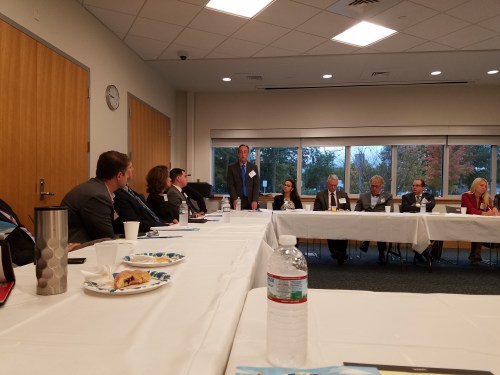
The Massachusetts Municipal Association holds legislative breakfasts to allow municipal officials to interact with their legislators.  I attended one this morning at the Christa McAuliffe Library in Framingham and the room was chock full of metrowest legislators.

20181012_MMA

I now see that my water bottle had prime placement.  The photo shows about a third of the attendees.

To my left was Representative Bruce Linsky (Natick and Sherborn) who said that Natick and Wellesley are being deluged by Open Meeting Law requests by some gadfly who is taking up way too much time of the town hall workers, and that some corrective legislative action will be needed.  I asked him to include allowing we selectmen to communicate by email on platforms where all our emails would appear in an on-line page in the town’s website, similar to a posted meeting, but the use of the emails would allow more efficient handling of the town’s business and the public could read the entire exchange (similar to listening to an in person meeting).

Senator Eldridge, to Linsky’s left, reported that:

  • education reform almost got out of the conference committee;
  • land use litigation will happen soon; and
  • 82 communities have now passed plastic bag bans and we are close to a tipping point that will allow passage of a state ban.

Senator Hannah Kim talked about need for more parking at transportation (MBTA) sites and proposing an income tax deduction for farmers who donate produce that alleviates food insecurity.

Rep. Carmen Gentile (Sudbury) is seeking to make the home rule action that allowed Sudbury to give real estate property tax relief to its seniors for the past three years to any town that wants to opt in.  BTW, I called and got that Sudbury material and I will organize and share it soon.

Lexington Selectman Michelle Ciccola, who is soon to be a state rep., wants to see the Massachusetts Community Preservation Act (CPA) to get better funded.

Rep. Kate Hogan was concerned about a litany of issues, and I mainly noted about transportation.

Our own Rep. Denise Garlick was not there, but was represented by Anne Weinstein, her Director of Constituent Services (out of the frame to the right).

Selectman Dan Matthews of Needham and I both told the legislators that towns need more revenue.  I shared my idea to have the auto excise tax be based on the car’s fair market value, which would likely triple our ca. $2 m. revenues (the statute mandates a steep decline in the car values by year).

MMA’s Pickard Innovation Award

The Massachusetts Municipal Association annually gives awards to innovative municipal programs.  Today I got the MMA email (inserted below) encouraging towns to submit entries for this year, and what I thought was interesting was to review the past winners list.  Massachusetts has 351 municipalities all trying to solve the same issues, and we can learn a lot from one another, which is the basic assumption behind the MMA.  Let me know if you see one that you think Medfield should be pursuing.

MMA-2


The following are recent winners of the MMA’s Pickard Innovation Award:

2018
Arlington: Property registry addresses commercial vacancies
Harwich: Municipal pet cemetery provides service while raising revenue
Orleans: Project uses shellfish to reduce water nitrogen levels

2017
Leominster: Creating an autism-friendly city and community
Salem: ‘Park Your Butts’ retools to improve cigarette waste recycling
Adams: Board unites artists, local government to spur creative economy
Scituate: Standard procedures, templates streamline emergency news dissemination

2016
Danvers: Incentive program reduces peak electricity use and costs
Everett: City-run center offers low-cost exercise classes and equipment
Leverett: Town builds high-speed fiber optic Internet network

2015
Chatham: Cloud provides access to meeting video archives
Deerfield, Sunderland, Whately: Emergency medical service improves response times
Springfield: After tornado, city promoted tree planting

2014
Arlington: ‘Visual Budget’ illuminates how taxes are spent
Bedford, Billerica, Burlington, Chelmsford, Lowell: Communities collaborate on economic development
Melrose: ‘Our City’ exercise helped sharpen civic goals

2013
Braintree, Weymouth: Collaboration bears fruit in Landing district
‘HarborWalk’ reveals Gloucester’s riches
Medford broadens its ‘Go Green’ initiative

2012
Bedford, Concord, Lexington, Lincoln, Sudbury, Weston: Towns formed coalition to monitor affordable housing
Danvers: Summer program created for homeless kids
Leominster: Effort to revive historic district nears fruition

2011
Fairhaven: Anaerobic digestion to offset energy costs
Hamilton-Wenham: Organic waste pick-up program nears goal
Wilmington: Land purchase led to library bookstore

2010
Bedford: Coordination boosts parent-education series
Dedham: Partnership helps alleviate foreclosure pain
Medford: Wind turbine marks progress in sustainability campaign

2009
Dennis: Blog spreads awareness of planning process
Natick shapes strategic planning to fit town government
Worcester moved quickly to confront foreclosure crisis

MMA on state budget

This today from the Massachusetts Municipal Association, with a good summary of the state budget issues –

MMA-2

LEGISLATIVE CONFERENCE COMMITTEE FINALIZING FISCAL 2019 STATE BUDGET – MILLIONS IN MUNICIPAL AND SCHOOL FUNDING AT STAKE


PLEASE CALL YOUR LEGISLATORS TODAY TO SUPPORT LOCAL AID FUNDING AND KEY MUNICIPAL ISSUES

June 7, 2018


Dear Osler Peterson,


Now that the House and Senate have each passed their own versions of next year’s fiscal 2019 state budget, the next step is for a conference committee to iron out the differences and present a balanced budget for adoption by July 1.


While both budgets would increase municipal and school aid, there are significant differences between the branches, especially in funding for essential K-12 education accounts. It is imperative that you contact your legislators today and ask them to support the full appropriations, and make municipal and education aid a top priority.


Earlier this morning, the MMA delivered a detailed letter to the conference committee emphasizing the key local aid accounts that need to be funded at the highest possible level. Please call your legislators today and ask them to support the highest possible funding amounts for these municipal and school aid programs.


Please click here to download a copy of the MMA’s letter, so you can read and reference it when you speak with your legislators


The House and Senate budgets would both add to the municipal and school aid recommendations made by the governor in January, which is good news. When you talk with your local legislators, please thank them for making local aid a priority during the budget process this year, and ask that they contact conference committee members in support of the highest possible funding for municipal and school aid.


Millions of dollars are at stake: if the conference committee agrees on full funding by adopting the higher number for municipal and school aid accounts, this would return over $75 million more to cities and towns, compared to the funding that would result from adopting the lower number.


Here is a summary of the key priorities for cities and towns:


Unrestricted General Government Aid (UGGA)

The House and Senate both appropriated $1.099 billion for the Unrestricted General Government Aid (UGGA) account, an increase of $37.2 million over the fiscal 2018 level of funding. The 3.5 percent increase reflects the policy of increasing general municipal aid at the rate of growth in state tax collections reflected in the consensus tax forecast. This policy has been adopted by the Governor and the House and Senate since fiscal 2016, and is supported by the MMA. The good news is that the $37.2 million UGGA increase has already been agreed to by the House and Senate!


Chapter 70 School Aid and Local Contributions

The House funds the basic requirements of Chapter 70 education aid (7061-0008 and section 3), adopts provisions to continue to implement the recommendations of the Foundation Budget Review Commission, phases in target share funding for those communities where the local contribution exceeds the target share amount, and funds minimum aid at $30 per student. This would provide a Chapter 70 increase of $124.6M – which is significantly higher than the $103.6M increase in the governor’s budget proposal.


The Senate budget builds on the House approach by closing 100% of the target share gap and establishing an enhanced English language learner (ELL) foundation budget factor. These two changes would provide a Chapter 70 increase of $160.6M, or $36M more than the House. The MMA is supporting the Senate funding level.


Both the House and Senate would supplement Chapter 70 by providing $12.5 million to provide assistance to communities impacted by changes in how low-income students are counted. They do this in different accounts. What matters is that the final budget maintain the $12.5 million.


Special Education Circuit Breaker

Please ask your legislators to support the Senate’s full funding of the Special Education Circuit Breaker Program at $319.3 million, through which the state provides a measure of support for services provided to high-cost special education students. This is critically important.


Charter School Impact Mitigation Payments

Please ask your legislators to support the Senate appropriation of $100 million for Charter School Impact Mitigation Payments (7061-9010). This reflects an increase of $19.5 million above the current fiscal 2018 level of funding. This is a vital account for those communities impacted by charter schools.


Charter School Impact Analysis and Accountability

Please ask your legislators to support sections 61 and 62 in the Senate bill, which would bring a much-needed level of accountability related to state decisions to approve new and expanded charter schools that would include an assessment of the impact on local public schools.


Regional School District Student Transportation

Please ask your legislators to support the Senate appropriation of $68.9 million to reimburse regional school districts for a portion of the cost of transporting students.


McKinney-Vento Homeless Student Transportation

Please ask your legislators to support the House appropriation of $9.1 million for this account to reimburse municipalities and school districts for a portion of the cost of transporting homeless students as required under state and federal rules.


Payment in Lieu of Taxes on State-owned Land

Please support the Senate appropriation of $28.5 million to pay a portion of the payment-in-lieu-of taxes amount due to cities and towns to offset the property tax exemption for state-owned land. We support the additional $1.7 million set aside in the Senate appropriation language to ensure that Cherry Sheet PILOT payments next year are not reduced below the fiscal 2018 level due to the revaluation of state-owned land that takes effect next year.


Shannon Anti-Gang Grant Program

Please support the Senate level of funding of $8 million for the highly effective and valuable Shannon Anti-Gang Grant Program that has helped cities and towns respond to and suppress gang-related activities.


Reserve Fund for Municipal Improvements

Please support the House appropriation that would provide $2.8 million for the District Local Technical Assistance Fund (DLTA) that helps support local efforts to regionalize local government services. Please support the Senate appropriation that includes $2 million to support the Community Compact Cabinet program to facilitate the adoption of municipal best practices in cities and towns.


Community Preservation Act

Please support sections 45, 46, 47, 142, 143 and 196 of the Senate bill which would strengthen the Community Preservation Act (CPA) by updating the Registry of Deeds fee schedule to provide adequate revenue to restore the state match to an estimated 30 percent.


Municipal Police Training Fund

Please support sections 13, 14, and 70 in the Senate bill that would create a $2 surcharge on each rental car transaction in the Commonwealth to help fund an expanded police training program.


If you have any questions or need additional information, please contact MMA Legislative Director John Robertson at 617-426-7272 ext. 122 or jrobertson@mma.org.


Thank you very much!