
The Dignity Index


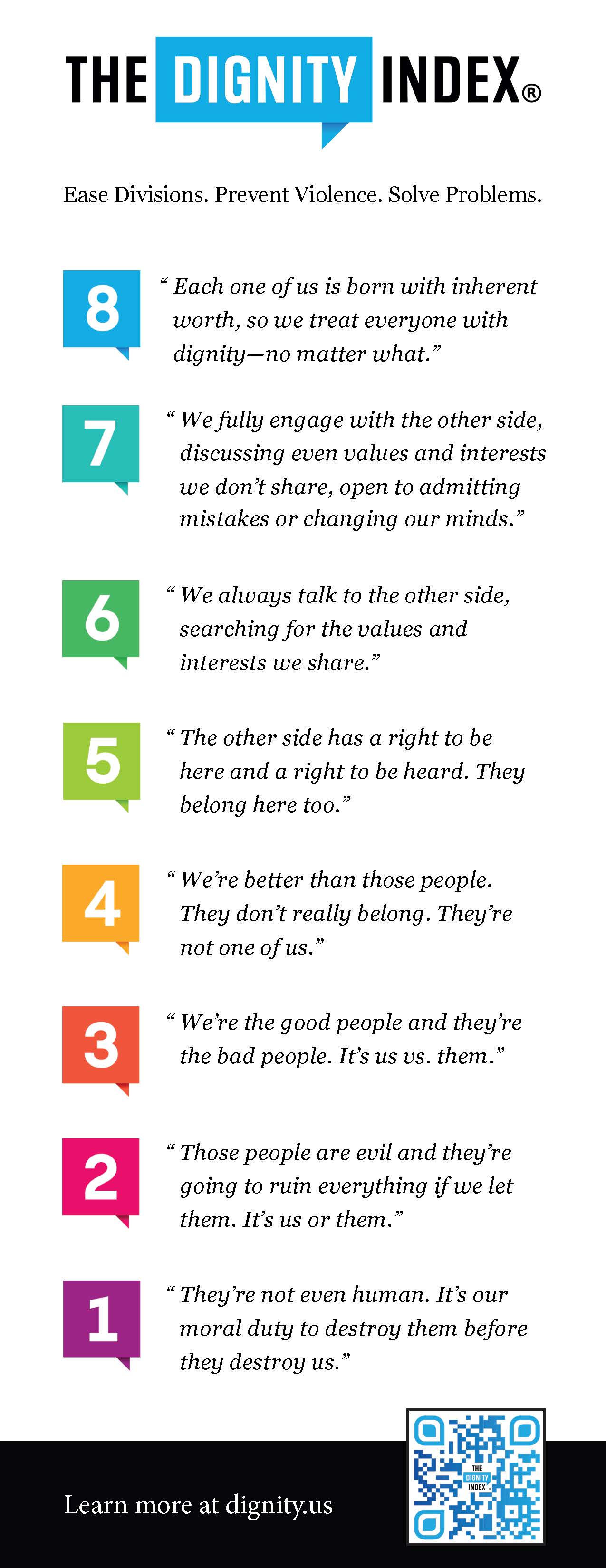
The Massachusetts Municipal Association had Tim Shriver speak to everyone at the opening of the Massachusetts Municipal Association annual convention this year in January about his Dignity Index, a way to lower the tone of disagreements in our political discourse. At first I discounted the value of the presentation, but after listening to him I think we all could do better by following his suggestions to measure our conversations against the Dignity Index and try to get ourselves to the Dignity Index 7 & 8 levels in our discussions with others:
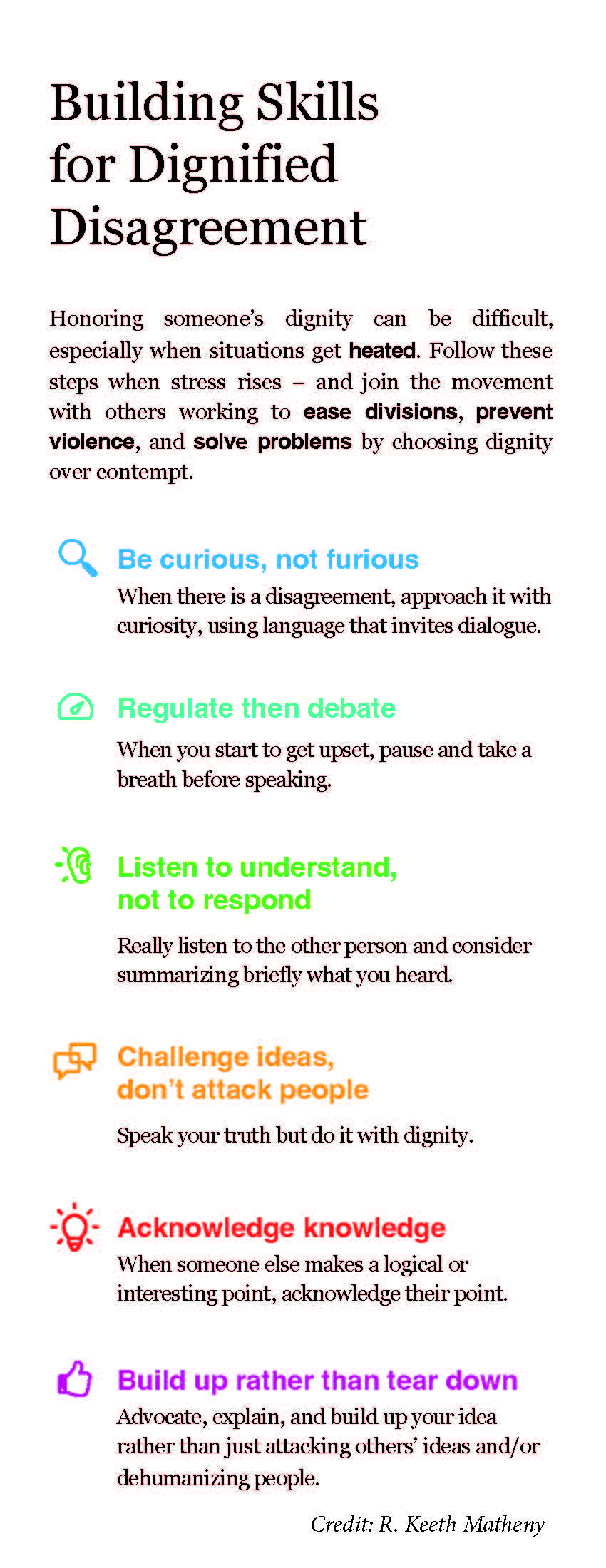
Building Skills
for Dignified
Disagreement
Honoring someone’s dignity can be difficult,
especially when situations get heated. Follow these
steps when stress rises – and join the movement
with others working to ease divisions, prevent
violence, and solve problems by choosing dignity
over contempt.
Be curious, not furious
When there is a disagreement, approach it with
curiosity, using language that invites dialogue.
Regulate then debate
When you start to get upset, pause and take a
breath before speaking.
Challenge ideas,
don’t attack people
Speak your truth but do it with dignity.
Acknowledge knowledge
When someone else makes a logical or
interesting point, acknowledge their point.
Build up rather than tear down
Advocate, explain, and build up your idea
rather than just attacking others’ ideas and/or
dehumanizing people.
Listen to understand,
not to respond
Really listen to the other person and consider
summarizing briefly what you heard.
Credit: R. Keeth Matheny
Each one of us is born with inherent
worth, so we treat everyone with
dignity—no matter what.”
“
We fully engage with the other side,
discussing even values and interests
we don’t share, open to admitting
mistakes or changing our minds.”
“
We always talk to the other side,
searching for the values and
interests we share.”
“
The other side has a right to be
here and a right to be heard. They
belong here too.”
“
We’re better than those people.
They don’t really belong. They’re
not one of us.”
“
We’re the good people and they’re
the bad people. It’s us vs. them.”
“
Those people are evil and they’re
going to ruin everything if we let
them. It’s us or them.”
“
They’re not even human. It’s our
moral duty to destroy them before
they destroy us.”
“
Lea rn mo re at dignity.us
Ease Divisions. Prevent Violence. Solve Problems.
Each one of us is born with inherent
worth, so we treat everyone with
dignity—no matter what.”
“
We fully engage with the other side,
discussing even values and interests
we don’t share, open to admitting
mistakes or changing our minds.”
“
We always talk to the other side,
searching for the values and
interests we share.”
“
The other side has a right to be
here and a right to be heard. They
belong here too.”
“
We’re better than those people.
They don’t really belong. They’re
not one of us.”
“
We’re the good people and they’re
the bad people. It’s us vs. them.”
“
Those people are evil and they’re
going to ruin everything if we let
them. It’s us or them.”
“
They’re not even human. It’s our
moral duty to destroy them before
they destroy us.”
“
Lea rn mo re at dignity.us
Ease Divisions. Prevent Violence. Solve Problems.
Learn more at dignity.us

Leave a comment