
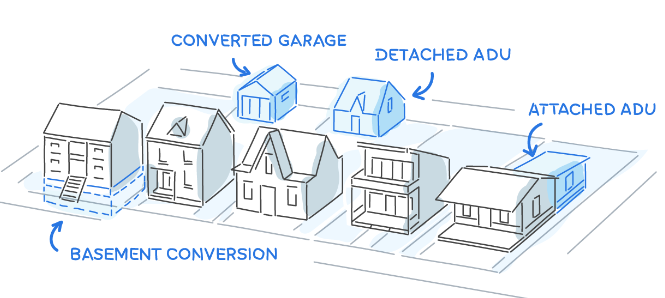
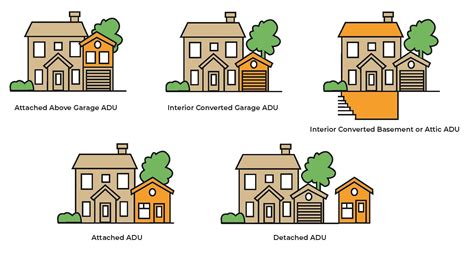
Accessory Dwelling Units (ADU’s), or small homes of up to 900 sq. ft., become permitted as of right in Massachusetts starting 2/2/2025 on any single family lot, subject only to “reasonable regulations.” The recently enacted Affordable Homes Act (AHA) stated the new rules, adding ADU’s onto the exemptions from local zoning that already exist for educational, religious, and agricultural uses. The permitted reasonable regulations cited are “dimensional setbacks and the bulk and height of structures and . . . short-term rental.”
STATUTE
The Affordable Homes Act, Chapter 150 of the Acts 2024
SECTION 7. Section 1A of chapter 40A of the General Laws, as appearing in the 2022 Official Edition, is hereby amended by striking out the definition “Accessory dwelling unit” and inserting in place thereof the following definition:-
“Accessory dwelling unit”, a self-contained housing unit, inclusive of sleeping, cooking and sanitary facilities on the same lot as a principal dwelling, subject to otherwise applicable dimensional and parking requirements, that: (i) maintains a separate entrance, either directly from the outside or through an entry hall or corridor shared with the principal dwelling sufficient to meet the requirements of the state building code for safe egress; (ii) is not larger in gross floor area than 1/2 the gross floor area of the principal dwelling or 900 square feet, whichever is smaller; and (iii) is subject to such additional restrictions as may be imposed by a municipality, including, but not limited to, additional size restrictions and restrictions or prohibitions on short-term rental, as defined in section 1 of chapter 64G; provided, however, that no municipality shall unreasonably restrict the creation or rental of an accessory dwelling unit that is not a short-term rental.
SECTION 8. Section 3 of said chapter 40A, as so appearing, is hereby amended by adding the following paragraph:-
No zoning ordinance or by-law shall prohibit, unreasonably restrict or require a special permit or other discretionary zoning approval for the use of land or structures for a single accessory dwelling unit, or the rental thereof, in a single-family residential zoning district; provided, that the use of land or structures for such accessory dwelling unit under this paragraph may be subject to reasonable regulations, including, but not limited to, 310 CMR 15.000 et seq., if applicable, site plan review, regulations concerning dimensional setbacks and the bulk and height of structures and may be subject to restrictions and prohibitions on short-term rental, as defined in section 1 of chapter 64G. The use of land or structures for an accessory dwelling unit under this paragraph shall not require owner occupancy of either the accessory dwelling unit or the principal dwelling; provided, that not more than 1 additional parking space shall be required for an accessory dwelling unit; and provided further, that no additional parking space shall be required for an accessory dwelling located not more than 0.5 miles from a commuter rail station, subway station, ferry terminal or bus station. For more than 1 accessory dwelling unit, or rental thereof, in a single-family residential zoning district there shall be a special permit for the use of land or structures for an accessory dwelling unit. The executive office of housing and livable communities may issue guidelines or promulgate regulations to administer this paragraph.
ANALYSIS
The law firm Mirrick O’Connell last week sent out an emailed update that summarized the legislative change that permits ADU’s as follows:
- Accessory Dwelling Units Permitted By-Right (Sections 7 and 8)
The AHA amends the Zoning Act by prohibiting towns and cities from restricting accessory dwelling units (ADUs) in single-family zoning districts. ADUs, sometimes known as in-law apartments, now fall under the protection of M.G.L. c. 40A, Section 3, which exempts religious, educational, and other uses from local zoning.
One ADU is now allowed by-right on each lot in a single-family zoning district, subject to “reasonable regulations”, which may include non-discretionary site plan review, certain dimensional controls, Title 5 septic regulations, and restrictions on short-term rentals.
The AHA provides that an accessory dwelling unit must have a separate entrance (interior or exterior) that complies with the State Building Code and may not be larger than half the gross floor area of the principal dwelling or 900 square feet, whichever is smaller. The AHA prohibits restrictions on owner-occupancy and rentals of ADUs, eliminating the requirement in many towns and cities that in-law apartments may only be used by an owner’s close relative.
In addition, towns and cities must allow additional ADUs in single-family zones through a special permit process.
The ADU provisions take effect on February 2, 2025, so municipalities have a few months to consider zoning amendments consistent with the AHA.


 Medfield02052's Blog